
What GLM-5.2 Cybersecurity Benchmarks Actually Show
Independent research — not an official Z.ai publication.Identity and provider disclosure

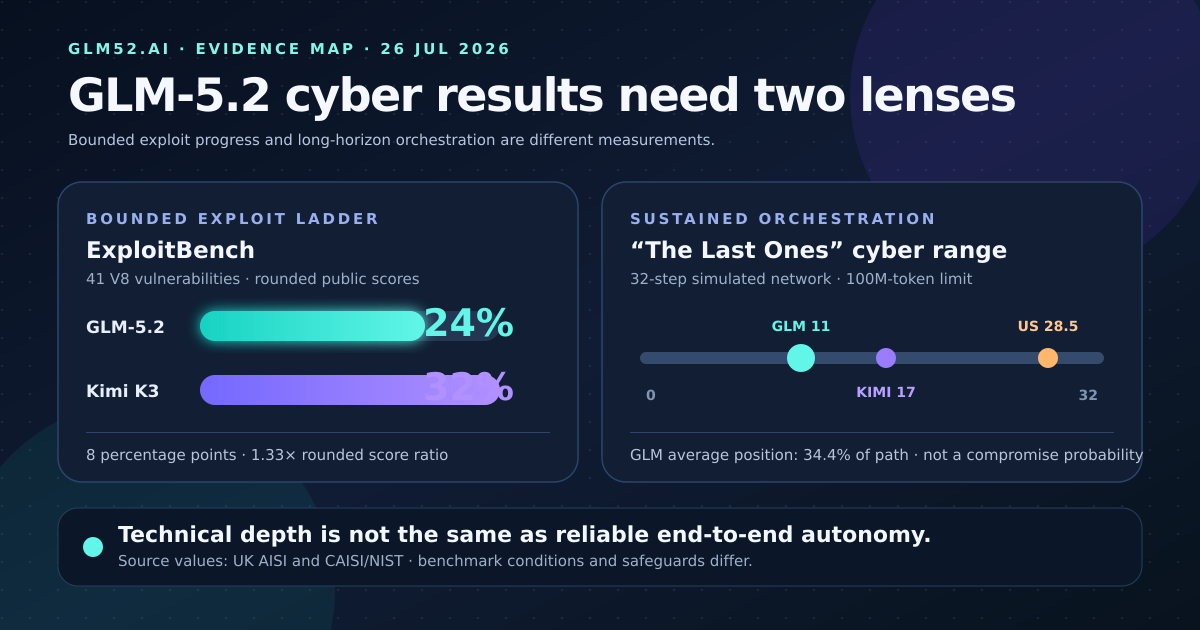
Original visualization of rounded values published by UK AISI and CAISI/NIST on July 17 and July 23, 2026. The bars describe different tests and must not be combined into one score.
GLM-5.2’s cybersecurity results look contradictory only when unlike tests are treated as the same job. One report calls it the most cyber-capable open-weight model tested in June. Another gives it 24% on ExploitBench. A cyber range shows progress to step 11 of 32, while a separate lab reports zero completed long-horizon scenarios.
Those findings can all be true. They measure technical depth, exploit-ladder progress, and sustained orchestration under different harnesses and budgets. This page reconciles the evidence without running an exploit or repeating a vendor leaderboard. It also turns the published numbers into a deployment rule for authorized defensive work.
In this analysis
Section titled “In this analysis”- Read the evidence as three different jobs
- A 24% ExploitBench score is not a 24% hack rate
- The step-11 stall measures orchestration, not zero skill
- Narrow tasks show the other side of the model
- Cost changes the pilot threshold, not the safety threshold
- Do not merge incompatible benchmark rows
- Choose a deployment boundary from the failure mode
- Reproduce the arithmetic without running an exploit
- Security controls to add before model access
- Questions the scorecard cannot answer
- Sources and method
Read the evidence as three different jobs
Section titled “Read the evidence as three different jobs”The most defensible conclusion comes from keeping each evaluation attached to its task:
| Evidence, checked July 26 | What the model had to do | Published GLM-5.2 result | What the result does not establish |
|---|---|---|---|
| AISI narrow cyber tasks | solve bounded vulnerability research, reverse engineering, web exploitation, and cryptography tasks | comparable to Opus 4.6 and GPT-5.3-Codex across the four difficulty levels | reliable completion of a long dependent chain |
| CAISI/NIST ExploitBench | progress through a 16-capability exploitation ladder over 41 V8 vulnerabilities | rounded score of 24% | compromise 24% of arbitrary software or networks |
| AISI “The Last Ones” range | sustain a 32-step simulated corporate-network attack | average progress to step 11 within a 100M-token limit | success against defended production infrastructure |
| Irregular’s three suites | combine atomic work, multi-stage scenarios, and open-ended research | three Atomic Task solves; no CyScenarioBench or FrontierCyber solve | zero useful intermediate analysis |
The GLM-5.2 benchmark hub separates official and independent evidence across more domains. This page goes narrower: it asks whether the cyber evidence supports bounded assistance, autonomous execution, or neither.
A 24% ExploitBench score is not a 24% hack rate
Section titled “A 24% ExploitBench score is not a 24% hack rate”ExploitBench rejects the idea that “the program crashed” and “the agent achieved arbitrary code execution” are equivalent. Its authors define 16 measurable capabilities, including coverage, crash reproduction, memory primitives, control-flow hijack, and arbitrary code execution. Deterministic oracles grade progress across 41 post-2023 V8 vulnerabilities.
The joint UK AISI / CAISI assessment reports 24% for GLM-5.2 and 32% for Kimi K3. The CAISI/NIST mirror publishes the same rounded values and methodology boundary.
The arithmetic is simple:
percentage-point gap = 32% - 24% = 8 pointsrelative score ratio = 32 / 24 = 1.33×The difference is 8 percentage points. The 1.33× figure is a ratio between two rounded scores on this harness. It is not evidence that Kimi is 33% better at security in general, and it says nothing about safe deployment. The public prose does not give GLM’s count at every ladder milestone, so converting 24% into “about ten vulnerabilities solved” would be an unsupported shortcut.
The distinction matters for defenders. A model that regularly finds a crash may accelerate triage. A model that sometimes constructs a memory primitive may help an expert investigate reachability. Neither observation proves reliable arbitrary code execution or permission to act on a live target.
The step-11 stall measures orchestration, not zero skill
Section titled “The step-11 stall measures orchestration, not zero skill”“The Last Ones” (TLO) is a 32-step simulated corporate network spanning four subnets and roughly 20 hosts. AISI gives agents initial access and measures progress through an intentional attack path. Within a 100M-token limit, the July 23 comparison reports these average positions:
| Model group | Average step | Descriptive share of 32 steps |
|---|---|---|
| GLM-5.2 | 11 | 34.4% |
| Kimi K3 | 17 | 53.1% |
| leading U.S. models in the comparison | 28.5 | 89.1% |
We calculated the last column by dividing the average step by 32. It makes scale visible; it is not a probability of compromise. Steps differ in difficulty, later actions depend on earlier ones, and average progress does not reveal the distribution across runs.
The GLM result still contains a useful clue. AISI’s July 17 analysis says GLM-5.2 reached step 7 with marginally fewer tokens than any other model on average and tracked Opus 4.6 to step 11 before stalling. That pattern points to efficient early progress followed by an orchestration ceiling.
The range also omits active defenders, defensive tooling, and penalties for noisy actions. It contains a deliberate route to the objective. Reaching step 11 there must not be presented as reaching one-third of a real enterprise compromise.
Narrow tasks show the other side of the model
Section titled “Narrow tasks show the other side of the model”AISI’s narrow suite uses 70 tasks, five attempts per task, and up to 2.5M tokens per attempt. The tasks span 18 technical-non-expert, 25 apprentice, 19 practitioner, and 8 expert items. AISI found GLM-5.2 comparable to Opus 4.6 and GPT-5.3-Codex on these tasks, including across all four difficulty bands.
That result is more optimistic than TLO because the job is different. A bounded task gives the agent a shorter feedback loop and fewer dependent decisions to preserve. The maximum allocation is 350 attempts and 875M tokens, although that ceiling is not reported consumption.
Irregular’s independent GLM-5.2 assessment shows the same split through another harness. Its self-hosted model solved three Atomic Tasks and demonstrated reverse engineering, protocol manipulation, cryptographic reasoning, and exploit-development progress. It solved no CyScenarioBench challenge and no open-ended FrontierCyber target.
Irregular describes meaningful intermediate work even on failures, including source inspection, custom tooling, memory disclosure, and early-stage access. Its conclusion is narrower than “the model cannot do cyber”: the main observed gap was carrying technical progress through a long chain with enough reliability to reach the final objective.
Cost changes the pilot threshold, not the safety threshold
Section titled “Cost changes the pilot threshold, not the safety threshold”AISI estimated a 100M-token range run at roughly $46 for GLM-5.2 and $85 for Opus 4.5 or 4.6. The GLM estimate is $39 lower, or 45.9% less. Across tasks that both GLM-5.2 and Opus 4.6 solved with 100% reliability, AISI reported $6.12 versus $15.17 per task, making the GLM figure 59.7% lower.
Those numbers can justify a broader controlled pilot. They do not justify broader permissions. Model cost excludes the reviewer, sandbox, instrumentation, remediation, false leads, and the expected loss from an unsafe action.
AISI also states that it did not use first-party providers for the open-weight models. The figures are evaluation estimates tied to a particular setup, not current Z.ai prices or a universal self-hosting bill. Use the GLM-5.2 cost calculator for a workload-specific commercial estimate, but keep safety controls outside the token-price formula.
Do not merge incompatible benchmark rows
Section titled “Do not merge incompatible benchmark rows”Five confounders prevent a single “cyber score”:
- Outcome: ExploitBench grades ladder progress; TLO records range steps; Irregular reports suite solves and intermediate findings.
- Budget: the tests use different token ceilings, attempt counts, stopping conditions, and agent scaffolds.
- Safeguards: AISI says U.S. closed-weight models were tested with system-level safeguards disabled. Public products normally expose different behavior.
- Environment: V8 bugs, a simulated network, bounded atomic tasks, and current real systems are different target classes.
- Date and route: model versions, hosted endpoints, prompts, tools, and open-weight serving stacks can change after publication.
This is why the broad GLM-5.2 versus Kimi K3 comparison remains a separate page. The 24% versus 32% row answers one exploit-ladder question; it cannot replace pricing, coding, modality, context, or access evidence.
Choose a deployment boundary from the failure mode
Section titled “Choose a deployment boundary from the failure mode”Use the observed reliability profile to choose permissions:
| Intended job | Evidence-led starting boundary | Stop condition |
|---|---|---|
| explain a suspicious code path | read-only repository and a human reviewer | model invents a path not supported by code or tests |
| draft a safe reproducer for an owned test fixture | disposable sandbox, no external network, synthetic data | target identity or authorization is ambiguous |
| rank alerts or propose triage steps | retrieved evidence attached to every recommendation | recommendation cannot be traced to a source artifact |
| run a multi-stage security investigation | explicit phase gates and fresh approval before each state-changing tool | the plan changes, credentials broaden, or scope drifts |
| autonomous production exploitation | do not grant this boundary from current public evidence | not applicable |
Open weights can keep sensitive artifacts inside infrastructure you control. The official GLM-5.2 model card lists an MIT license, a 1M context claim, and a 753B model size. That is a real privacy and customization path, but it is a large infrastructure commitment. Review the local hardware requirements before treating “downloadable” as “easy to isolate.”
Reproduce the arithmetic without running an exploit
Section titled “Reproduce the arithmetic without running an exploit”We copied only values stated in the AISI and CAISI/NIST prose into a small JSON fixture. A dependency-free script checks the expected task counts and computes the ratios:
const pointGap = 32 - 24;const relativeRatio = 32 / 24;const glmPathShare = (11 / 32) * 100;const rangeCostReduction = ((85 - 46) / 85) * 100;The script ran inside pinned node:24.4.1-alpine3.22 with no network, a read-only root filesystem, all Linux capabilities dropped, and only the evidence directory mounted read-only. It called no model and performed no security operation. The exact container was removed and the pulled image deleted after the calculation.
You can inspect the sanitized derived result JSON. Its interpretation limits travel with the numbers so a chart cannot silently turn range progress into real-world risk.
Security controls to add before model access
Section titled “Security controls to add before model access”A strong bounded-task result increases the need for conventional controls:
- give the model read-only access by default and separate analysis from action;
- replace production credentials with scoped, expiring test identities;
- block external network access unless a reviewed task needs an allowlisted destination;
- run code in a disposable sandbox with CPU, memory, time, file, and token caps;
- validate tool arguments and require approval for writes, scans, shell execution, or credential use;
- retain prompts, tool calls, model/version IDs, artifacts, and human decisions in an audit log;
- treat generated code, commands, URLs, and findings as untrusted until independently checked;
- define an incident stop button outside the agent and test it before expanding scope.
For a hosted route, compare provider data terms, logs, and access controls in the GLM-5.2 API provider guide. For self-hosting, apply the same controls at the orchestration layer; possessing the weights does not create monitoring or authorization.
Questions the scorecard cannot answer
Section titled “Questions the scorecard cannot answer”Is GLM-5.2 the best open-weight cybersecurity model?
Section titled “Is GLM-5.2 the best open-weight cybersecurity model?”AISI called it the most cyber-capable open-weight model as of its June 2026 testing. The later preliminary comparison placed Kimi K3 above it on ExploitBench and TLO. “Best” therefore needs a date, a workload, a harness, and a reproducible configuration.
Does 24% mean GLM-5.2 fully exploited about ten of 41 bugs?
Section titled “Does 24% mean GLM-5.2 fully exploited about ten of 41 bugs?”No. ExploitBench is a capability ladder with 16 graded flags, and the government publication reports a rounded aggregate score. Without the underlying GLM milestone table and scoring calculation, multiplying 41 by 24% would invent a solve count.
Why can narrow-task performance look strong when range performance stalls?
Section titled “Why can narrow-task performance look strong when range performance stalls?”Short tasks reduce planning depth and dependency management. A long range requires the agent to preserve state, choose the next action, recover from errors, and maintain a coherent objective across many tool calls. The evidence suggests GLM-5.2’s technical depth is stronger than its sustained orchestration reliability.
Can defenders still use GLM-5.2?
Section titled “Can defenders still use GLM-5.2?”Yes, for authorized, bounded assistance with human verification and least-privilege tools. The results support piloting analysis, triage, and controlled test-fixture work. They do not support unattended access to production systems.
Did GLM52.ai run these offensive benchmarks?
Section titled “Did GLM52.ai run these offensive benchmarks?”No. We did not run a model, exploit, target, or cyber range. We verified primary reports, normalized their test boundaries, and reproduced only the published arithmetic in an isolated container.
Sources and method
Section titled “Sources and method”Checked July 26, 2026. The topic was discovered through this AI HOT item; AI HOT was used only as a lead, not as evidence for changing claims.
- UK AISI: open-weight cyber capability gap — narrow-task setup, TLO trajectory, cost estimates, safeguards, and limitations.
- UK AISI / CAISI: preliminary Kimi K3 assessment — rounded ExploitBench scores and TLO comparison.
- CAISI/NIST mirror of the joint assessment — U.S. government publication of the same joint results.
- ExploitBench paper — 16-level capability design, 41 V8 vulnerabilities, and deterministic grading.
- Irregular’s GLM-5.2 assessment — independent bounded-task and long-horizon observations.
- Z.ai’s official GLM-5.2 model card — model identity, license, size, context, and deployment links.
The 8-point gap, 1.33× ratio, path shares, and cost reductions are our arithmetic over rounded published values. They are descriptive, not confidence intervals or predictions. AISI’s cost figures are not first-party provider quotes. Irregular did not publish enough raw GLM run data on its page for us to reproduce that evaluation, so its findings remain attributed rather than presented as our test.