
GLM-5.2 Stop Tokens: Audit EOS in vLLM and SGLang
Independent research — not an official Z.ai publication.Identity and provider disclosure

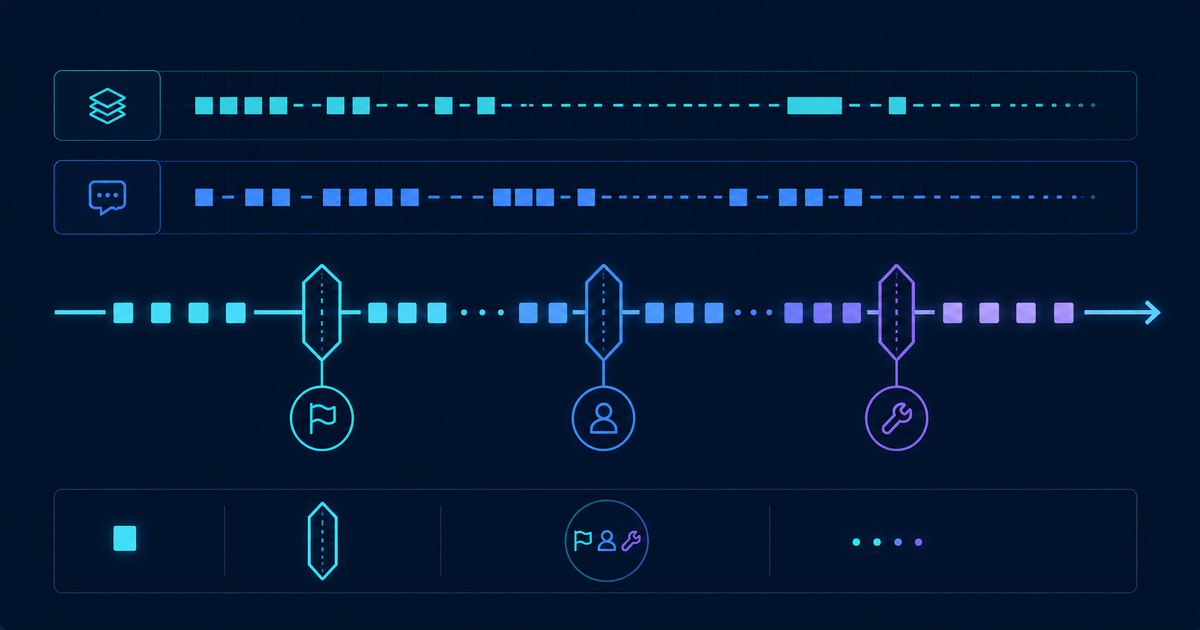
Original editorial diagram of the generated-token gate. The two upper rails represent prompt context; the lower stream represents output tokens. It is not a Z.ai, Hugging Face, vLLM, SGLang, RunPod, or GPU product screen.
GLM-5.2 does not declare one end-of-sequence token. At pinned official revision
b4734de4facf877f85769a911abafc5283eab3d9, both config.json and
generation_config.json list three EOS IDs: 154820, 154827, and
154829. The tokenizer maps them to <|endoftext|>,
<|user|>, and <|observation|>.
That is an operational contract. A server that retains only 154820 can keep
generating after a user or observation role marker. A diagnostic that enables
ignore_eos can bypass every model-default stop. A home-grown scanner that
searches the prompt can stop before generation begins because GLM-5.2 uses
154820 for left padding and embeds role tokens in valid prompts.
The safe starting profile is small: preserve all three checkpoint EOS IDs,
leave ignore_eos false, inspect the effective request after every engine
override, and test stop logic only against newly generated IDs. String cleanup
and reasoning/tool parsing remain later, separate gates.
Navigate the stop-token audit
Section titled “Navigate the stop-token audit”- Read the three-token contract
- Separate prompt roles from output stops
- Verify Transformers metadata
- Audit the vLLM effective set
- Audit the SGLang effective set
- Run the three positive fixtures
- Keep the negative controls
- Build a release gate
- Diagnose continuation failures
- Run a bounded GPU canary
- Audit sources and limits
- Resolve practical questions
Read the three-token contract
Section titled “Read the three-token contract”The checkpoint and generation metadata agree exactly. Our probe fails if either file changes or if their ordered EOS lists diverge:
| Token ID | Token text | Generated-token effect | Default? |
|---|---|---|---|
154820 |
`< | endoftext | >` |
154827 |
`< | user | >` |
154829 |
`< | observation | >` |
154826 |
`< | system | >` |
154828 |
`< | assistant | >` |
The descriptions for the two role-boundary stops are operational inferences from the IDs and tokenizer mapping. They are not a quotation about Z.ai’s training intent. The measurable claim is narrower: those token IDs are in the default EOS list, and the system and assistant role IDs are not.
Do not “normalize” this list to a scalar just because many causal models expose
one EOS ID. Also do not add every role token. Adding 154826 or 154828 would
create a new termination policy without checkpoint evidence. Start with the
publisher metadata and make changes only through an explicit, tested request
contract.
The pinned tokenizer also declares left padding and uses
<|endoftext|> as
both EOS and pad text. Sharing an ID is supported, but it makes the boundary
between prompt inspection and output inspection important.
Separate prompt roles from output stops
Section titled “Separate prompt roles from output stops”The GLM-5.2 chat-template guide proves how messages become one prompt. This audit begins after that prompt enters the engine. Role markers in input are context; a matching token accepted from the decoder is a termination event.
Our prompt fixture deliberately contains two left-pad IDs, a user role ID, and ordinary content:
prompt: [154820, 154820, 154827, 920, 921]generated: [610, 611, 154820]A naive scan reports a stop at prompt offset zero. The correct generated-only
scan reports 154820 at output offset two. This is why substring searching an
assembled transcript is a fragile substitute for the engine’s token-level
finish reason.
Keep three layers distinct:
- the template serializes roles, tools, and thinking controls into input IDs;
- the decoder accepts new output IDs and stops when one matches its effective stop set; and
- the reasoning/tool parser interprets the bounded output that remains.
A passing template fixture cannot prove layer two. A correct stop set cannot prove layer three. Debug the first layer where observed behavior diverges instead of patching the final string until the symptom disappears.
Verify the Transformers metadata path
Section titled “Verify the Transformers metadata path”Pinned Transformers v5.15.0 documents eos_token_id as either an integer or
a list of integers, and GenerationConfig loads that field. The smallest
checkpoint preflight does not need model weights:
import json
EXPECTED = [154820, 154827, 154829]
with open("config.json", encoding="utf-8") as handle:    model_config = json.load(handle)with open("generation_config.json", encoding="utf-8") as handle:    generation_config = json.load(handle)
assert model_config["eos_token_id"] == EXPECTEDassert generation_config["eos_token_id"] == EXPECTEDassert model_config["pad_token_id"] == 154820assert generation_config["pad_token_id"] == 154820
In an online loader, pin revision and inspect the resolved generation config
before allocating accelerators. Record the revision, Transformers version, and
effective EOS list beside the deployment. A friendly repository name is not an
immutable input.
Request-level stop IDs can be additive. That does not make them a replacement for the model list. If a product adds a domain delimiter, test the union and retain the three defaults unless the engine’s documented override semantics say otherwise. Raw string stops are useful only for a separately specified text protocol; tokenization and boundary matching can make them behave differently from EOS IDs.
Audit vLLM’s effective stop set
Section titled “Audit vLLM’s effective stop set”At pinned vLLM v0.27.1, the request input processor supplies the tokenizer’s
EOS ID and updates sampling parameters from generation-config fields. The
sampling branch keeps 154820 as the primary EOS and adds 154827 plus
154829 to stop-token IDs. The resulting set is:
{ "primary_eos_token_id": 154820, "stop_token_ids": [154827, 154829], "all_stop_token_ids": [154820, 154827, 154829], "ignore_eos": false}The model configuration defaults generation_config to auto. That is the
expected path for importing repository generation defaults. The important
override is --generation-config vllm: pinned source turns that option into an
empty generation-config mapping. It can be valid when an operator wants vLLM
defaults, but it is not evidence that the model’s supplemental EOS IDs survived.
Treat that flag as a review event. Inspect the effective sampling parameters or send deterministic boundary fixtures before promotion. Do the same after an engine upgrade, a custom generation-config file, an API gateway rewrite, or a request that supplies its own stop fields.
ignore_eos=true is an even stronger override. In the pinned branch it clears
the primary EOS termination path; our translated diagnostic produced no active
default stop. Use it only when a bounded test needs to observe output past EOS,
with a strict token cap and isolated result. It should not be an unexplained
production default.
Audit SGLang’s effective stop set
Section titled “Audit SGLang’s effective stop set”Pinned SGLang v0.5.17 unions EOS IDs from model and generation configuration
into hf_eos_token_id, passes that set into each request, and checks newly
accepted output tokens against multiple stop sources. With no request-specific
additions, our translation is:
{ "hf_eos_token_ids": [154820, 154827, 154829], "request_stop_token_ids": [], "tokenizer_eos_token_id": 154820, "additional_stop_token_ids": [], "effective_generated_stop_ids": [154820, 154827, 154829], "ignore_eos": false}The scheduling branch checks the request stop IDs, the Hugging Face EOS set, the tokenizer EOS, and tokenizer-defined additional stop IDs for accepted output tokens. The union matters more than which internal field first carries an ID. Your deployment receipt should therefore record the final set exposed to the request, not only the value in one JSON file.
SGLang also honors ignore_eos. The pinned default is false, but our negative
control shows that true removes all three effective generated stops in the
translated branch. A maximum-token limit still bounds a request; it does not
restore correct semantic termination. Treat “always hits max tokens” as a
configuration symptom, not proof that the model never emits EOS.
Test each generated boundary
Section titled “Test each generated boundary”The positive suite feeds the same short token pattern to both translated engine branches and changes only the intended boundary ID:
| Fixture | Generated IDs | Expected match | vLLM | SGLang |
|---|---|---|---|---|
| end of text | [610, 611, 154820, 612] |
154820 at offset 2 |
pass | pass |
| next user boundary | [610, 611, 154827, 612] |
154827 at offset 2 |
pass | pass |
| observation boundary | [610, 611, 154829, 612] |
154829 at offset 2 |
pass | pass |
| non-stop roles | [610, 154826, 154828, 612] |
no match | pass | pass |
These fixtures are intentionally deterministic. They verify configuration and branch semantics without pretending to predict which token the 753B model will emit. A later live canary should add one synthetic conversation for ordinary text, one turn transition, and one tool-result transition, then assert finish reason, bounded output, and parser state.
Archive token IDs as well as decoded text. A parser may remove a special token before an application log sees it, while a gateway may expose a generic finish reason. The engine receipt is the most useful layer for deciding whether the decoder saw the expected boundary.
The sanitized machine-readable result is available at the public stop-token receipt. It preserves all twelve source hashes, versions, token fixtures, negative controls, 48 assertion outcomes, and the no-weights/no-server boundary.
Keep three negative controls
Section titled “Keep three negative controls”A test suite that only confirms the expected profile can pass while its failure detector is broken. Retain these controls:
Drop the supplemental role stops
Section titled “Drop the supplemental role stops”Configure only [154820]. The user-boundary and observation-boundary fixtures
must both fail to match. If they pass, the harness is importing an unrecorded
stop source or checking decoded strings instead of the declared token set.
Enable ignore_eos
Section titled “Enable ignore_eos”Feed [610, 154827, 154829, 154820] with ignore_eos=true. Neither translated
engine branch should terminate on the model defaults. Bound the diagnostic by
output tokens so the deliberate non-stop cannot run indefinitely.
Put stop IDs in the prompt
Section titled “Put stop IDs in the prompt”Left padding plus a user role marker must not end generation before the first new token. If a test reports that prompt match as a finish event, move the scanner to the decoder’s accepted-output path.
Do not “fix” these controls by adding three raw strings to every request. String stops may span different token boundaries, interact with detokenization, or truncate user-visible text that merely contains a marker-like sequence. Correct the metadata or engine configuration first; add application delimiters only when their protocol and tests require them.
Turn stop behavior into a release gate
Section titled “Turn stop behavior into a release gate”Use one receipt per engine profile and fail closed when any row changes:
| Layer | Required evidence | Stop condition |
|---|---|---|
| Checkpoint | pinned revision; model and generation EOS lists agree | digest or list changes without review |
| Tokenizer | five mapped role IDs; left padding; pad ID 154820 |
role mapping or padding contract changes |
| Engine | version/commit and effective set are recorded | one of three defaults disappears |
| Request | ignore_eos=false; additions are explicit |
gateway or client silently overrides stops |
| Positive tests | all three boundaries stop at exact generated offsets | continuation after any boundary |
| Negative tests | single-EOS, ignore-EOS, and prompt-scan controls fail as designed | harness cannot detect bad profiles |
| Parser | reasoning/tool layers receive one bounded assistant turn | stop pass is mistaken for parser pass |
| Runtime | output cap and cancellation remain active | semantic stop is the only safety bound |
Roll out one engine version at a time. Keep the previous launch command and generation config as the rollback point. For a live tool canary, pair this gate with the site’s tested tool-calling loop. For transport truncation and terminal-event handling, use the streaming API parser guide.
Observe stop ID or finish reason by route, engine version, template revision, and request profile. Alert on a rise in maximum-token finishes, role markers in visible output, repeated assistant turns, or tool loops that wait for an observation after generation should have ended. Do not log private prompts to obtain this telemetry; synthetic fixtures and bounded counters are sufficient.
Diagnose stop-token failures by symptom
Section titled “Diagnose stop-token failures by symptom”| Symptom | First check | Likely boundary | Do not assume |
|---|---|---|---|
| `< | user | >` appears and text continues | effective set contains 154827 |
| tool loop generates an observation role | effective set contains 154829 |
observation stop or parser integration missing | tool result itself is invalid |
every request reaches max_tokens |
ignore_eos and finish reason |
EOS path bypassed or stops absent | model never emits EOS |
| request stops before decoding | prompt/output ID separation | prompt was scanned for stop IDs | pad and EOS cannot share an ID |
| system/assistant marker ends output | custom stop additions | unverified role IDs were added | all role tokens should be stops |
| output stops but tool parsing fails | parser flags and schema | layer three, after correct termination | more EOS IDs will fix parsing |
| one engine passes and another leaks | pinned versions and resolved sets | engine-specific import/override semantics | same CLI flags mean same behavior |
When decoded output hides the matched special token, reproduce with a synthetic token fixture at the engine layer. If that layer passes, move outward to the gateway, SDK, stream assembler, and parser. Change one layer per test so a successful workaround does not erase the root cause.
Rent a canary only after the metadata gate
Section titled “Rent a canary only after the metadata gate”Stop-token validation itself is CPU-light. The evidence run needed no GPU and should happen before the larger capacity planning in the local GLM-5.2 hardware guide. Rent compute only when the pinned source, effective engine profile, and deterministic controls all pass and you need a live generation canary.
Audit the sources and evidence boundary
Section titled “Audit the sources and evidence boundary”Sources checked on August 12, 2026:
- the pinned GLM-5.2 model repository, model config, generation config, and tokenizer artifacts for exact IDs and mappings;
- Transformers
v5.15.0generation configuration for scalar-or-list EOS metadata; - vLLM
v0.27.1sampling parameters, input processor, and model configuration for import, effective-set, override, andignore_eosbehavior; and - SGLang
v0.5.17model configuration, scheduler, and schedule batch for EOS union, request propagation, accepted-token checks, and bypass logic.
The Z.ai GLM-5.2 release confirms the model and supported open-weight serving context, but the stop behavior in this article is grounded in pinned artifacts and engine source. The probe’s simulations are dependency-free translations of only the cited branches, guarded by exact source hashes. We did not import or start the engines. A live release still needs the canary described above.
The full research record and probe scripts are versioned in the site’s private repository; the public JSON receipt is the reader-accessible audit. Re-run the source gate when any model revision, engine tag, generation config, or client override changes.
Answer common GLM-5.2 stop-token questions
Section titled “Answer common GLM-5.2 stop-token questions”What are GLM-5.2’s default EOS token IDs?
Section titled “What are GLM-5.2’s default EOS token IDs?”At pinned revision b4734de4…, both model and generation config list
[154820, 154827, 154829]. They map to end of text, user role, and observation
role tokens. Always recheck the revision you deploy.
Why are the user and observation tokens stops?
Section titled “Why are the user and observation tokens stops?”They are configured as EOS IDs. Operationally, stopping prevents one assistant generation from continuing into the next user or observation role. That description is inferred from the token map; it is not a claim about hidden training intent.
Should system and assistant role IDs also be stops?
Section titled “Should system and assistant role IDs also be stops?”Not by default. IDs 154826 and 154828 are absent from the pinned EOS list,
and the non-stop fixture confirms they should not match this contract. Adding
them requires a separate protocol and test.
Is max_tokens enough if EOS configuration is wrong?
Section titled “Is max_tokens enough if EOS configuration is wrong?”It limits damage and cost but does not restore semantic turn boundaries. A request can leak role markers, produce malformed tool transitions, or waste its full output budget before the cap ends it.
Should I add the three token strings as stop strings?
Section titled “Should I add the three token strings as stop strings?”Fix the engine’s token-ID configuration first. String stops operate after or during detokenization depending on the stack, can cross token boundaries, and may truncate marker-like text. Use them only for a defined application protocol with its own fixtures.
Does this prove vLLM and SGLang run GLM-5.2 correctly?
Section titled “Does this prove vLLM and SGLang run GLM-5.2 correctly?”No. It proves pinned source and configuration branches plus deterministic stop fixtures. It does not start either engine, load weights, generate a model token, validate parsers, or measure performance.