
GLM-5.2 vs MiniMax M3: Which Model Should You Choose?
Independent research — not an official Z.ai publication.Identity and provider disclosure

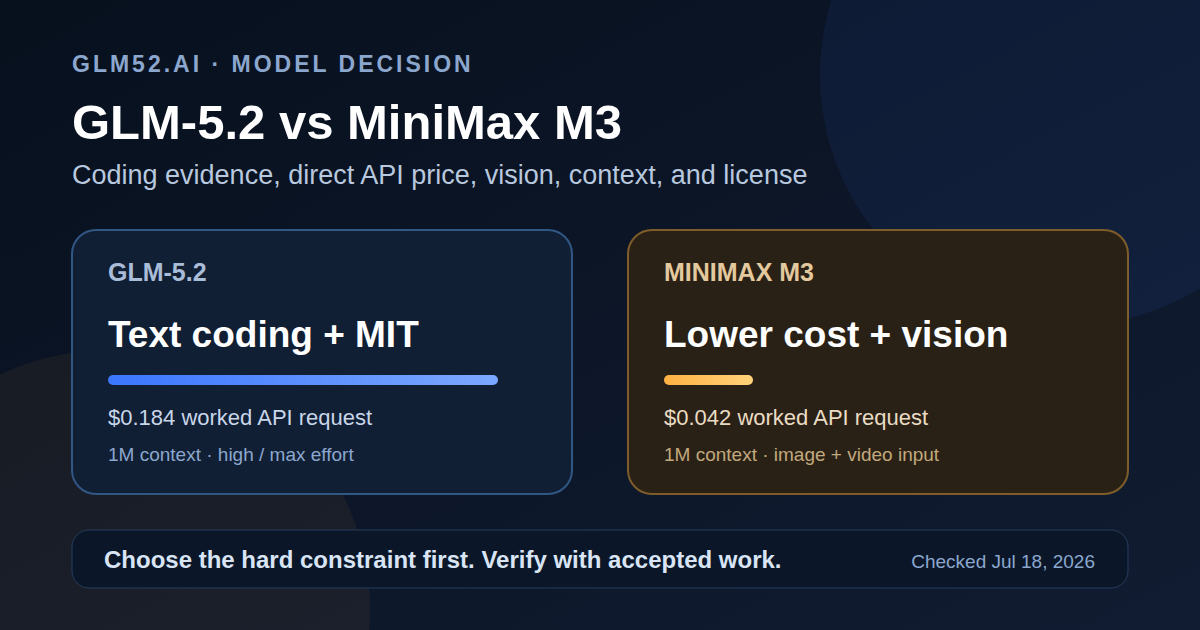
We checked the specifications, prices, weights, and license terms on this page against first-party sources on July 18, 2026.
The useful GLM-5.2 vs MiniMax M3 question is not “which model wins?” It is “which constraint can stop this workload?” A text coding agent, screenshot-driven frontend loop, high-volume API, and commercial self-hosted product need different answers.
This comparison separates four evidence types:
- documented facts from Z.ai and MiniMax;
- publisher benchmark claims with the source named;
- cost arithmetic that you can reproduce with your token counts;
- selection guidance that follows from those facts.
GLM52.ai did not buy either API or run an independent benchmark for this article. We do not present a vendor table as our own test.
In this comparison
Section titled “In this comparison”- Quick verdict
- Specifications at a glance
- What the benchmark evidence says
- Direct API price comparison
- The 512K pricing threshold
- Context and long-horizon work
- Vision and reasoning controls
- Open weights and license obligations
- Which model should you choose?
- How to test both models
- Common questions
- Sources and method
Quick verdict
Section titled “Quick verdict”GLM-5.2 makes the stronger first test for text-heavy coding and agent work. Z.ai’s model card places it ahead of M3 on most shared reasoning, coding, and agent rows. The largest selected gaps appear on DeepSWE and Terminal-Bench 2.1. GLM’s MIT license creates a cleaner self-hosting path for products that cannot accept attribution, notice, revenue-threshold, or use restrictions.
MiniMax M3 makes the stronger first test for API cost and visual input. MiniMax charges $0.30 per million input tokens and $1.20 per million output tokens for standard requests at or below 512K input. M3 accepts text, images, and video in one model. GLM-5.2 accepts text.
Neither advantage gives a universal winner. The benchmark comparison comes from Z.ai, not a neutral test lab. The price comparison holds token counts constant, but each tokenizer and agent can consume a different number. Use the evidence to choose the first candidate, then rank accepted work.
Start with four hard gates:
- If the base model must inspect images or video, test M3 first.
- If the weights must use a permissive MIT license, test GLM-5.2 first.
- If direct token cost dominates and both models pass, choose M3.
- If a text coding task has a high failure cost, test GLM-5.2 first, then verify the public score pattern in your harness.
Specifications at a glance
Section titled “Specifications at a glance”| Decision factor | GLM-5.2 | MiniMax M3 | Why it matters |
|---|---|---|---|
| Publisher | Z.ai | MiniMax | Separate APIs, policies, regions, and support paths |
| Release date | June 16, 2026 | June 1, 2026 | GLM arrived 15 days later |
| Direct API model ID | glm-5.2 |
MiniMax-M3 |
Use the exact provider name in tests and logs |
| Input | Text | Text, image, video | M3 can put pixels inside the base-model request |
| Output | Text | Text | Neither model generates images through this endpoint |
| Advertised context | 1M tokens | 1M tokens | Capacity matches at headline level; behavior needs testing |
| Maximum output | 128K documented | Check the active endpoint | Do not infer output capacity from input context |
| Fresh input / MTok | $1.40 | $0.30 up to 512K input | M3 has the lower standard list rate |
| Cached input / MTok | $0.26 | $0.06 up to 512K input | Cache eligibility depends on provider rules |
| Output / MTok | $4.40 | $1.20 up to 512K input | Long reasoning can make output the cost driver |
| Model size | 753B reported | About 428B | Full checkpoint size shapes hosting cost |
| Active parameters | About 40B reported | About 23B | Active size does not equal total memory need |
| Reasoning control | Off, high, max | Disabled, adaptive, enabled | The APIs expose different routing choices |
| Weight license | MIT | MiniMax Community License | Commercial obligations differ in material ways |
The rates above describe each direct provider’s standard pay-as-you-go endpoint. A gateway, coding subscription, priority tier, or hosted checkpoint can publish another price, context limit, cache policy, or modality set.
What the benchmark evidence says
Section titled “What the benchmark evidence says”The official GLM-5.2 model card includes both models in one table. GLM leads eight of the nine selected rows below. M3 leads GPQA-Diamond by 1.8 points.
| Benchmark | GLM-5.2 | MiniMax M3 | Reported gap |
|---|---|---|---|
| HLE | 40.5 | 37.0 | GLM +3.5 |
| CritPt | 20.9 | 3.7 | GLM +17.2 |
| HMMT Feb. 2026 | 92.5 | 84.4 | GLM +8.1 |
| GPQA-Diamond | 91.2 | 93.0 | M3 +1.8 |
| SWE-bench Pro | 62.1 | 59.0 | GLM +3.1 |
| NL2Repo | 48.9 | 42.1 | GLM +6.8 |
| DeepSWE | 46.2 | 20.0 | GLM +26.2 |
| Terminal-Bench 2.1, Terminus-2 | 81.0 | 65.0 | GLM +16.0 |
| MCP Atlas, public set | 76.8 | 74.2 | GLM +2.6 |
MiniMax’s M3 launch report lists 59.0 on SWE-bench Pro, 66.0 on Terminal-Bench 2.1, and 74.2 on MCP Atlas. Those values match or sit close to the M3 column above. This cross-check makes transcription error less plausible. It does not validate the GLM result or remove vendor interest.
Harnesses can move the score
Section titled “Harnesses can move the score”MiniMax says its launch evaluations used several shells: Claude Code for SWE-bench Pro, Terminus 2 for Terminal-Bench, and the official MCP Atlas codebase with a Gemini judge. Z.ai publishes its own table and footnotes. Prompt, tool schema, permissions, retries, timeout, context policy, and grader can change the result.
Use public scores as a candidate filter. A 62.1 score does not give your next ticket a 62.1% pass probability. Your repository and agent add another system around the weights:
accepted result = model + prompt + tools + permissions + context policy + effort + retries + timeout + tests + reviewThe table supports a GLM-first text coding test. It does not support “GLM wins every coding task.” M3’s native visual input can reverse the decision when the work includes screenshots, diagrams, browser states, or video.
Direct API price comparison
Section titled “Direct API price comparison”Z.ai’s pricing page lists $1.40 per million fresh input tokens, $0.26 per million cached input tokens, and $4.40 per million output tokens for GLM-5.2.
MiniMax’s pay-as-you-go page lists $0.30 input, $0.06 cache read, and $1.20 output for standard M3 requests with no more than 512K input tokens.
For 100,000 fresh input tokens and 10,000 output tokens:
GLM-5.2 = 0.10 × $1.40 + 0.01 × $4.40 = $0.184MiniMax M3 = 0.10 × $0.30 + 0.01 × $1.20 = $0.042M3 costs 77.2% less, or GLM costs 4.38× as much, for this equal-token request shape.
If all 100,000 input tokens earn the cache-read rate:
GLM-5.2 = 0.10 × $0.26 + 0.01 × $4.40 = $0.070MiniMax M3 = 0.10 × $0.06 + 0.01 × $1.20 = $0.018M3 costs 74.3% less in this full-cache case. The provider must report a cache hit. Repeated text alone does not guarantee the lower rate.
Four M3 attempts can fit under one GLM attempt
Section titled “Four M3 attempts can fit under one GLM attempt”Four M3 runs with the fresh-input shape cost $0.168. Five cost $0.210 and cross the $0.184 GLM bill. The equal-token retry break-even is 4.38 M3 attempts per GLM attempt.
This ratio is arithmetic, not a quality claim. An agent may change its token use after an error, and the two tokenizers may bill different counts for the same files. Measure the metric that connects quality and price:
Cost per accepted result = total model and tool spend across attempts ÷ accepted outputs
GLM can win this metric if its pass-rate gain exceeds the price gap. M3 keeps the clear cost lead when both models pass with similar tokens and supervision.
The 512K pricing threshold
Section titled “The 512K pricing threshold”M3 doubles its standard input, cache-read, and output rates when input exceeds 512K tokens. The long-context tier lists $0.60 input, $0.12 cache read, and $2.40 output per million tokens. GLM’s published table does not add a context-length tier.
For 600,000 fresh input tokens and 20,000 output tokens:
GLM-5.2 = 0.60 × $1.40 + 0.02 × $4.40 = $0.928MiniMax M3 = 0.60 × $0.60 + 0.02 × $2.40 = $0.408M3 costs 56.0% less, or GLM costs 2.27× as much, for this equal-token long request. M3 remains cheaper, but the gap narrows after the 512K boundary.
Do not trim a 520K prompt to 511K without checking what the removed evidence does. A lower bill can raise repair cost if retrieval loses a contract, test, or design decision. First remove generated files, duplicate logs, stale branches, build artifacts, and unrelated documents.
Context and long-horizon work
Section titled “Context and long-horizon work”Both vendors advertise a 1M-token context. The MiniMax API overview lists 1,000,000 tokens, while the M3 checkpoint configuration exposes 1,048,576 positions. Z.ai documents GLM-5.2 as 1M with a 128K output ceiling.
Capacity does not prove equal recall, latency, instruction retention, or stability. MiniMax built M3 around MiniMax Sparse Attention. Its technical report says the mechanism selects blocks rather than attending to the full history for each query. Z.ai says GLM-5.2 uses IndexShare to reuse an indexer across sparse-attention layers. These are architecture descriptions and publisher efficiency results, not an independent long-context contest.
Test the context you plan to buy. Place required facts near the start, middle, and end. Add two similar filenames, a stale specification, and a tool error. Ask each agent to cite paths and preserve constraints after several tool calls. A curated 100K working set can beat a 1M repository dump.
Vision and reasoning controls
Section titled “Vision and reasoning controls”M3 is a native multimodal model. Its model card and launch report document text, image, and video input. This matters for frontend repair, chart extraction, scanned documents, computer use, and any task where pixels contain evidence that alt text or source code omits.
The base GLM-5.2 endpoint accepts text. A coding product can route screenshots to a separate vision model or Vision MCP tool, but that creates a multi-model workflow. Our GLM-5.2 image support guide explains how to track pixel provenance and avoid calling a tool-assisted result native vision.
The reasoning controls differ:
| Control goal | GLM-5.2 | MiniMax M3 |
|---|---|---|
| Lowest-latency path | Disable thinking | thinking: disabled |
| Model-routed effort | No documented adaptive mode | thinking: adaptive |
| Deliberate reasoning | Enable thinking with high |
thinking: enabled |
| Highest documented effort | Enable thinking with max |
No named high/max tier |
Use the GLM-5.2 reasoning-effort guide for the exact accepted values and normalization rules. For M3, follow the official model card and record the thinking value with each test result.
Open weights and license obligations
Section titled “Open weights and license obligations”Both publishers offer downloadable checkpoints. They do not offer the same permissions.
GLM-5.2 uses the MIT license. The short, permissive grant supports commercial use, modification, and distribution while retaining the copyright and permission notice.
M3 uses the MiniMax Community License. Its license file requires commercial products to display “Built with MiniMax M3.” It asks organizations at or below $20 million in yearly revenue to send a one-time notice. Above that threshold, it requires separate prior written authorization. It includes prohibited-use terms.
This difference can decide the model before any benchmark:
- choose GLM when legal review requires a standard permissive license;
- consider M3 when the product can satisfy its attribution, notice, revenue, and use terms;
- have counsel read the current license before commercial deployment. This article is not legal advice.
Model scale affects the operations case. The official M3 card reports about 428B total parameters and 23B active. GLM documentation reports 753B total and about 40B active. Active parameters shape compute, but the full checkpoint, runtime buffers, KV cache, and concurrency shape memory. Neither model is a casual single-GPU deployment. See the GLM-5.2 local hardware guide for the capacity-planning method.
Which model should you choose?
Section titled “Which model should you choose?”Choose GLM-5.2 for text coding evidence and a permissive license
Section titled “Choose GLM-5.2 for text coding evidence and a permissive license”Start with GLM when the work is text-based, repository tests define success, and the Z.ai benchmark pattern matches your task. GLM fits commercial self-hosting cases that need MIT terms and applications that want explicit high/max effort routing.
Choose MiniMax M3 for native vision and lower direct token rates
Section titled “Choose MiniMax M3 for native vision and lower direct token rates”Start with M3 when a base-model call must inspect screenshots, diagrams, scans, or video. M3 makes a strong cost candidate for high-volume agents, repeated document work, and workflows where four same-size attempts can remain below one GLM attempt.
Accept the license terms before self-hosting. Track the 512K input threshold, cache-read usage, and output growth. A low list rate loses value when a task consumes more tokens, needs more retries, or requires repair from another model.
Route by task instead of declaring one default
Section titled “Route by task instead of declaring one default”A two-model policy can beat a universal winner:
- send bounded text edits with tests to the cheaper model that passes your suite;
- send screenshot or video tasks to M3;
- send high-risk text coding tasks to both during evaluation, then keep the higher accepted-result rate;
- keep license-sensitive self-hosted work on an approved checkpoint;
- escalate failures in a new session so each model receives a clean context.
How to test both models
Section titled “How to test both models”Use 10 to 20 tasks from your own backlog. Include a small bug, cross-file refactor, test repair, tool failure, long-document question, and visual task if your product needs pixels.
Hold these conditions constant where the APIs permit:
- repository commit and selected files;
- system instructions and acceptance tests;
- tool permissions and network policy;
- wall-clock and turn limits;
- retry rule and human intervention;
- fresh input, cache-read input, output tokens, and tool cost.
Keep model-native settings visible. Do not force M3’s adaptive thinking into a GLM-shaped field or map GLM max effort to an unsupported M3 label. Report the harness beside the score.
Rank each model on accepted outputs, total spend, elapsed time, manual corrections, and severe failures. Public benchmarks choose candidates; your test chooses the default.
Common questions
Section titled “Common questions”Is MiniMax M3 cheaper than GLM-5.2?
Section titled “Is MiniMax M3 cheaper than GLM-5.2?”Yes at the standard direct-API rates checked July 18, 2026. A 100K fresh-input and 10K-output example costs $0.042 on M3 and $0.184 on GLM-5.2. M3 prices requests above 512K input at a higher tier, but it remains cheaper in the 600K-input example on this page.
Is GLM-5.2 better than MiniMax M3 for coding?
Section titled “Is GLM-5.2 better than MiniMax M3 for coding?”Z.ai’s model card reports higher GLM scores on SWE-bench Pro, NL2Repo, DeepSWE, Terminal-Bench 2.1, and the MCP Atlas public set. Those are publisher results shaped by a harness. Test both on your repository before turning the pattern into a production claim.
Does MiniMax M3 support images?
Section titled “Does MiniMax M3 support images?”Yes. MiniMax documents native text, image, and video input. GLM-5.2’s base endpoint is text-only, though a product can add a separate vision tool or model.
Are both models open source?
Section titled “Are both models open source?”Both publish downloadable weights. “Open-weight” is the more precise shared term because their licenses differ and weight access does not publish every training artifact. GLM uses MIT. M3 uses the MiniMax Community License with commercial obligations and prohibited uses.
Do both models have one million tokens of context?
Section titled “Do both models have one million tokens of context?”Both vendors advertise 1M. Endpoint limits, output budgets, price tiers, tokenization, and effective recall can differ. M3 doubles its standard rates above 512K input tokens.
Sources and method
Section titled “Sources and method”Primary sources checked July 18, 2026:
- Z.ai GLM-5.2 guide — modalities, context, output limit, API usage, and capability description.
- Z.ai model pricing — GLM-5.2 fresh input, cached input, and output rates.
- GLM-5.2 model card — benchmark table, checkpoint, MIT license, and architecture claims.
- MiniMax M3 launch report — release date, modalities, benchmark methods, 512K price boundary, and launch claims.
- MiniMax API overview — model ID, API routes, tool support, and 1M context.
- MiniMax pay-as-you-go pricing — standard and priority rates, cache-read price, and long-context tier.
- MiniMax M3 model card — downloadable weights, model size, modalities, reasoning modes, and local serving paths.
- MiniMax Community License — commercial attribution, notice, authorization threshold, and prohibited uses.
- MiniMax Sparse Attention paper — architecture and controlled efficiency experiments.
We reviewed the live sitemap and found no MiniMax M3 page. Fresh exact-pair search results and recent developer discussions showed demand around price, coding, context, modalities, and license terms. No keyword-volume tool was available, so this article makes no monthly-volume claim.
The three cost cases hold billed token counts constant and use the providers’ standard direct rates. They exclude tax, credits, priority service, tokenization differences, tool calls, human review, and self-hosting. We did not purchase either endpoint or run a controlled benchmark. We mark the Z.ai link as sponsored; MiniMax has no commercial relationship with GLM52.ai.