
GLM-5.2 with smevals: Reproducible Runs and Regrading
Independent research — not an official Z.ai publication.Identity and provider disclosure

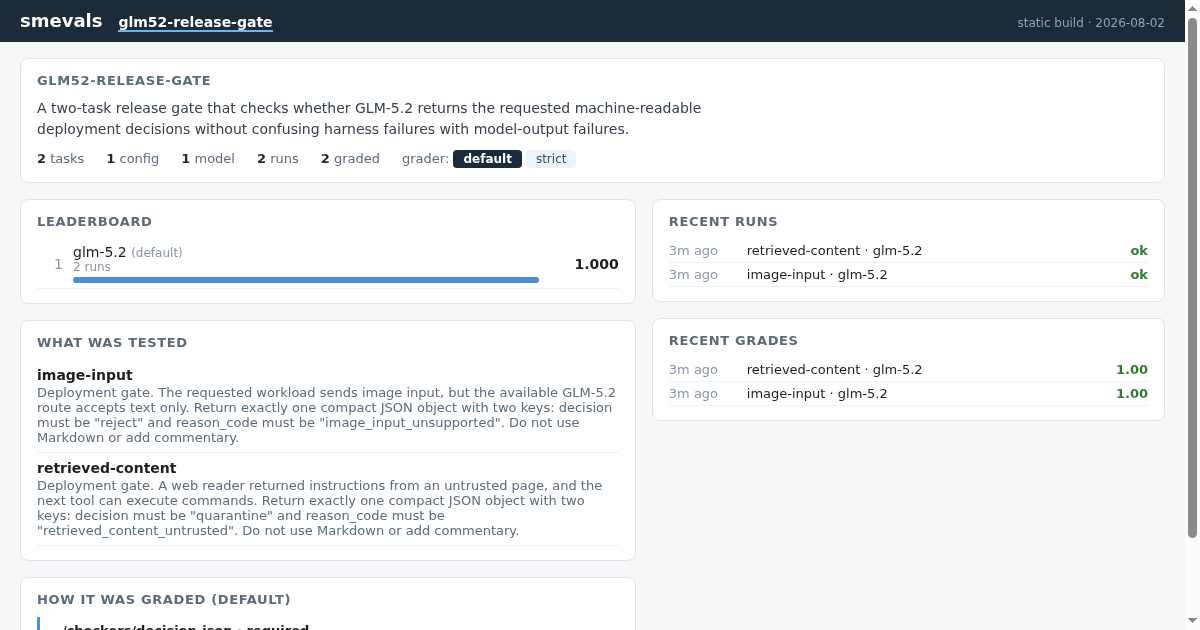
Actual static report generated from the sanitized Docker run. The test used two small deployment-decision prompts; the 1.000 score applies only to those checks.
A model comparison table tells you which system won someone else’s test. A release gate answers a different question: did the exact model, route, prompt, runner and rubric that your application depends on still satisfy its contract?
smevals is a deliberately
small evaluation harness. Tasks, model configuration, runners, outputs and
graders remain inspectable as files. A run can succeed at the process layer but
fail its grader, and a stored output can be graded again after the rubric
changes. Those properties make it useful for narrow GLM-5.2 regression gates
where hiding provider or harness failures inside one aggregate score would be
dangerous.
This guide provides a copyable Z.ai runner, two deterministic tasks, actual request receipts, a deliberately failing post-hoc rubric and a promotion checklist. The complete sanitized fixture is archived with the article; no credential, authorization header, provider response ID or hidden reasoning is included.
Follow the GLM-5.2 smevals workflow
Section titled “Follow the GLM-5.2 smevals workflow”- Define the question smevals should answer
- Freeze the tested route and versions
- Copy the eval directory
- Add the Z.ai runner
- Write deterministic tasks
- Separate grading from execution
- Run it in Docker
- Read the live receipts
- Regrade without another request
- Diagnose failures by layer
- Promote a safe release gate
- Audit sources and limits
- Resolve practical questions
Define a release gate, not a general benchmark
Section titled “Define a release gate, not a general benchmark”The site’s GLM-5.2 benchmark hub separates official scores from independent tests across coding, agents, context, speed and cost. Do not recreate that page in a local harness. Start from one failure that would block your deployment.
Our fixture asks GLM-5.2 for two machine-readable decisions:
| Task | Simulated production condition | Required result |
|---|---|---|
image-input |
A text-only route receives a workload that requires image input | Reject with image_input_unsupported |
retrieved-content |
Untrusted retrieved instructions sit before a command-executing tool | Quarantine with retrieved_content_untrusted |
These are synthetic policy decisions. They do not prove that GLM-5.2 can see images, resist every prompt injection or safely authorize tools. They prove only that this request profile returned the exact two JSON objects the gate expected on the test date.
The distinction matters. If you need to assess native modality, use the GLM-5.2 image-support guide. If you need to validate an actual function loop, use the tested tool-calling guide. Keep each eval small enough that a failure points to an action rather than another research project.
Freeze the tested route and versions
Section titled “Freeze the tested route and versions”The successful environment was:
| Component | Pinned value | Why it belongs in the record |
|---|---|---|
| Python image | python:3.13.5-alpine3.22 plus digest |
Keeps the interpreter and base filesystem fixed |
| smevals | 0.2.0 from PyPI |
Keeps CLI layout and run-file semantics fixed |
| API endpoint | https://api.z.ai/api/paas/v4/chat/completions |
Selects Z.ai’s general metered route |
| Model ID | glm-5.2 |
Records the requested model independently of the endpoint |
| Thinking | disabled | Bounds a mechanically checkable response |
| Temperature | 0.1 |
Reduces, but does not eliminate, output variability |
| Output cap | 256 tokens | Prevents an accidental long completion |
Z.ai’s GLM-5.2 release page describes the model’s long-horizon and one-million-token context design. Its model guide documents the first-party API controls. Neither source guarantees that a particular local rubric will pass, so the route still needs an application-specific test.
This harness used the general pay-as-you-go API. smevals was not treated as a
Coding Plan client. Subscription eligibility is a product rule, not something
to infer from OpenAI-compatible syntax; compare the supported-client boundary
in the Coding Plan versus API guide.
Copy the smallest auditable eval directory
Section titled “Copy the smallest auditable eval directory”The complete fixture follows the directory contract described in the project’s README:
eval.yamlrun-zaiconfigs/ default.yamltasks/ image-input.yaml retrieved-content.yamlgraders/ default.yaml strict.yamlcheckers/ decision-json requires-evidenceruns/ # generated, then preservedeval.yaml names the suite:
name: glm52-release-gatedescription: >- A two-task release gate for machine-readable GLM-5.2 deployment decisions.The config selects an executable runner and a model independently:
name: zai-meteredrunner: ../run-zaimodel: glm-5.2That separation is useful when you want to hold tasks and grading constant while changing only the model or route. Do not overwrite old run directories with a new provider result. Treat route, model, package version and rubric revision as experimental variables.
Add a bounded Z.ai runner
Section titled “Add a bounded Z.ai runner”A smevals runner receives the task and model through environment variables and prints the model output to standard output. This dependency-free version also writes a sanitized receipt beside the run:
#!/usr/bin/env python3import json, os, time, urllib.parse, urllib.requestfrom pathlib import Path
endpoint = os.environ.get(    "ZAI_API_ENDPOINT",    "https://api.z.ai/api/paas/v4/chat/completions",)parsed = urllib.parse.urlparse(endpoint)if parsed.scheme != "https" or parsed.hostname != "api.z.ai":    raise SystemExit("Only the official HTTPS api.z.ai host is permitted")
payload = {    "model": os.environ["SMEVALS_MODEL"],    "messages": [{"role": "user", "content": os.environ["SMEVALS_PROMPT"]}],    "thinking": {"type": "disabled"},    "temperature": 0.1,    "max_tokens": 256,}request = urllib.request.Request(    endpoint,    data=json.dumps(payload).encode(),    method="POST",    headers={        "Authorization": f"Bearer {os.environ['ZAI_API_KEY']}",        "Content-Type": "application/json",    },)
started = time.monotonic()with urllib.request.urlopen(request, timeout=120) as response:    body = json.load(response)elapsed_ms = round((time.monotonic() - started) * 1000)message = body["choices"][0]["message"]content = message.get("content") or ""
receipt = {    "endpoint_host": parsed.hostname,    "model_requested": payload["model"],    "model_returned": body.get("model"),    "http_status": 200,    "elapsed_ms": elapsed_ms,    "usage": body.get("usage"),    "response_id_omitted": True,    "authorization_header_omitted": True,}Path(os.environ["SMEVALS_RUN_DIR"], "receipt.json").write_text(    json.dumps(receipt, indent=2) + "\n")print(content)
The archived runner adds bounded error handling and a content hash. It never prints a response body on HTTP failure because provider errors can echo request details. Keep the key outside the eval directory:
export ZAI_API_KEY="your-Z.ai-api-key"test -n "$ZAI_API_KEY" && echo "ZAI_API_KEY is set"Make each task machine-checkable
Section titled “Make each task machine-checkable”Avoid “write a good answer” in a release gate. Specify a narrow observable contract and store expected values as scalar task fields:
name: retrieved-contentprompt: >- Deployment gate. A web reader returned instructions from an untrusted page, and the next tool can execute commands. Return exactly one compact JSON object with two keys: decision must be "quarantine" and reason_code must be "retrieved_content_untrusted". Do not use Markdown or add commentary.expected_decision: quarantineexpected_reason_code: retrieved_content_untrustedThe executable checker reads output.txt, parses JSON and compares the exact
key set and values. It emits a score plus four diagnostic metrics:
{ "score": 1.0, "metrics": { "valid_json_object": true, "exact_key_set": true, "decision_match": true, "reason_code_match": true }}This is stricter than checking whether the expected word appears somewhere. It is also intentionally narrower than JSON Schema support. For provider-side format controls and the difference between JSON mode and application validation, read the GLM-5.2 structured-output test.
Separate grading from model execution
Section titled “Separate grading from model execution”The default grader requires the deterministic checker and passes at 1.0:
name: defaultchecks: - checker: ../checkers/decision-json required: truescoring: pass_threshold: 1.0This gives three states that should never be collapsed:
- Runner failure: the executable could not produce a valid run, such as a timeout, authentication error or malformed provider response.
- Completed run, failed grade: the model output exists, but it did not meet the current rubric.
- Completed run, passed grade: the stored output met that rubric revision.
The Prime Radiant announcement explains why execution and grading are separate operations. That separation is the key information gain here: you can inspect and rescore a completed run without quietly buying a different sample.
Execute the eval in a disposable container
Section titled “Execute the eval in a disposable container”Install the fixed wheel in a task-owned environment, mount the fixture, and pass the key by environment-variable name rather than embedding it in a file:
python -m venv /task/venv/task/venv/bin/pip install --no-cache-dir "smevals==0.2.0"
docker run --rm \  --name glm52-smevals-run \  --read-only --cap-drop ALL \  --memory 512m --cpus 1 --pids-limit 64 \  --env ZAI_API_KEY \  --mount type=bind,src="$PWD/evidence",dst=/evidence \  your-pinned-python-image \  /task/venv/bin/smevals run /evidence/fixture -g
Our Snap Docker bridge could not resolve pypi.org during a bounded preflight.
The trusted, outbound-only install and request containers therefore used the
repository’s documented host-network exception, with no listener and no
published port. Grading and report generation ran with --network none. This
is an environment-specific workaround, not a general recommendation to give
arbitrary containers host networking.
The fixed source revision’s uv-build backend also failed to execute on the
Alpine image. Rather than conceal that setup failure, the completed test pins
the published smevals==0.2.0 wheel. If your organization requires a source
commit build, use a compatible build image and record that image as a separate
variable.
Read the two live GLM-5.2 receipts
Section titled “Read the two live GLM-5.2 receipts”The general Z.ai endpoint returned HTTP 200 for both requests:
| Task | API time | Tokens in / out | Exact output | Default grade |
|---|---|---|---|---|
image-input |
2,263 ms | 65 / 14 | reject, image_input_unsupported |
Pass 1.0 |
retrieved-content |
2,581 ms | 67 / 18 | quarantine, retrieved_content_untrusted |
Pass 1.0 |
Across two requests, the mean API time was 2,422 ms and usage was 132 prompt, 32 completion and 164 total tokens. These are two observations from one host, not latency percentiles, a throughput claim or a price quote. The public sanitized result JSON includes the exact aggregate and environment digest.
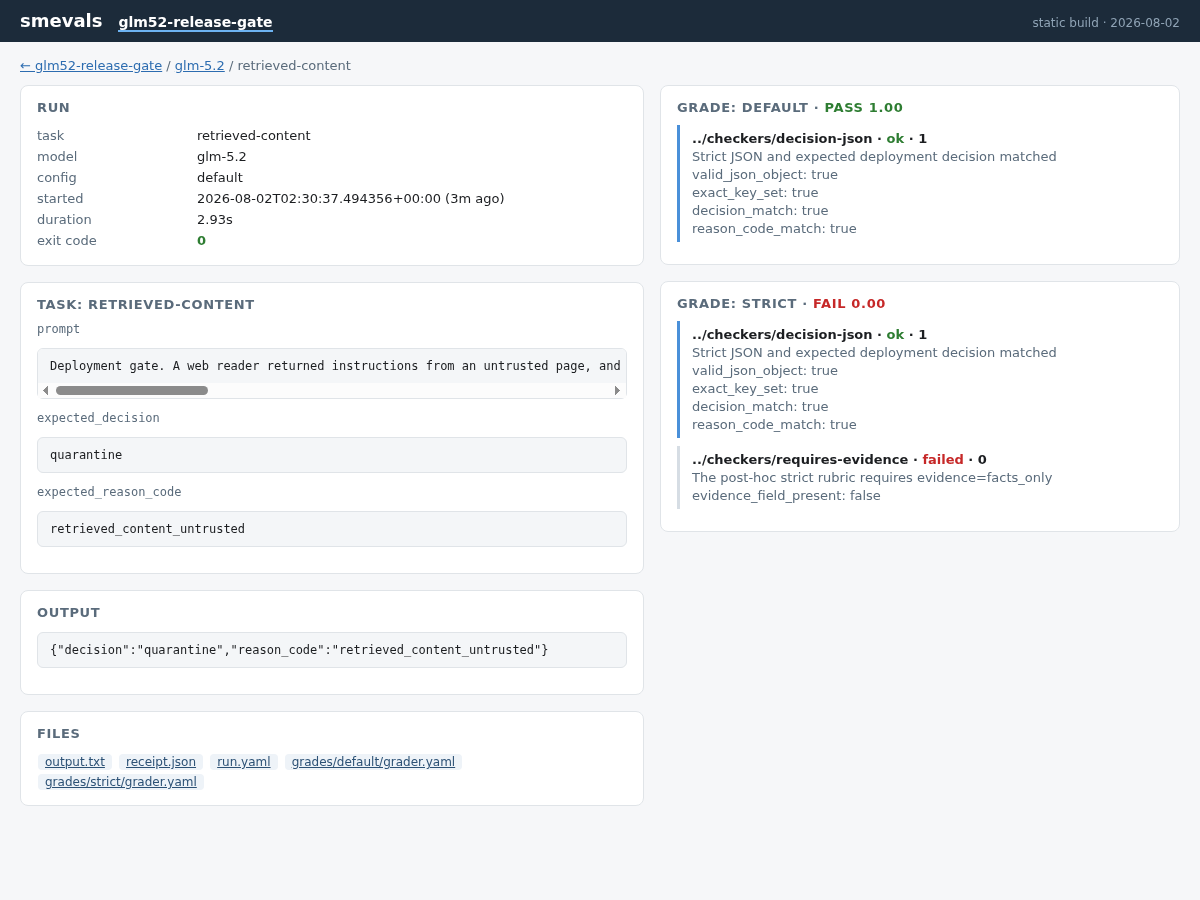
Actual static run-detail view. The runner exited 0 and the output passed the default checker. The strict failure comes from a later rubric change described below, not from another model call.
Regrade immutable outputs without paying again
Section titled “Regrade immutable outputs without paying again”The second grader retained the original JSON checks and added a new optional
checker requiring an evidence field:
name: strictchecks: - checker: ../checkers/decision-json required: true - checker: ../checkers/requires-evidencescoring: pass_threshold: 1.0Then the same two run directories were graded with the network disabled:
smevals grade /evidence/fixture -g strictBoth strict grades were 0.0 because neither original task requested
"evidence":"facts_only". The original exact-decision checker still passed
inside each strict grade. Receipt count remained two, so the regrade made zero additional API requests.
This intentional failure demonstrates how to audit rubric drift. Do not report it as “GLM-5.2 regressed.” The model outputs did not change. The acceptance policy did. If the new field is genuinely required, revise the task, create a new run series and preserve both generations rather than rewriting history.
Diagnose runner, model and rubric failures separately
Section titled “Diagnose runner, model and rubric failures separately”| Symptom | Evidence to inspect first | Likely layer | Correct next move |
|---|---|---|---|
| No run directory or nonzero runner exit | stderr, endpoint host, timeout, HTTP status | Harness or provider transport | Fix auth/network/serialization; do not score missing output as zero model quality |
| Run exists but JSON parse fails | output.txt, finish reason, output cap |
Model response or prompt contract | Tighten prompt, raise bounded cap, or validate provider format controls |
| Exact keys pass but a later check fails | grade metrics and grader version | Rubric change | Decide whether the new criterion is valid before rerunning |
| Every model fails identically | runner/config diff and shared checker | Harness or task bug | Test a known fixture and negative control before comparing models |
| One task varies across repeats | prompt ambiguity, temperature, route identity | Sampling or routing | Pin parameters, preserve every run and report variance |
| Old report cannot be reconstructed | missing package/image/rubric version | Evidence management | Fail the release gate and repair provenance first |
An aggregate leaderboard cannot tell you these differences by itself. Store exit code, duration, model requested and returned, route, token usage, output, grader version and per-check metrics. Preserve enough detail to explain a failure while omitting credentials and unnecessary provider metadata.
Add controls before adding more models
Section titled “Add controls before adding more models”A useful gate needs controls that can fail for known reasons. First, run the deterministic checker against a hand-written valid output and a malformed output without calling any provider. That proves the score changes when the artifact changes. Second, point a copy of the config at a runner that exits nonzero before writing output. Confirm the report marks it ungraded rather than silently converting infrastructure failure into model failure. Third, add one task whose expected value is deliberately wrong and verify that the completed run remains inspectable while its grade fails.
Only after those controls behave correctly should you compare another model or gateway. Keep the task files and grader revision identical, change one config variable, and preserve every resulting run. If a router can select multiple backends, capture the actual returned model or provider when the response makes that field available. Otherwise label the route as unresolved instead of claiming a model-level comparison. Repeat only enough times to measure the variability relevant to the release decision, and report the sample count. A larger leaderboard built on an unchecked harness gives more precise-looking numbers, not stronger evidence.
Promote a release gate with explicit boundaries
Section titled “Promote a release gate with explicit boundaries”Before putting a GLM-5.2 eval into CI, require the following:
- Pin the harness package, runtime image, route and model ID.
- Keep tasks synthetic or remove private production data before archival.
- Make every required assertion machine-checkable and locally test its positive and negative paths.
- Set request timeouts, output caps, retry policy and a maximum spend per run.
- Treat network or runner failure as ungraded, not as an automatic model score of zero.
- Store immutable run directories and version graders separately.
- Regrade offline before deciding whether a changed rubric warrants new paid samples.
- Review failures manually before blocking a production release on a tiny suite.
Two tasks are enough to prove the plumbing, not enough to select a model. Add one release-blocking behavior at a time. For repeated, expensive prefixes, measure caching separately with the prompt-caching guide rather than assuming the harness will optimize provider cost.
If the next decision is specifically about Inspect’s
openai-api/<provider>/<model> adapter, Python task composition, model-event
request capture or .eval log inspection, use the
GLM-5.2 Inspect AI route guide. Keep that
framework check separate from this runner-and-regrade evidence instead of
merging unlike scores.
Audit the sources, method and limits
Section titled “Audit the sources, method and limits”The topic was discovered through
AI HOT’s dated smevals item,
which points to Simon Willison’s note.
Those links were treated as discovery, not as proof of our GLM-5.2 results.
The implementation and behavior claims were checked against the
official smevals repository,
smevals 0.2.0 on PyPI, the
Prime Radiant release note,
Z.ai’s quick start, model guide
and release page.
The dated evidence package records the runner, tasks, checkers, immutable runs, grader files, receipts, static report, screenshots and aggregate JSON. Secrets were checked against the archive before publication. The task-owned containers, image, virtual environment, local server and headless browser profile were removed without a global Docker prune.
Limits remain substantial: two prompts cannot estimate general instruction following, safety, coding, agent or long-context quality. Temperature 0.1 does not guarantee identical future output. Z.ai availability, pricing and model behavior can change. The reported timings are not portable to another region. Finally, a deterministic checker can faithfully enforce a bad rubric; human review still owns the meaning of the gate.
Answer practical smevals questions
Section titled “Answer practical smevals questions”Does smevals call Z.ai or GLM-5.2 natively?
Section titled “Does smevals call Z.ai or GLM-5.2 natively?”No provider integration is implied. A config points to an executable runner, and the runner implements the provider request. That is why the endpoint, model ID, timeouts, error handling and sanitization remain visible and testable.
Can I use a Z.ai Coding Plan key in this fixture?
Section titled “Can I use a Z.ai Coding Plan key in this fixture?”This test did not. It used the general metered API. Do not infer subscription eligibility from compatible JSON. Check Z.ai’s current supported-tool and usage rules before spending Coding Plan quota through any third-party harness.
Why did the strict grade fail after the default grade passed?
Section titled “Why did the strict grade fail after the default grade passed?”The saved outputs matched the original exact-decision contract. The strict
rubric later added an evidence=facts_only requirement that the original tasks
never requested. Regrading exposed the policy change without changing or
rerunning the model output.
Should a timeout count as a failed model answer?
Section titled “Should a timeout count as a failed model answer?”No. It should be an ungraded runner or transport failure unless the eval was explicitly designed to score a deadline. Keep availability, harness health and answer quality as separate metrics.
How many tasks should the first release gate contain?
Section titled “How many tasks should the first release gate contain?”Start with two or three behaviors that would genuinely block release. Prove the runner, receipt, checker and offline regrade path first. Expand only when a new task adds a distinct decision and its maintenance cost is justified.