
GLM-5.2 vs Laguna S 2.1: Which Coding Model Fits?
Independent research — not an official Z.ai publication.Identity and provider disclosure

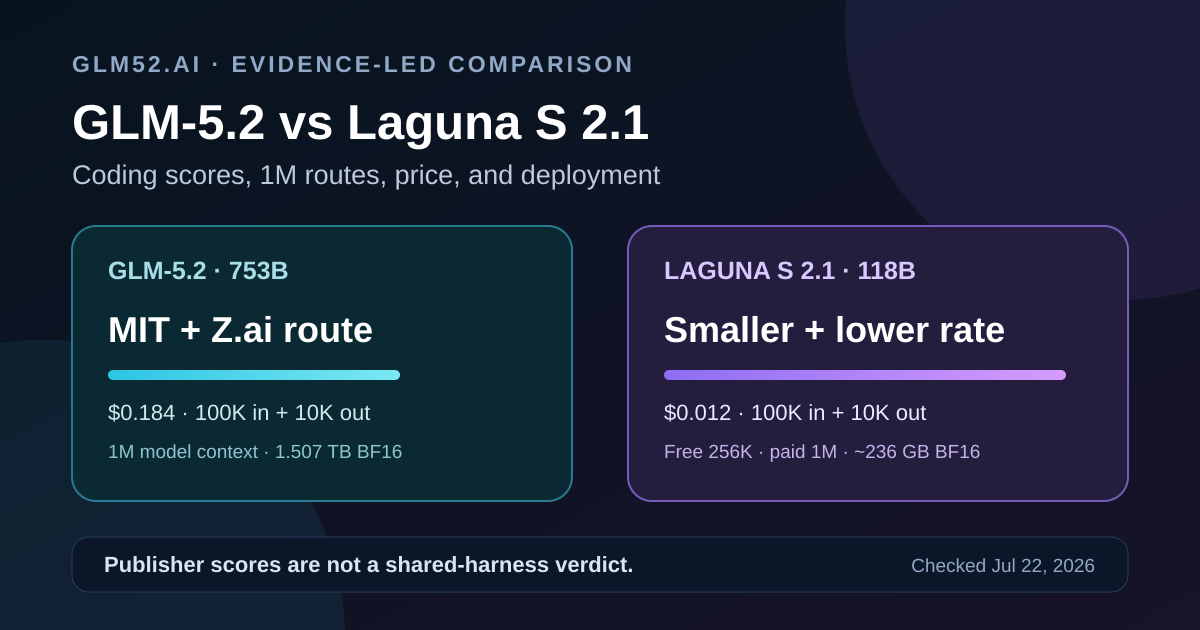
We checked model cards, launch notes, prices, access routes, benchmark methods, and disclosed limitations against current sources on July 22, 2026.
The useful GLM-5.2 vs Laguna S 2.1 question is not whether a 753B model must beat a 118B model. Sparse models activate only part of their weights per token, while agent results also depend on the harness, tool schema, token budget, retries, and verifier. The decision is whether Laguna’s smaller footprint and lower hosted rate outweigh GLM’s MIT license, direct-provider route, and stronger publisher evidence for your own tickets.
This page keeps four evidence layers separate:
- current facts from Z.ai, Poolside, Hugging Face, and the named access provider;
- publisher benchmark claims, with different harnesses left visible;
- reproducible cost and checkpoint-size calculations;
- workload guidance inferred from those facts.
GLM52.ai did not buy both APIs or run a controlled model bake-off for this article. We do not relabel provider trajectories as an independent test.
In this comparison
Section titled “In this comparison”- The decision in 30 seconds
- Facts that change the choice
- Why the public coding scores need labels
- Hosted cost: a 15.33× sample gap
- One-million context is route-specific
- Checkpoint size and license are separate gates
- Reasoning and tool-call failure modes
- Access through OpenCode and APIs
- Choose by constraint, not model size
- Run a shared-harness coding pilot
- Questions before switching
- Sources and method
The decision in 30 seconds
Section titled “The decision in 30 seconds”Laguna S 2.1 is the lower-cost and smaller-footprint first test. Poolside publishes a 118B-total, roughly 8B-active model, while its dedicated OpenRouter endpoint is listed at $0.10 per million input tokens and $0.20 per million output tokens. The BF16 weights are about 236 GB. That is still a multi-GPU artifact, but it is far below GLM’s official 1.507 TB BF16 repository total.
GLM-5.2 is the license- and direct-route-first test. Its official checkpoint uses MIT, Z.ai operates the named API and Coding Plan, and its model card reports higher values on SWE-bench Pro, DeepSWE, and Terminal-Bench 2.1. Those scores came from different scaffolds than Poolside’s rows, so they establish a test order rather than a guaranteed quality gap.
Apply these hard gates before comparing prose quality:
- Need a standard MIT checkpoint? Start with GLM-5.2.
- Need the smaller full checkpoint? Start with Laguna S 2.1.
- Need a metered hosted route at the lowest listed token rate? Start with Laguna.
- Already standardized on Z.ai Coding Plan or direct API controls? Start with GLM.
- Need image input in the base request? Neither qualifies; use a vision route instead.
- Need tool calls that survive several third-party harnesses? Test both, with extra negative cases for Laguna’s documented schema limitations.
Facts that change the choice
Section titled “Facts that change the choice”| Decision factor | GLM-5.2 | Laguna S 2.1 | Operational consequence |
|---|---|---|---|
| Publisher | Z.ai | Poolside | Different API, support, policy, and release channels |
| Total parameters | About 753B | 118B | Total size drives download and weight-memory requirements |
| Base modality | Text to text | Text to text | Screenshots need a separate vision component |
| Advertised model context | 1,048,576 tokens | 1,048,576 tokens | Endpoint limits can still be lower |
| Fresh input / MTok | $1.40 on Z.ai | $0.10 on dedicated OpenRouter route | Provider and SLA are not held constant |
| Cached input / MTok | $0.26 | $0.01 | Cache eligibility must be measured, not assumed |
| Output / MTok | $4.40 | $0.20 | Long reasoning can dominate the bill |
| Thinking controls | Off, high, or max routes documented | Off or max at release | Effort labels cannot be mapped one-to-one |
| Official BF16 weight size | 1.507 TB in repository files | Roughly 236 GB | Both need headroom beyond raw weights |
| License | MIT | OpenMDW-1.1 plus responsible-use terms | Legal review cannot treat “open” as one license |
| Named hosted paths | Z.ai API and Coding Plan | OpenRouter, Baseten, Vercel AI Gateway | Availability and data terms follow the chosen endpoint |
| Named coding tools | OpenCode, Claude Code, ZCode, others | OpenCode, Kilo, Hermes, pi, Cline, others | Tool availability does not prove equal context or reliability |
The prices above were visible on July 22. A subscription, free endpoint, gateway, or self-hosted cluster has a different cost shape. Recheck the selected route before procurement.
Why the public coding scores need labels
Section titled “Why the public coding scores need labels”The closest same-name rows come from the two publishers, not a neutral evaluator running one prompt and scaffold:
| Coding benchmark | GLM-5.2, Z.ai model card | Laguna S 2.1, Poolside release | Comparability limit |
|---|---|---|---|
| SWE-bench Pro, public dataset | 62.1% | 59.4% | GLM used OpenHands with a tailored prompt; Laguna used its Pool/Harbor setup |
| DeepSWE | 46.2% | 40.4% | GLM used mini-swe-agent; Laguna used its internal Harbor fork and pool harness |
| Terminal-Bench 2.1 | 81.0% with Terminus-2 | 70.2% | Different agent harnesses, budgets, and execution settings |
GLM leads these rows by 2.7, 5.8, and 10.8 points. The arithmetic is accurate; a universal ranking would not be. Z.ai documents its context budgets, sampling, timeouts, sandboxes, and harnesses in model-card footnotes. Poolside discloses its internal Harbor fork, up to 500 steps, multiple attempts, sandbox rules, and downloadable final trajectories.
Poolside also warns that its cross-model table takes the maximum reported score from vendor, benchmark-author, or third-party sources. Its own DeepSWE score uses pool rather than the benchmark leaderboard’s mini-swe-agent harness. That is an unusually useful disclosure because it prevents a clean-looking table from becoming fake experimental control.
The defensible inference is: GLM deserves the first quality run when publisher coding evidence is the deciding signal; Laguna deserves a serious efficiency run because it stays close at much lower model and API scale. Only a shared test on your repositories can convert that hypothesis into a routing rule.
For more provenance labels and reusable prompts, use the GLM-5.2 benchmark hub.
Hosted cost: a 15.33× sample gap
Section titled “Hosted cost: a 15.33× sample gap”Z.ai’s price table lists GLM-5.2 at $1.40 fresh input, $0.26 cached input, and $4.40 output per million tokens. Poolside’s release lists its dedicated paid OpenRouter endpoint at $0.10 input, $0.20 output, and $0.01 cache read.
For 100,000 fresh input tokens and 10,000 output tokens:
GLM-5.2 = 0.10 × $1.40 + 0.01 × $4.40 = $0.184Laguna S 2.1 = 0.10 × $0.10 + 0.01 × $0.20 = $0.012Laguna costs 93.5% less, or GLM costs 15.33× as much, for this equal-token shape.
When all 100,000 input tokens qualify for the documented cache-read rate:
GLM-5.2 = 0.10 × $0.26 + 0.01 × $4.40 = $0.070Laguna S 2.1 = 0.10 × $0.01 + 0.01 × $0.20 = $0.003Laguna costs 95.7% less, or GLM costs 23.33× as much, in the full-cache-read example.
This is a token-rate comparison across two providers. It does not equalize tokenization, completion length, cache creation, rate limits, failed tool calls, data policy, support, or accepted-task quality. Poolside’s own chart shows why output length matters: max thinking raised mean Terminal-Bench completion tokens from about 80K to 129K while lifting its score from 60.4% to 70.2%. More reasoning can buy more solved tasks and more tokens at the same time.
Budget against this quantity:
cost per accepted task = all input + cache + output + retries + tool/runtime fees + review + repairOur GLM-5.2 cost calculator helps model the GLM side. Put actual Laguna usage and accepted-result counts beside it rather than multiplying the list price by an imagined fixed completion.
One-million context is route-specific
Section titled “One-million context is route-specific”Both model cards advertise 1,048,576 tokens, but access products can expose less. Poolside states that OpenRouter’s free endpoint offers 256K context, while the dedicated paid deployment provides the full 1M. The release names OpenCode as a supported tool, yet it does not say that every free OpenCode route inherits the paid endpoint’s 1M allowance.
That distinction matters because the discovery post combined “free,” “OpenCode,” and “1M” in one short announcement. Treat the model ceiling, provider endpoint, and client configuration as three separate limits:
usable context = min(model ceiling, provider limit, client budget)A 1M request can also fail economically before it fails technically. Long prefill increases latency; KV cache consumes accelerator memory; output and repair loops can dominate cost. Neither publisher’s 1M statement proves that a model will retrieve the right constraint from a million-token repository dump.
Test at 32K, 128K, 256K, and the largest route you intend to buy. Plant conflicting facts near the beginning and end, ask for file-and-line citations, and verify every cited location. Log truncation and context-compaction events.
Checkpoint size and license are separate gates
Section titled “Checkpoint size and license are separate gates”GLM’s official BF16 repository totals 1.507 TB. Poolside estimates roughly 236 GB for Laguna BF16. Dividing those file figures gives 6.39×. The ratio is useful for first-pass capacity planning, but neither number includes KV cache, runtime buffers, allocator headroom, concurrent sequences, or redundancy.
Laguna provides FP8, NVFP4, INT4, and GGUF variants. Poolside says the optimized model can run on a single DGX Spark, while its BF16 card still calls for multiple GPUs. GLM also provides an official FP8 checkpoint, but at 755.6 GB it remains a datacenter-scale artifact. Read our GLM-5.2 local hardware guide before turning “open weights” into a workstation plan.
The licenses create another boundary:
- GLM-5.2’s official checkpoint is MIT.
- Laguna S 2.1 uses OpenMDW-1.1, and Poolside directs users to its Acceptable Use Policy and safety guidance.
Poolside describes commercial and non-commercial use and modification. That does not make OpenMDW text identical to MIT or remove product-policy review. Check redistribution, modifications, prohibited uses, downstream notices, and the exact serving provider’s terms with counsel.
Reasoning and tool-call failure modes
Section titled “Reasoning and tool-call failure modes”GLM documents thinking off plus high and max effort paths. Laguna launched with two choices: no thinking or max thinking, enabled by default. Poolside says Laguna works best when prior reasoning_content is preserved between tool calls; dropping those blocks can change later reasoning behavior.
Laguna’s release also names three failure modes worth putting into acceptance tests, beginning with tool-schema overfitting:
- It can overfit to a remembered tool interface and initially ignore a slightly different third-party schema.
- Nested tool arguments, especially JSON arrays, can be escaped incorrectly or become invalid JSON.
- Max thinking can continue longer than expected before productive action.
Poolside says a rejected invalid call can often be corrected through in-context feedback. That is useful recovery behavior, but it still consumes latency and tokens. Measure first-call validity, retry count, argument fidelity, and whether the agent verifies the tool result.
The absence of an equivalent warning in GLM’s launch material is not evidence that GLM never makes malformed calls. Give both models adversarial schemas: renamed required fields, arrays of patch operations, optional booleans, Unicode paths, large outputs, timeouts, permission denials, and a tool that returns a plausible error inside HTTP 200.
Access through OpenCode and APIs
Section titled “Access through OpenCode and APIs”Both publishers name OpenCode. The paths are not interchangeable:
- GLM can use Z.ai Coding Plan or metered API credentials, with the endpoint and model mapping described in our verified GLM-5.2 OpenCode setup.
- Laguna can use its hosted OpenRouter route or a compatible self-hosted endpoint. Confirm whether the selected model suffix is free or paid and inspect the effective context limit.
- A free model route may have lower limits, weaker availability, or different training/data terms. Do not send proprietary repositories until the endpoint policy is approved.
Do not stop at a model selector. Ask the agent to read a sentinel file, call one harmless tool, modify a disposable fixture, run its test, and report the loaded model plus endpoint. A successful config parse is not proof that the intended model served the request.
Choose by constraint, not model size
Section titled “Choose by constraint, not model size”Choose Laguna for a low-rate coding pilot
Section titled “Choose Laguna for a low-rate coding pilot”Start with Laguna when metered cost, a smaller checkpoint, or cheap long-horizon experimentation dominates. Its publisher publishes final trajectories, known tool limitations, and thinking-token tradeoffs that make an evaluation easier to audit. Keep the free 256K route separate from the paid 1M route.
Choose GLM for MIT and the Z.ai stack
Section titled “Choose GLM for MIT and the Z.ai stack”Start with GLM when a standard permissive license, direct Z.ai access, mature Coding Plan workflow, or the stronger current publisher rows are procurement gates. Its much larger weight footprint can make the API or subscription preferable to self-hosting.
Route after measuring accepted work
Section titled “Route after measuring accepted work”A two-model policy may be cheaper than a winner-take-all decision. Send bounded, test-rich tickets to Laguna; escalate tasks that fail twice or cross a risk threshold to GLM; and keep license-sensitive self-hosted work on the approved checkpoint. Reverse that order when existing Z.ai integration removes more engineering cost than Laguna’s token discount saves.
Record model, endpoint, context limit, reasoning mode, tool schema version, prompt tokens, output tokens, retries, wall time, test result, and human acceptance. Without those fields, a routing rule cannot explain its own bill or regressions.
Run a shared-harness coding pilot
Section titled “Run a shared-harness coding pilot”Use 20 representative tasks across languages and repository sizes. Include bug localization, cross-file refactoring, dependency installation, a terminal-only task, a malformed-tool recovery case, and one long-context retrieval task. Freeze repository commits and run each model at least three times in randomized order.
Use a prompt contract such as:
Goal: <one acceptance outcome>Repository commit: <immutable SHA>Allowed tools: <exact schemas and permissions>Forbidden actions: network, secrets, destructive commandsRequired checks: <commands and exit codes>Completion proof: changed files, diff summary, test output, unresolved risksBudget: <wall time, tool calls, output tokens, maximum retries>Keep four result layers:
| Layer | Minimum record |
|---|---|
| Request | Model slug, endpoint, prompt hash, context limit, effort |
| Execution | Tool calls, invalid arguments, retries, timeouts, files changed |
| Verification | Test commands, exit codes, independent evaluator, security scan |
| Economics | Input, cached input, output, provider fees, review minutes |
Score exact test pass, accepted result, unsafe action, schema-valid tool calls, median completion time, and cost per accepted task. Keep failed trajectories. Excluding failures turns reliability problems into invisible “outliers.”
Questions before switching
Section titled “Questions before switching”Is Laguna S 2.1 better than GLM-5.2 for coding?
Section titled “Is Laguna S 2.1 better than GLM-5.2 for coding?”Not established. GLM has higher current publisher rows on three same-name coding benchmarks, while Laguna uses a smaller checkpoint and much lower hosted token price. Different harnesses prevent a controlled ranking. Run both on the same tickets and acceptance tests.
Is Laguna’s free OpenCode route a full 1M context?
Section titled “Is Laguna’s free OpenCode route a full 1M context?”Poolside documents a 256K free OpenRouter endpoint and a dedicated paid endpoint with the full 1M context. OpenCode availability does not override that provider distinction. Inspect the effective model route before relying on 1M.
Can both models run locally?
Section titled “Can both models run locally?”Yes, both publish weights and serving guidance. Laguna’s roughly 236 GB BF16 checkpoint is far smaller than GLM’s 1.507 TB BF16 files, yet both need additional runtime memory. Quantization reduces weight storage and may change quality.
Are MIT and OpenMDW-1.1 the same kind of open license?
Section titled “Are MIT and OpenMDW-1.1 the same kind of open license?”No. GLM uses MIT; Laguna uses OpenMDW-1.1 and references Poolside’s Acceptable Use Policy. Review the exact text for your distribution and use case instead of relying on an “open-weight” label.
Which one is cheaper through an API?
Section titled “Which one is cheaper through an API?”At the rates checked here, Laguna’s dedicated OpenRouter route is cheaper per token. The 100K-input and 10K-output example is $0.012 for Laguna and $0.184 for GLM. Accepted-work cost can reverse if retries, token use, support, or quality differ enough.
Sources and method
Section titled “Sources and method”Primary and route-specific material checked on July 22, 2026:
- Poolside’s Laguna S 2.1 launch, limitations, access, prices, and evaluation method
- Poolside’s Laguna S 2.1 model card and serving recipes
- Laguna S 2.1 evaluation trajectories
- OpenRouter’s Laguna S 2.1 endpoint page
- Z.ai’s official GLM-5.2 model card and benchmark footnotes
- Z.ai’s GLM-5.2 release and access notes
- Z.ai’s current direct API pricing
- AI HOT discovery item for the OpenCode announcement
AI HOT supplied the discovery lead, not the factual basis for changing claims. We followed the named sources, corrected the free-context implication against Poolside’s release, and recorded the item ID in the dated research note. Prices, free access, context routes, and provider policies can change; recheck them before purchase. The cost examples use decimal million-token rates and do not estimate quality. Benchmark values remain labeled as publisher evidence because no checked source ran both models under one independent harness.