
GLM-5.2 vs Kimi K3: Which Model Should You Choose?
Independent research — not an official Z.ai publication.Identity and provider disclosure

Moonshot launched Kimi K3 on July 16, 2026, one day before this review. Product details can change during launch week. We checked each specification and price against first-party pages on July 17.
The useful version of GLM-5.2 vs Kimi K3 asks one question: which model fits your work? A broad “which model is smarter?” verdict hides cost, input type, agent shell, test coverage, deployment needs, and failure risk.
This review separates four forms of evidence:
- product facts from Z.ai and Moonshot documentation;
- publisher scores from Moonshot’s Kimi K3 launch table;
- arithmetic that you can replace with your token counts;
- selection guidance that follows from those facts.
We did not run an independent model benchmark. We do not present a vendor chart as our own test.
In this comparison
Section titled “In this comparison”- Quick verdict
- Specifications at a glance
- What changed with Kimi K3
- What the benchmark table shows
- Why the test harness matters
- API pricing and task cost
- One-million-token context
- Vision, tools, and reasoning controls
- Open weights and self-hosting
- Limits that can break an agent run
- Which model should you choose?
- How to test both models
- Common questions
- Sources and method
Quick verdict
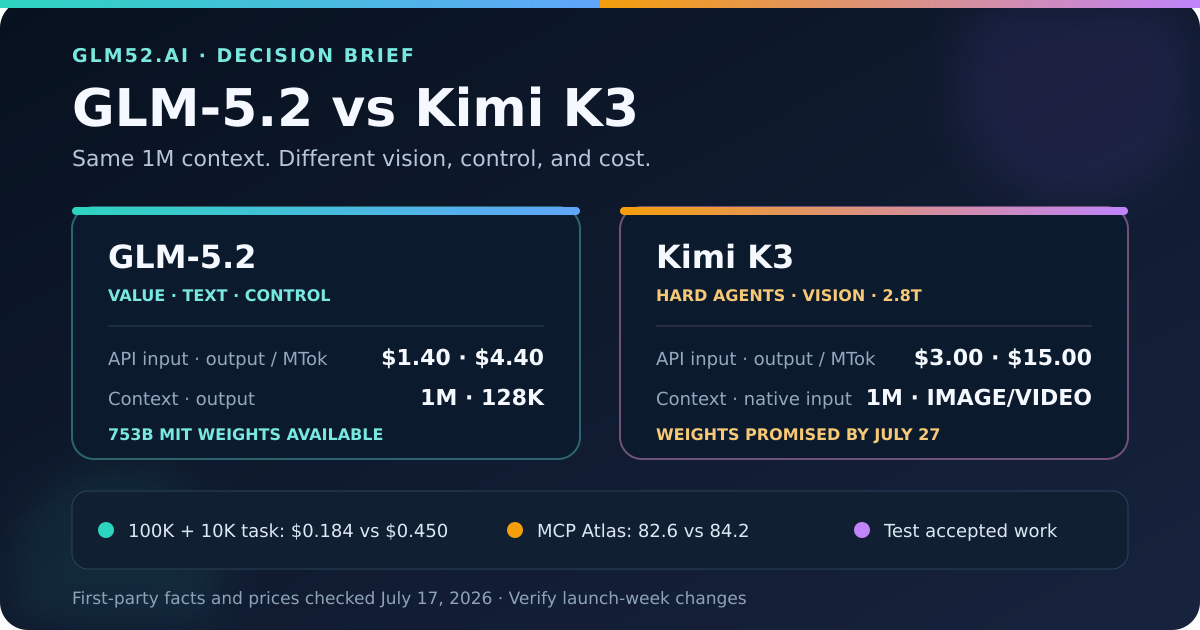
Section titled “Quick verdict”Kimi K3 holds the stronger launch-week capability case. Moonshot’s table gives K3 a lead over GLM-5.2 on every row where both models have a score. K3 accepts images and video, while the base GLM-5.2 API accepts text. Those two facts make K3 the stronger first test for visual frontend work, game creation, document analysis, and hard agent tasks.
GLM-5.2 holds the stronger cost and control case. Z.ai charges $1.40 per million fresh input tokens and $4.40 per million output tokens. Moonshot charges $3 and $15. Z.ai hosts the 753B GLM-5.2 checkpoint under the MIT license now. Moonshot says K3’s 2.8T weights will arrive by July 27.
The result has no universal winner. K3 gives you a higher capability hypothesis. GLM-5.2 gives you a lower-cost production hypothesis. Your acceptance tests decide which hypothesis survives.
Use this starting rule:
- choose Kimi K3 when the task needs pixels, long autonomy, broad judgment, or costly-error control;
- choose GLM-5.2 when tests can catch mistakes and volume, token cost, or deployment control drives the choice;
- use a clean second session when you route a failed GLM task to K3. Kimi warns against a model switch inside an active K3 conversation.
Specifications at a glance
Section titled “Specifications at a glance”| Decision factor | GLM-5.2 | Kimi K3 | What it means |
|---|---|---|---|
| Publisher | Z.ai | Moonshot AI | Separate APIs, policies, regions, and support paths |
| Release date | June 16, 2026 | July 16, 2026 | K3 has one month of release recency |
| Direct API model ID | glm-5.2 |
kimi-k3 |
Both support OpenAI-style chat calls, with model-specific rules |
| Input | Text | Text, image, video | K3 can inspect pixels inside the base model call |
| Output | Text | Text | Both models return text and tool calls |
| Context window | 1,048,576 tokens | 1,048,576 tokens | Capacity matches; recall and agent stability need task tests |
| Completion limit | 131,072 tokens | Up to 1,048,576 within the context budget | A larger limit raises cost and review load |
| Standard API input | $1.40 / MTok | $3.00 / MTok | K3 costs 2.14× the GLM fresh-input rate |
| Cached input | $0.26 / MTok | $0.30 / MTok | The cache-hit rates sit close; cache rules matter |
| Standard API output | $4.40 / MTok | $15.00 / MTok | K3 costs 3.41× the GLM output rate |
| Model scale | 753B parameters | 2.8T parameters | Size affects infrastructure; it does not measure task quality |
| Weights on July 17 | Downloadable, MIT | Moonshot promises release by July 27 | GLM offers a self-host path now |
| Thinking control | On or off; effort choices | Required; max at launch |
GLM gives apps more latency and behavior control |
| Best first test | Volume, text, control | Hard agents, vision, knowledge work | Match the model to the failure cost |
The API limits above describe the direct provider endpoints. A gateway, coding plan, app, or hosted inference service can expose another context limit, rate, feature set, or price.
What changed with Kimi K3
Section titled “What changed with Kimi K3”Moonshot built Kimi K3 around three changes that alter this comparison.
First, K3 combines a 2.8-trillion-parameter mixture-of-experts model with Kimi Delta Attention and Attention Residuals. The model routes each token through 16 of 896 experts. Moonshot says this design gives K3 2.5× the scaling efficiency of Kimi K2. Treat that ratio as a publisher claim, not an independent measurement.
Second, K3 adds native visual understanding. Its API accepts image and video content. A coding agent can inspect a screenshot, change the page, view the result, and repeat the loop. GLM-5.2 needs a separate vision tool or model for that job.
Third, K3 targets long-horizon action. Moonshot shows code, research, presentation, spreadsheet, game, CAD, and chip-design cases. These cases prove that Moonshot built complete demonstrations. They do not prove that your next ticket will finish with the same quality, time, or supervision.
The launch state needs one clear correction: K3 does not offer downloadable weights as of July 17. Moonshot calls K3 an open model and promises the full weights by July 27. Until the files and license arrive, buyers can use the API and Kimi products, but they cannot audit or host the promised checkpoint.
What the benchmark table shows
Section titled “What the benchmark table shows”Moonshot’s launch table gives both models a score on 19 rows across coding, agents, office work, and reasoning. K3 leads all 19 rows. That pattern supports a strong K3 hypothesis. The table does not support a claim that K3 wins every real task.
The rows below show the most useful spread. “Gap” means score points, not a percent gain.
| Benchmark | Kimi K3 | GLM-5.2 | Reported gap | Main caution |
|---|---|---|---|---|
| DeepSWE | 67.5 | 46.2 | K3 +21.3 | Moonshot uses KimiCode for K3; GLM score comes from the GLM release |
| Program Bench | 77.8 | 63.7 | K3 +14.1 | The models use different agent shells |
| Terminal-Bench 2.1 | 88.3 | 82.7 | K3 +5.6 | The table selects strong reported harnesses |
| FrontierSWE | 81.2 | 67.3 | K3 +13.9 | Scores reflect the July 16 leaderboard and distinct stacks |
| SWE-Marathon | 42.0 | 13.0 | K3 +29.0 | Long runs magnify harness and retry effects |
| PostTrain Bench | 36.6 | 34.3 | K3 +2.3 | The gap is small beside run variance risk |
| MCP Atlas | 84.2 | 82.6 | K3 +1.6 | Moonshot states one public set, turn limit, and judge for all models |
| Automation Bench | 30.8 | 12.9 | K3 +17.9 | Scores remain low enough to demand supervision |
| GPQA-Diamond | 93.5 | 91.2 | K3 +2.3 | A knowledge score does not stand in for code-agent reliability |
Three conclusions hold.
- K3 deserves the first test for hard work. The lead covers many task types, not one favorable row.
- The biggest coding gaps appear on long or broad tasks. SWE-Marathon, DeepSWE, and FrontierSWE support K3’s long-horizon position.
- Close rows matter. MCP Atlas, PostTrain Bench, and GPQA show small gaps. Price, speed, control, and error cost can outweigh those gaps.
A score does not equal your pass rate
Section titled “A score does not equal your pass rate”A Terminal-Bench score of 88.3 does not give your next shell task an 88.3% success chance. Each benchmark supplies its own tasks, tools, timeouts, graders, context rules, and security limits. Your repository adds another language mix, test suite, dependency graph, and review standard.
Use public scores to select candidates. Use accepted work to select a default.
Why the test harness matters
Section titled “Why the test harness matters”An agent result comes from more than a model:
accepted result = model + prompt + agent shell + tools + permissions + context policy + effort + retries + time + graderMoonshot’s table mixes KimiCode, Claude Code, Codex, benchmark-owned systems, and cited results. The footnotes disclose much of that mix, which helps readers judge the chart. The mix blocks a clean claim that each gap comes from model weights alone.
The MCP Atlas row offers a stronger comparison signal because Moonshot says all models use the 500-task public set, a 100-turn limit, and Gemini 3.1 Pro as judge. K3 scores 84.2 and GLM-5.2 scores 82.6. The small gap says “test both,” not “ignore cost.”
For a clean internal test, hold files, tools, permissions, stop rules, and graders constant. Let each model use provider-supported settings. Do not force a K3-specific field into GLM or a GLM thinking object into K3 and call the result fair.
API pricing and task cost
Section titled “API pricing and task cost”The direct API list prices create a clear GLM advantage.
| Token type | GLM-5.2 | Kimi K3 | K3-to-GLM rate ratio |
|---|---|---|---|
| Fresh input / MTok | $1.40 | $3.00 | 2.14× |
| Cached input / MTok | $0.26 | $0.30 | 1.15× |
| Output / MTok | $4.40 | $15.00 | 3.41× |
For a task with 100,000 fresh input tokens and 10,000 output tokens:
GLM-5.2 = 0.10 × $1.40 + 0.01 × $4.40 = $0.184Kimi K3 = 0.10 × $3.00 + 0.01 × $15.00 = $0.450K3 costs 2.45× more for that request shape.
If the provider treats all 100,000 input tokens as cache hits:
GLM-5.2 = 0.10 × $0.26 + 0.01 × $4.40 = $0.070Kimi K3 = 0.10 × $0.30 + 0.01 × $15.00 = $0.180Output keeps the total gap wide. Moonshot says its API sees a cache-hit rate above 90% in coding workloads. That figure describes Moonshot’s traffic; it does not promise the same rate for your prompt order and file churn.
One clean K3 run can cost less than three GLM runs
Section titled “One clean K3 run can cost less than three GLM runs”Token price does not equal task price. In the fresh-input example, three GLM attempts cost $0.552. One K3 attempt costs $0.450. K3 wins the bill if it finishes once while GLM needs three equal-size runs.
Use this measure:
cost per accepted result = model spend + tool spend + review and repair cost ----------------------------------------------- accepted outputsK3 needs a real success-rate gain to earn its premium. GLM wins when both models pass the same check with similar supervision.
One-million-token context
Section titled “One-million-token context”Both providers advertise 1,048,576 tokens. The shared capacity removes one easy tie-breaker. It does not establish equal recall, latency, tokenization, or stability across a million-token prompt.
GLM-5.2 caps output at 131,072 tokens. Kimi’s API accepts max_completion_tokens up to 1,048,576, subject to the total context budget. A huge completion can produce a large bill, a long wait, and an artifact that no person can review in one pass. Treat the number as a ceiling, not a target.
Test long context with questions that require evidence from the start, middle, and end of the prompt. Add conflicting names and stale files. Ask the model to cite file paths and line numbers. Then test whether it preserves constraints after tool errors and context compaction.
A curated 100K-token working set can beat a 1M-token repository dump. Give the agent architecture notes, contracts, relevant code, tests, and repository rules first. Add files when the task needs them.
Vision, tools, and reasoning controls
Section titled “Vision, tools, and reasoning controls”K3 and GLM-5.2 expose different control surfaces.
| API behavior | GLM-5.2 | Kimi K3 | Decision impact |
|---|---|---|---|
| Native vision | No; base endpoint uses text | Images and video | K3 fits screenshot and document loops |
| Thinking mode | App can enable or disable it | Required | GLM can serve short tasks with less reasoning |
| Effort | Multiple levels | max at launch |
K3 lacks a low-cost effort level at launch |
| Sampling | API examples expose temperature | Temperature and top-p stay fixed | A migrated app must remove unsupported controls |
| Function tools | Yes | Yes | Tool presence does not prove equal tool choice |
| Tool choice | Function calling and MCP | Required choice and dynamic tool loading | K3 can load tools as the task changes |
| Structured output | Yes | Strict JSON Schema | Both fit typed application output |
| Context cache | Yes | Automatic cache lookup | Stable prefixes help both models |
| Partial response prefix | No matching feature on the checked guide | Supported | K3 can continue from an assistant prefix |
K3 vision has launch constraints. The API does not accept a public image URL. Send base64 data or a Moonshot file ID. Video uses the file path flow. K3’s official web-search tool carries an update warning, so Moonshot does not recommend it for near-term production use.
GLM-5.2 gives teams more control over thinking and sampling. K3 gives teams a richer multimodal and tool-loading surface. Choose the surface your application can use, not the longer feature list.
Open weights and self-hosting
Section titled “Open weights and self-hosting”GLM-5.2 wins the immediate open-weight comparison. Z.ai publishes the 753,329,940,480-parameter checkpoint on Hugging Face under MIT. The files remain huge: our GLM-5.2 local hardware guide measures about 1.5 TB for BF16 and about 756 GB for the official FP8 set before runtime overhead.
Moonshot reports 2.8 trillion parameters for K3. It plans to release full weights by July 27. Moonshot recommends a supernode with 64 or more accelerators for deployment. That guidance places K3 far outside a workstation setup.
Do not translate “open model” into “easy local model.” Ask four separate questions:
- Can you download the exact weights and license?
- Can your inference stack load the architecture and quantization format?
- Can your hardware hold weights, cache, buffers, and concurrent requests?
- Can your team operate the service at a useful speed and uptime?
GLM answers the first question now. K3 does not answer it until Moonshot ships the files and terms. Both models pose a major infrastructure project.
Limits that can break an agent run
Section titled “Limits that can break an agent run”Moonshot publishes two K3 limits that deserve a place near the verdict.
K3 needs its full thinking history
Section titled “K3 needs its full thinking history”K3 expects an agent to return the complete assistant message in later turns, including thinking content. Moonshot warns that a missing history or a mid-session switch from another model can make output quality unstable. Start K3 with a clean session. Keep the returned message intact. Test your agent shell before a production rollout.
K3 can take too much initiative
Section titled “K3 can take too much initiative”Moonshot says K3 may make choices for the user when it meets a small issue or unclear intent. Strong autonomy helps open work, but it raises risk in deployment, finance, data deletion, and permission changes. Put boundaries in the system prompt or AGENTS.md. Require approval for costly or destructive actions.
GLM has another limit: the base model cannot inspect an image. A text extraction tool can bridge some documents, but it cannot replace pixel-level feedback for a frontend or CAD loop. GLM’s open weights demand heavy infrastructure.
Both vendors publish their own benchmark stories. Neither story supplies your service latency, regional capacity, uptime, privacy terms, or support quality. Run an API pilot in the region and account tier you plan to buy.
Launch demand can constrain one purchase layer without taking the direct API offline. Our GLM-5.2 vs Kimi K3 API availability guide separates Moonshot’s new-subscription pause from public API status, vendor error signals, account quota, and tested fallback capacity.
Alibaba’s new preview creates another access question: qwen3.8-max-preview is testable in Token Plan but its plan forbids application backends. Our GLM-5.2 vs Qwen3.8 comparison separates interactive preview access from production API readiness, public pricing, vision, and open weights.
Which model should you choose?
Section titled “Which model should you choose?”Choose Kimi K3 for hard, visual, high-value work
Section titled “Choose Kimi K3 for hard, visual, high-value work”Start with K3 for screenshot-driven frontend repair, game or CAD iteration, image-heavy document analysis, deep research, broad repository change, and long tasks where a failed run costs more than the token premium.
K3 fits cases where an agent must select from a large tool catalog. Dynamic tool loading can keep irrelevant definitions out of the first prompt.
Choose GLM-5.2 for volume, text, and control
Section titled “Choose GLM-5.2 for volume, text, and control”Start with GLM for test-driven code fixes, repository audits, batch transformations, scheduled text agents, and workloads with a clear machine grader. Its lower output rate matters when reasoning traces and tool loops produce many tokens.
Choose GLM when you need downloadable weights now, an MIT license, more provider choice, or thinking controls that match short and long tasks.
Use a two-model route when task difficulty changes
Section titled “Use a two-model route when task difficulty changes”Send bounded, testable work to GLM. Escalate a failed or visual task to K3. Pass a clean brief, selected files, test results, and failure notes into a new K3 session. Do not move the raw GLM conversation into K3.
This route creates a practical split:
- GLM handles low-cost exploration and repeatable execution;
- K3 handles visual inspection, hard recovery, and high-risk judgment;
- your acceptance suite decides when the route ends.
How to test both models
Section titled “How to test both models”Run a small test before you move production traffic.
Pick five tasks with a finish line
Section titled “Pick five tasks with a finish line”Use real work: one bug fix, one cross-file feature, one tool failure, one long-context question, and one visual task if your product needs vision. GLM cannot enter the native-vision row, so record that as a product mismatch rather than a failed intelligence test.
Give each task pass conditions. Examples include passing tests, an unchanged API contract, a cited source count, a pixel-diff threshold, or a valid JSON schema.
Hold the workspace constant
Section titled “Hold the workspace constant”Give both models the same repository snapshot, permissions, tools, time limit, and spending cap. Record each model’s supported effort and sampling fields. Start a new session for each run.
Score accepted work
Section titled “Score accepted work”Track these fields:
| Measure | Why it matters |
|---|---|
| Pass or fail | Keeps the test tied to the task |
| Human corrections | Captures supervision cost |
| Tool errors | Exposes agent-shell fit |
| Input, cache, and output tokens | Produces an auditable API bill |
| Wall time | Captures user wait and queue effects |
| Out-of-scope changes | Measures control risk |
| Cost per accepted result | Joins quality and price |
Choose the default that produces accepted work at the lower total cost. Keep the other model as a route for tasks that need its distinct strength.
Common questions
Section titled “Common questions”Is Kimi K3 better than GLM-5.2?
Section titled “Is Kimi K3 better than GLM-5.2?”Kimi K3 leads all 19 shared rows in Moonshot’s launch table and adds native image and video input. That makes K3 the stronger capability hypothesis. GLM-5.2 costs less, offers downloadable MIT weights, and gives apps more thinking control. Your workload can reverse the practical verdict.
Which model costs less?
Section titled “Which model costs less?”GLM-5.2 costs less at direct provider list rates. Z.ai charges $1.40 for fresh input and $4.40 for output per million tokens. Moonshot charges $3 and $15. For 100K fresh input and 10K output, GLM costs $0.184 and K3 costs $0.450.
Do both models have a 1M context window?
Section titled “Do both models have a 1M context window?”Yes. Both direct API guides list 1,048,576 tokens. The number describes capacity, not equal recall, speed, or agent stability. A third-party endpoint can impose another limit.
Can I run Kimi K3 or GLM-5.2 on local hardware?
Section titled “Can I run Kimi K3 or GLM-5.2 on local hardware?”Z.ai hosts the 753B GLM-5.2 weights under MIT now, but the checkpoint needs server-class hardware. Moonshot says K3 has 2.8T parameters and recommends 64 or more accelerators. It promises K3 weights by July 27, 2026. Neither model fits a normal laptop deployment.
Which model should a coding agent use?
Section titled “Which model should a coding agent use?”Use K3 for hard, long, or visual coding work. Use GLM for high-volume text work with strong tests and cost limits. Run both in the agent shell you plan to deploy because the shell can change the result.
Can an app switch from GLM-5.2 to Kimi K3 inside one conversation?
Section titled “Can an app switch from GLM-5.2 to Kimi K3 inside one conversation?”Avoid that design. Moonshot says K3 depends on preserved thinking history and warns that a mid-session model switch can destabilize output. Start a new K3 session with a clean task brief, relevant files, and failure evidence.
Sources and method
Section titled “Sources and method”Primary sources checked July 17, 2026:
- Kimi K3 technical blog — launch claims, benchmark table, architecture, availability, weight schedule, deployment guidance, and limitations.
- Kimi K3 API guide — context, vision, tools, output limits, reasoning controls, cache behavior, and request rules.
- Kimi K3 API pricing — cache-hit, cache-miss, and output rates.
- GLM-5.2 model guide — context, modalities, tools, output limit, and thinking controls.
- Z.ai API pricing — GLM-5.2 input, cached-input, and output rates.
- GLM-5.2 official model card — parameter count, MIT license, architecture notes, deployment support, and publisher benchmarks.
- Z.ai release notes — GLM-5.2 release date.
We searched the exact comparison query and close variants on July 17, reviewed the leading comparison pages, and checked each decision-changing claim against a first-party page. The benchmark section selects rows from Moonshot’s launch table and keeps its harness cautions. The cost examples use provider list prices and visible arithmetic. Model recommendations remain inferences, not measured universal results.
Kimi K3 launched one day before this review. Recheck its weight release, license, API limits, effort levels, and prices after July 27. We will update this page when first-party facts change.