
GLM-5.2 vs Grok 4.5: Which Model Fits Your Workload?
Independent research — not an official Z.ai publication.Identity and provider disclosure

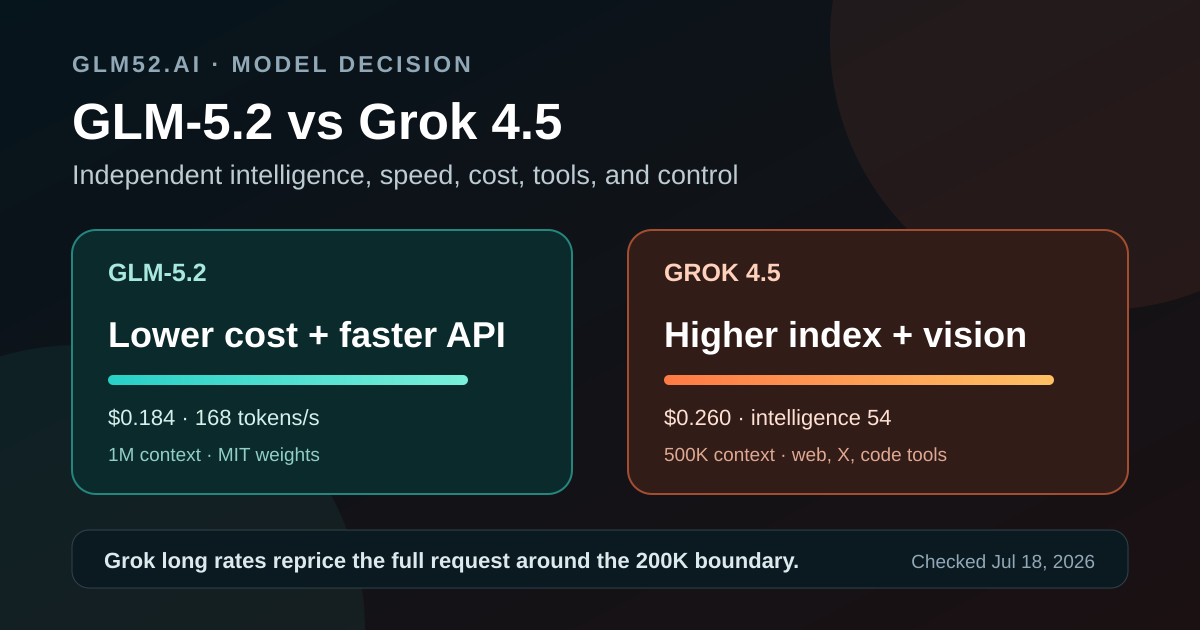
We checked model specifications, prices, launch claims, and independent comparison data on July 18, 2026—two days after xAI’s dated Grok 4.5 launch post.
The useful GLM-5.2 vs Grok 4.5 question is whether Grok’s measured intelligence edge and tools improve accepted results enough to cover its price and latency, or whether GLM’s speed, context, price, and open-weight control fit better.
This article keeps four evidence layers separate:
- documented product facts from xAI and Z.ai;
- publisher benchmark claims from xAI’s launch page;
- independent measurements from Artificial Analysis and a small Composio agent test;
- reproducible cost arithmetic and editorial inferences based on those inputs.
GLM52.ai did not buy either API or run an independent benchmark for this article. The independent results belong to the named publishers, and their configurations and limits travel with the scores.
In this comparison
Section titled “In this comparison”- Quick verdict
- Specifications at a glance
- Independent intelligence and speed
- What the coding benchmarks say
- A small real-account agent test
- Direct API cost comparison
- What changes around 200K prompt tokens
- Acceptance-rate break-even
- Context, images, and tools
- Reasoning and prompt caching
- Weights and deployment control
- Which model should you choose?
- How to test both models
- Common questions
- Sources and method
Quick verdict
Section titled “Quick verdict”Grok 4.5 is the stronger first hypothesis for intelligence-first multimodal agents. Artificial Analysis’s current exact-pair page scores Grok 4.5 at 54 and GLM-5.2 at 51 on Intelligence Index v4.1, with Grok set to high reasoning and GLM to max. Grok also accepts images and xAI documents function calling, web search, X search, and code execution. Those are product-level advantages when the agent must inspect pixels or gather current information.
GLM-5.2 is the stronger first hypothesis for price, response speed, long context, and control. Artificial Analysis measures 168.2 output tokens per second for GLM versus 92.5 for Grok, while its time-to-first-answer-token measurement is 1.56 seconds for GLM and 10.47 for Grok. Z.ai lists lower fresh, cached, and output token prices. GLM also advertises twice the context and publishes its 753B checkpoint under MIT.
Coding evidence requires a private test. xAI’s launch table puts Grok ahead on two shared coding rows. A small Composio test gives GLM one more completed task and lower time, turns, tool calls, and tokens. The tests have different publisher, harness, and routing limits.
Use these hard gates before comparing scores:
- If the base request must accept images, test Grok first.
- If downloadable permissive weights are mandatory, test GLM first.
- If prompts can exceed 500K tokens, Grok’s documented window does not fit; test GLM or reduce context.
- If none is a hard gate, compare accepted results, elapsed time, tokens, and total cost on the same tasks.
Specifications at a glance
Section titled “Specifications at a glance”| Decision factor | GLM-5.2 | Grok 4.5 | Why it matters |
|---|---|---|---|
| Direct API model | glm-5.2 |
grok-4.5; aliases include grok-4.5-latest |
Pin an exact version or dated behavior when reproducibility matters |
| Input | Text | Text and image | Grok can inspect pixels in the base request |
| Output | Text | Text | Neither cited endpoint is an audio or video generator |
| Context window | 1M tokens | 500K tokens | GLM has 2× the advertised capacity |
| Maximum output | 128K | Not stated on the cited xAI model page | Do not infer Grok’s output cap from context size |
| Fresh input / MTok | $1.40 | $2.00 short; $4.00 long | Grok reprices the full long request |
| Cached input / MTok | $0.26 | $0.50 short; $1.00 long | Cache eligibility and routing affect realized cost |
| Output / MTok | $4.40 | $6.00 short; $12.00 long | Agent reasoning and verbose repairs amplify output cost |
| Reasoning | Can be disabled; high or max when enabled | Low, medium, or high; default high; cannot be disabled | Effort labels are not cross-provider equivalents |
| Documented tools | Function calling, MCP, structured output | Function calling, web search, X search, code execution | Tool coverage changes integration work and total cost |
| Checkpoint access | 753B checkpoint published under MIT | No public weights on the cited xAI distribution pages | Determines self-hosting and model-control options |
| Knowledge cutoff | Not stated on the cited GLM guide | February 1, 2026 | Current retrieval still depends on tools |
Independent intelligence and speed
Section titled “Independent intelligence and speed”Artificial Analysis’s exact comparison provides the cleanest available independent signal because both results use its current methodology and first-party API measurements. The checked configuration uses high reasoning for Grok and max for GLM.
| Artificial Analysis measure | Grok 4.5 | GLM-5.2 | Difference |
|---|---|---|---|
| Intelligence Index v4.1 | 54 | 51 | Grok leads by 3 points |
| Output speed | 92.5 tokens/s | 168.2 tokens/s | GLM is 1.82× as fast |
| Time to first answer token | 10.47 seconds | 1.56 seconds | Grok takes 6.71× as long |
Grok produces the higher aggregate intelligence score; GLM returns the first answer token sooner and generates measured output faster. A one-shot research task may value the index edge. Interactive coding or a loop with many short tool turns may value latency more.
The numbers are snapshots that can change with infrastructure, region, load, routing, and method. We use direct provider prices below so each calculation matches a visible request shape.
What the coding benchmarks say
Section titled “What the coding benchmarks say”xAI’s Grok 4.5 launch post publishes two shared coding rows that include a GLM comparison:
| xAI launch table | Grok 4.5 | GLM-5.2 | Reported gap |
|---|---|---|---|
| SWE-bench Pro | 64.7% | 62.1% | Grok +2.6 points |
| DeepSWE 1.1, mini-swe-agent on Datacurve | 53% | 44% | Grok +9 points |
These rows support a Grok-first coding hypothesis, especially for DeepSWE. They remain publisher evidence. xAI says competitor figures come from system cards or leaderboards, so the chart is not proof that both endpoints ran together under one account, region, or token budget.
The GLM result also depends on harness choice. Z.ai’s GLM-5.2 model card reports 62.1 on SWE-bench Pro and 81.0 on Terminal-Bench 2.1 with Terminus-2, plus an 82.7 best-reported Terminal-Bench result under another harness. Agent scaffolding can move the score without changing the base model.
Treat public rows as test-design inputs. Select tasks from your backlog instead of assuming the leaderboard mix transfers.
A small real-account agent test
Section titled “A small real-account agent test”Composio’s Grok versus GLM test offers another angle: 38 real-account scenarios across services such as email, calendars, spreadsheets, and developer tools. The author used the same Claude Code interface and Composio MCP tools, gave each model one attempt, and checked results against the connected accounts.
| Composio’s reported result | Grok 4.5 | GLM-5.2 |
|---|---|---|
| Tasks passed | 36 / 38 (95%) | 37 / 38 (97%) |
| Average time | 164.2 seconds | 101.4 seconds |
| Average turns | 13.7 | 7.1 |
| Average tool calls | 12.7 | 6.1 |
| Average tokens | 508,421 | 320,480 |
In this test, GLM completed one more task while using less time, fewer turns, fewer tool calls, and fewer tokens. That pattern supports the independent latency result and suggests GLM can be the leaner operator in a tool loop.
Thirty-eight one-attempt tasks make a one-task pass gap fragile. Composio authored the test and supplies the tool layer. Grok ran through OpenRouter, while GLM used Z.ai’s Claude Code runtime, so routing was not controlled. Do not insert its token totals into a direct-API budget without the test’s accounting context.
Use this evidence as a reason to record turns, tools, tokens, and verified side effects—not as a reason to declare a universal agent winner.
Direct API cost comparison
Section titled “Direct API cost comparison”Z.ai pricing lists GLM-5.2 at $1.40 fresh input, $0.26 cached input, and $4.40 output per million tokens. xAI pricing lists Grok 4.5 short-context rates of $2 fresh input, $0.50 cached input, and $6 output.
For 100,000 fresh input tokens and 10,000 output tokens:
GLM-5.2 = 0.10 × $1.40 + 0.01 × $4.40 = $0.184Grok 4.5 = 0.10 × $2.00 + 0.01 × $6.00 = $0.260GLM costs 29.2% less, or Grok costs 1.41× as much, for this equal-token request.
If all 100,000 input tokens earn the cached-input rate:
GLM-5.2 = 0.10 × $0.26 + 0.01 × $4.40 = $0.070Grok 4.5 = 0.10 × $0.50 + 0.01 × $6.00 = $0.110GLM costs 36.4% less, or Grok costs 1.57× as much, in the full-cache example. Repeated text does not guarantee a cache hit. Check the provider’s usage fields and cache policy before treating the discount as realized savings.
Equal tokens make the arithmetic comparable, not the agents identical. Tokenization, reasoning, tool results, and retries change the production bill.
What changes around 200K prompt tokens
Section titled “What changes around 200K prompt tokens”xAI uses two descriptions for the boundary. The Grok 4.5 model page says requests exceeding 200K tokens use long-context pricing. The pricing page says the long rate applies once the prompt reaches the threshold. Because those phrases differ at exactly 200K, use a conservative budget boundary and verify account billing for a request that lands on it.
Both pages agree on the important part: a long Grok request is billed at $4 fresh input, $1 cached input, and $12 output per million tokens, and the higher prices apply to the full request—not only the tokens beyond 200K.
For a safely-above-threshold request with 250,000 fresh input and 20,000 output tokens:
GLM-5.2 = 0.25 × $1.40 + 0.02 × $4.40 = $0.438Grok 4.5 = 0.25 × $4.00 + 0.02 × $12.00 = $1.240GLM costs 64.7% less, or Grok costs 2.83× as much, for this equal-token long request. Z.ai’s checked pricing table does not list an equivalent long-context multiplier for GLM. That is a current page observation, not a permanent price guarantee.
Log prompt size before each Grok request. Retrieval, file selection, compaction, or a fresh conversation can avoid carrying low-value history across the boundary.
Acceptance-rate break-even
Section titled “Acceptance-rate break-even”Cost per request matters less than cost per accepted result. If both agents consume the same 100K fresh input and 10K output, Grok costs 1.41× as much. It must therefore deliver a 41.3% relative acceptance-rate improvement to break even on model spend alone.
For example, if GLM passes 60% of tasks, Grok needs an 84.8% pass rate under the same token shape:
60% × ($0.260 ÷ $0.184) = 84.8%For the 250K-plus-20K long request, Grok costs 2.83× as much. If GLM already accepts more than 35.3% of those tasks, no possible pass rate above 100% lets Grok recover the entire token-price gap through acceptance alone.
Native image input may remove a vision call, built-in search may reduce integration work, and a higher-quality result can reduce review or prevent an incident. The equation identifies what must be measured beyond tokens.
Context, images, and tools
Section titled “Context, images, and tools”GLM documents 1M context and 128K maximum output. Grok documents 500K context but does not state a maximum output figure on the cited model page. Context capacity is therefore a clear two-to-one GLM advantage; output-cap parity is not established.
A window limit is not a retrieval guarantee. Test fact retrieval, early constraints, stale-file avoidance, and task completion. Larger prompts also increase bill, latency, and failure surface.
Grok accepts text and image input with text output. GLM-5.2’s cited API guide lists text input and output. A GLM application can call another vision model or an MCP tool, but that is a routed system rather than native pixel input. Our GLM-5.2 image support guide explains the provenance and testing difference.
xAI documents function calling, web search, X search, and code execution. GLM documents function calling, structured output, MCP, streaming, and caching. Hosted tools can remove custom integration while adding fees, policies, latency, and lock-in. Compare the finished agent.
Reasoning and prompt caching
Section titled “Reasoning and prompt caching”Grok 4.5 supports low, medium, and high reasoning effort, defaults to high, and xAI says reasoning cannot be disabled. GLM thinking can be disabled; when enabled, its guide documents high and max. Our GLM-5.2 reasoning guide explains the accepted controls. The labels do not represent shared compute budgets, so do not treat Grok high and GLM high as normalized test settings.
xAI applies prompt caching automatically and recommends prompt_cache_key or x-grok-conv-id for routing affinity. Its prompt caching guide does not guarantee a hit. Put stable content first, then verify cached-token usage.
GLM also documents context caching. Rank both systems using realized hit rate, total request cost, latency, and correctness.
Weights and deployment control
Section titled “Weights and deployment control”GLM-5.2 publishes a 753B-parameter checkpoint under MIT. Teams can download, modify, and serve the weights subject to the license notice. That supports offline operation, data-local deployments, model adaptation, and version control.
The cited xAI pages distribute Grok 4.5 through managed products and gateways and do not publish its weights. This does not make a claim about undisclosed internals or future releases.
Open weights are not low-cost hardware. GLM’s full checkpoint is about 1.5 TB in BF16 and roughly 756 GB in the official FP8 files before runtime overhead. Read the GLM-5.2 local hardware guide before choosing self-hosting on license alone.
Choose deployment control when data locality, offline operation, modification, or reproducible pinning justifies the infrastructure. Choose managed access when tools, operations, and time-to-market matter more.
Which model should you choose?
Section titled “Which model should you choose?”Choose Grok 4.5 for intelligence, images, and xAI tools
Section titled “Choose Grok 4.5 for intelligence, images, and xAI tools”Start with Grok when the three-point independent index lead matches a difficult reasoning task, the agent must inspect images, or web/X/code tools remove integration work. It is also the stronger first hypothesis from xAI’s published SWE-bench Pro and DeepSWE rows.
Watch full-request repricing around 200K prompt tokens. xAI’s docs also said the API console was unavailable to EU users when checked, with access expected later in July; verify regional availability before committing a workflow.
Choose GLM-5.2 for price, speed, context, and MIT weights
Section titled “Choose GLM-5.2 for price, speed, context, and MIT weights”Start with GLM for high-volume text work, latency-sensitive loops, prompts beyond 500K, and deployments that need downloadable permissive weights. It is cheaper in all three equal-token examples and faster in Artificial Analysis’s current output and first-answer measurements.
Route by task when both clear the hard gates
Section titled “Route by task when both clear the hard gates”A practical policy can use both:
- send image-dependent and X-native research tasks to Grok;
- send high-volume, text-only, latency-sensitive tasks to GLM;
- use retrieval before either model instead of filling the whole context window;
- shadow a sample of important tasks through both models;
- promote a model only after tests verify the output and side effects.
How to test both models
Section titled “How to test both models”Select 20 to 50 tasks, including repository repair, cross-file refactoring, long-document retrieval, tool failure recovery, and image inspection if relevant.
Hold these conditions constant where the APIs permit:
- repository commit, selected context, system instructions, and task text;
- tool schemas, permissions, network access, and side-effect approval rules;
- wall-clock, turn, retry, token, and cost limits;
- deterministic acceptance tests and a blinded review rubric;
- logging for cache hits, reasoning/output tokens, tool calls, and failures.
Keep product differences visible. Run the same baseline, then allow a documented model-specific prompt pass. Test one latency-conscious and one quality-first setting for each model.
Rank accepted outputs and severe failures first. Then compare tail latency, tokens, tool cost, corrections, and cost per accepted result.
Common questions
Section titled “Common questions”Is GLM-5.2 cheaper than Grok 4.5?
Section titled “Is GLM-5.2 cheaper than Grok 4.5?”Yes at the direct standard prices checked July 18, 2026. A 100K-fresh-input and 10K-output request costs $0.184 on GLM and $0.260 on Grok. At 250K fresh input and 20K output, Grok’s long rates make the comparison $0.438 versus $1.240.
Is Grok 4.5 better than GLM-5.2?
Section titled “Is Grok 4.5 better than GLM-5.2?”Not for every workload. Grok leads Artificial Analysis’s Intelligence Index 54 to 51 and xAI’s two shared coding rows. GLM leads independent output speed and first-answer latency, costs less, has twice the context, and publishes MIT weights. The correct default depends on accepted results in your system.
Which model is faster?
Section titled “Which model is faster?”Artificial Analysis measured GLM at 168.2 output tokens per second and Grok at 92.5, with first answer tokens at 1.56 and 10.47 seconds. Treat those as dated independent API measurements, not permanent guarantees for every region or provider.
Does Grok 4.5 support images?
Section titled “Does Grok 4.5 support images?”Yes. xAI documents text and image input with text output. GLM-5.2’s base endpoint is text-only, though a product can route images through another model or tool.
Can I self-host both models?
Section titled “Can I self-host both models?”GLM-5.2 publishes MIT-licensed weights and serving examples. The cited xAI Grok 4.5 pages offer managed API and product access and do not publish downloadable weights. GLM self-hosting still requires substantial infrastructure because the checkpoint is 753B parameters.
What happens when a Grok prompt passes 200K tokens?
Section titled “What happens when a Grok prompt passes 200K tokens?”xAI applies the long-context rates to the full request: $4 fresh input, $1 cached input, and $12 output per million tokens. The model and pricing pages differ in wording at exactly 200K, so use a conservative guardrail and verify billing at that edge.
Sources and method
Section titled “Sources and method”Sources checked July 18, 2026:
- Z.ai GLM-5.2 guide — model ID, modalities, context, output, thinking, tools, and caching.
- Z.ai model pricing — fresh input, cached input, and output rates.
- GLM-5.2 model card — checkpoint, license, serving paths, and publisher benchmarks.
- xAI Grok 4.5 launch — July 16 release date, distribution, tools, and publisher coding results.
- xAI Grok 4.5 model page — model ID, aliases, modalities, context, cutoff, prices, and features.
- xAI pricing — short and long rates and full-request repricing.
- xAI reasoning guide — effort values and default behavior.
- xAI prompt caching — automatic caching, routing keys, and cache-hit limits.
- Artificial Analysis exact comparison — independent intelligence, output-speed, first-answer, context, and access measurements.
- Composio agent test — 38-task method, verified results, agent efficiency, and provider-route limitations.
We searched the exact comparison and close variants before drafting. Fresh result pages and developer discussions showed demand around cost, coding, speed, tools, image input, and availability. Community posts informed the questions only; product claims come from first-party pages, while independent results retain their original attribution. No keyword-volume tool was available, so this article makes no monthly search-volume claim.
The cost cases hold billed token counts constant and exclude tax, credits, gateway markups, tools, tokenization differences, retries, review, and infrastructure. The acceptance break-even is mathematical, not measured quality. GLM52.ai did not purchase either endpoint or run a controlled benchmark. The Z.ai link is sponsored; xAI has no commercial relationship with GLM52.ai.