
What Is GLM-5.2? A Plain-English Technical Guide
Independent research — not an official Z.ai publication.Identity and provider disclosure

Specifications, prices, repository metadata, and publisher benchmark results were checked July 15, 2026. Benchmark claims are labeled as publisher evidence, not independent testing by GLM52.ai.
If you keep seeing GLM-5.2 in coding tools, model menus, or “open versus closed AI” debates, the short description can sound contradictory. It is a 753B model, yet only about 40B parameters are active. It has open weights, yet most people will use an API. It accepts one million tokens, yet pasting one million tokens is not automatically good context engineering.
Those statements can all be true. This guide explains what the numbers mean, what GLM-5.2 can actually do, how its architecture reduces some—not all—of the cost of long context, and where the model is a poor fit.
There is also a naming trap. Here, GLM means the General Language Model family introduced in the original GLM research. It does not mean a statistical generalized linear model, and GLM-5.2 is not GPT-5.2 or an OpenAI product.
In this guide
Section titled “In this guide”- GLM-5.2 in one minute
- Who made GLM-5.2, and what does GLM mean?
- Key specifications
- How the architecture works
- What the 1M context window means
- What GLM-5.2 can do
- What the benchmark evidence says
- API pricing and real request cost
- How to access GLM-5.2
- What open weights really mean
- Limitations and common misconceptions
- Who should use it?
- How to evaluate it responsibly
- Frequently asked questions
- Sources and methodology
GLM-5.2 in one minute
Section titled “GLM-5.2 in one minute”GLM-5.2 is the June 2026 flagship in Z.ai’s GLM-5 family. Z.ai positions it for long-horizon tasks: work where a model must keep track of requirements, files, tool results, errors, and decisions across a long sequence rather than answer one isolated prompt.
Its defining facts are:
- Text in, text out. The base GLM-5.2 model is not a native image-input model.
- 1,048,576-token context. This is five times GLM-5.1’s documented 200K context capacity.
- Up to 131,072 output tokens. That is a ceiling, not a sensible default response length.
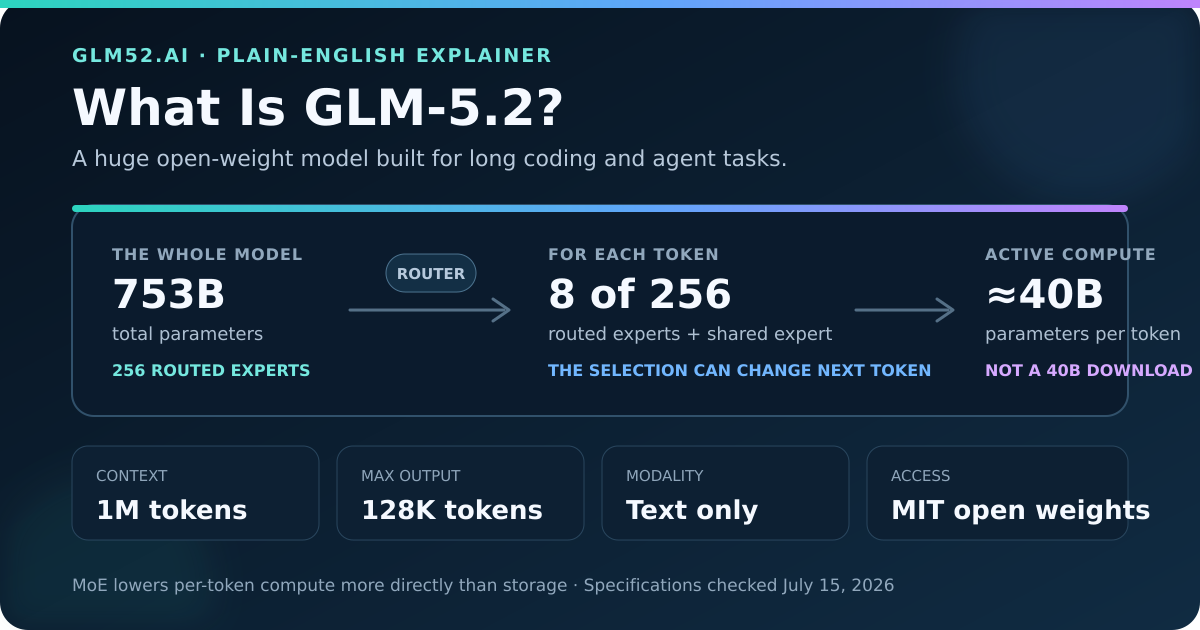
- Mixture-of-experts architecture. The checkpoint contains about 753B parameters, while roughly 40B participate in computing a token.
- Thinking and agent features. The official endpoint supports thinking modes, configurable reasoning effort, streaming, function calling, structured output, context caching, and MCP integration.
- MIT-licensed weights. The checkpoint can be downloaded and deployed outside Z.ai’s API.
- Coding emphasis. Z.ai’s published evaluations focus heavily on repository work, terminal tasks, tool use, and long autonomous engineering.
The practical pitch is not “a chatbot with a huge number.” It is an open-weight text model intended to keep working through large, multi-step engineering problems without paying closed-frontier API rates for every token.
That is a positioning statement, not a universal quality verdict. The model still hallucinates, can misuse tools, can lose important details in long context, and must be tested on the work that will depend on it.
Who made GLM-5.2, and what does GLM mean?
Section titled “Who made GLM-5.2, and what does GLM mean?”GLM-5.2 is developed by Z.ai, the organization that publishes the official API documentation and the zai-org/GLM-5.2 weight repository.
The name GLM comes from “General Language Model.” The original 2021 GLM paper proposed a pretraining framework based on autoregressive blank infilling. The present GLM-5 family has evolved substantially since that early architecture, so the acronym explains the lineage—not every mechanism inside GLM-5.2.
The version number also needs context:
| Name | What it refers to |
|---|---|
| GLM-5 | The 2026 model family and its first flagship release |
| GLM-5.1 | A later long-horizon flagship with a documented 200K context |
| GLM-5.2 | The long-context and coding-focused successor with 1M context |
| GLM-5V-Turbo | A separate vision-language model; not the base GLM-5.2 endpoint |
| GPT-5.2 | An unrelated OpenAI model name |
| Generalized linear model | A statistics concept unrelated to this LLM |
GLM-5.2 builds on the GLM-5 lineage rather than replacing it with an unrelated model. Its visible changes concentrate on usable long context, coding-agent performance, reasoning effort control, sparse-attention efficiency, and speculative decoding.
For the full sequence from the 2021 GLM paper to the current model—and a transparent estimate for the next launch—see the GLM model release history and forecast.
GLM-5.2 key specifications
Section titled “GLM-5.2 key specifications”| Specification | GLM-5.2 | What it means in practice |
|---|---|---|
| Publisher | Z.ai | Official API, model card, pricing, and support come from Z.ai |
| Model type | Decoder-only text-generation MoE | Generates text token by token and routes token computation through selected experts |
| Input modality | Text | Screenshots and images need a separate vision model or preprocessing step |
| Output modality | Text | It can write code for media workflows, but does not natively generate image or video pixels |
| Context length | 1,048,576 tokens | Maximum documented working window on the direct model specification |
| Maximum output | 131,072 tokens | Upper response limit; actual apps or hosts may expose less |
| Published model size | About 753B total parameters | Full expert library is extremely large |
| Active computation | About 40B parameters per token | Sparse routing reduces compute more directly than storage |
| Routed experts | 256, with 8 selected per token | Plus a shared expert, according to the published configuration |
| Reasoning controls | Thinking on/off; effort controls | Lets an application trade latency and output use against deeper work |
| Agent interfaces | Function calling and MCP | Enables a surrounding agent to expose tools; it does not give the raw model automatic internet access |
| Structured output | Supported | Useful for JSON workflows, subject to schema and behavior testing |
| Context caching | Supported | Repeated prompt material can be billed at a lower cached-input rate |
| Weight license | MIT | Broad permission to use, modify, and redistribute the published weights |
| Official API ID | glm-5.2 |
The model name used in Z.ai’s general chat-completions examples |
| Official weight ID | zai-org/GLM-5.2 |
The Hugging Face repository for the BF16 checkpoint |
The limits above describe Z.ai’s direct model surface. A coding subscription, cloud marketplace, gateway, quantized checkpoint, or third-party host can impose different context, output, rate, tool, or availability limits. Always verify the endpoint you will actually call.
How the GLM-5.2 architecture works
Section titled “How the GLM-5.2 architecture works”Three engineering ideas explain most of GLM-5.2’s unusual specification sheet: mixture-of-experts routing, sparse attention with shared indexing, and multi-token prediction.
A 753B model that computes with about 40B at a time
Section titled “A 753B model that computes with about 40B at a time”In a dense model, most model weights participate in computing every token. GLM-5.2 is a mixture-of-experts (MoE) model. Many feed-forward “expert” subnetworks exist, and a learned router selects a small subset for the current token.
The published configuration lists 256 routed experts, selects 8 routed experts per token, and includes a shared expert. These are not 256 human-readable specialist personalities such as “the Python expert” or “the finance expert.” They are learned mathematical subnetworks whose roles emerge during training.
An analogy helps:
753B total parameters = the whole library~40B active parameters = the books opened for this tokenrouter = the catalog choosing which shelves to consult nextThe next token may use a different expert combination. A general-purpose server therefore needs the whole library available even though it does not read every book on every step.
That is why 40B active does not mean 40B of memory. Sparse routing reduces the multiplication performed for one token; it does not shrink the complete checkpoint to a workstation-sized model.
Why some sources say 744B and others say 753B
Section titled “Why some sources say 744B and others say 753B”You will see both numbers. GLM-5 architecture papers and some serving tools use a roughly 744B label. The current official Hugging Face model page reports 753B, and its checkpoint inspector counts about 753.33B parameters. The difference comes from what components and embeddings a particular summary counts and how it rounds—not from two fundamentally different public models.
For hardware planning, labels are less useful than files. The official BF16 index contains 1,506,659,919,872 bytes of tensors: about 1.507 TB in decimal units or 1,403 GiB. The official FP8 checkpoint is about 755.6 GB before runtime buffers, KV cache, the operating system, and serving headroom. Our GLM-5.2 local hardware guide shows the exact capacity math.
IndexShare makes the long-context indexer cheaper
Section titled “IndexShare makes the long-context indexer cheaper”Long context is expensive partly because the model must decide which earlier tokens matter to the current token. DeepSeek Sparse Attention uses a lightweight indexer to select relevant positions before core attention. Running a separate indexer at every layer still becomes expensive at very long sequences.
GLM-5.2 uses a mechanism Z.ai calls IndexShare: one indexer result is reused across groups of four sparse-attention layers. Z.ai says this reduces per-token indexer FLOPs by 2.9× at 1M context.
That wording matters. It does not mean every GLM-5.2 request is 2.9× faster, cheaper, or lower-latency than GLM-5.1. It describes computation in a particular attention component. End-to-end speed also includes expert layers, memory movement, routing, KV cache, batching, network time, and the serving stack.
The related IndexCache paper offers useful scale, but on a different experimental setup: a 30B DSA model at 200K context reached up to 1.82× faster prefill and 1.48× faster single-request decoding after eliminating 75% of indexer computations. Those paper results explain the mechanism; they are not a measured end-to-end GLM-5.2 API latency promise.
Multi-token prediction helps speculative decoding
Section titled “Multi-token prediction helps speculative decoding”GLM-5.2 also improves its multi-token prediction (MTP) layer. Instead of only proposing the next token, an auxiliary prediction path helps a serving system speculate several tokens ahead and verify them. Z.ai reports up to a 20% increase in accepted speculative length.
Again, acceptance length is not identical to 20% lower latency. Real speed depends on how the inference engine implements speculative decoding, request length, batch size, hardware, and whether memory bandwidth or computation is the bottleneck.
What the 1M context window means
Section titled “What the 1M context window means”The direct specification lists 1,048,576 tokens, commonly shortened to 1M. That is five times GLM-5.1’s documented 200K window and large enough to change how a coding or research agent can package evidence.
Possible uses include:
- a repository’s relevant source, tests, documentation, configuration, and task history;
- a long sequence of tool calls and results without aggressive early compaction;
- many related contracts, policies, or research papers in one working set;
- multi-stage migrations where earlier architectural constraints still matter later;
- long research sessions that must preserve citations and unresolved questions.
But capacity is not recall. A model accepting one million tokens does not prove that it will retrieve every fact equally well at every position, maintain every constraint across hundreds of turns, or choose the right evidence from a noisy dump.
A useful long-context evaluation separates at least six questions:
- Does the exact provider accept the documented request size?
- How many tokens does the provider’s tokenizer produce for your code or documents?
- Can the model retrieve the right fact when it appears near the beginning, middle, and end?
- Can it preserve a constraint after many tool calls and failed attempts?
- What are prefill latency and time to first token at realistic prompt sizes?
- What does the request cost, and how much of the stable prefix receives a cache hit?
More context can reduce quality when most of it is irrelevant. Generated files, vendored dependencies, build artifacts, duplicated logs, and stale documentation consume attention and money. A curated 80K-token working set can outperform an unfiltered 800K-token dump.
The best default is progressive context: begin with repository instructions, architecture, contracts, tests, and task-relevant files; add evidence when the model demonstrates a gap. Treat 1M as headroom, not a target.
What can GLM-5.2 do?
Section titled “What can GLM-5.2 do?”Long-running coding and repository work
Section titled “Long-running coding and repository work”The model is designed for work that crosses files and stages: architecture audits, repository issue resolution, migrations, refactors, test-driven debugging, dependency analysis, performance investigation, and implementation from a specification.
Its large context helps an agent carry more repository state, while thinking and effort controls let the application spend more computation on difficult steps. Tool calling lets a surrounding agent read files, edit code, run tests, query services, and inspect failures.
The surrounding system remains decisive. A model without a shell cannot run tests. A shell without permission boundaries can cause damage. A coding benchmark score does not replace a clean worktree, scoped credentials, deterministic checks, review, or rollback.
Tool-driven agents
Section titled “Tool-driven agents”GLM-5.2 supports function calling and MCP integration. In plain terms, an application can describe tools with structured arguments, let the model choose a tool, execute it outside the model, and return the result for another reasoning step.
This enables search, databases, ticket systems, browsers, code execution, internal APIs, or custom business actions. It does not mean the base model automatically knows current information or can reach the internet. Tool availability, permissions, schemas, retries, and audit logs belong to the agent product around it.
Reasoning and structured work
Section titled “Reasoning and structured work”The API supports thinking modes and reasoning_effort, with Z.ai’s examples using max for difficult coding. It also supports structured output for programmatic workflows and streaming for interactive applications.
Thinking is not a guarantee of correctness. Higher effort can increase latency and output-token consumption. Structured output can improve format reliability, but applications should still parse, validate, and reject invalid or unsafe values.
Text-based creative and research workflows
Section titled “Text-based creative and research workflows”The same model can draft specifications, analyze documents, synthesize research, plan products, and write code-driven media such as Remotion projects. When Z.ai demonstrates code-to-video, the model is writing and running video-generation code; the base model is not emitting a native video file from pixels.
What it cannot do natively
Section titled “What it cannot do natively”The base endpoint is documented as text input and text output. It cannot directly inspect a screenshot, design file, chart, photo, or video frame. A separate vision model such as GLM-5V-Turbo, OCR service, or multimodal tool can turn visual evidence into text, but that is a multi-model system with additional latency and failure modes.
What the benchmark evidence says
Section titled “What the benchmark evidence says”Z.ai publishes a broad comparison covering reasoning, coding, agent tools, and long-horizon work. The cleanest way to understand the GLM-5.2 update is to compare it with GLM-5.1 inside that one publisher table:
| Vendor-published benchmark | GLM-5.2 | GLM-5.1 | Reported change |
|---|---|---|---|
| SWE-bench Pro | 62.1 | 58.4 | +3.7 |
| Terminal-Bench 2.1, Terminus-2 harness | 81.0 | 63.5 | +17.5 |
| FrontierSWE dominance | 74.4 | 30.5 | +43.9 |
| SWE-Marathon | 13.0 | 1.0 | +12.0 |
| MCP-Atlas public set | 76.8 | 71.8 | +5.0 |
| AIME 2026 | 99.2 | 95.3 | +3.9 |
The pattern supports Z.ai’s claim that 5.2 is more than a larger context setting. Its biggest reported gains appear on long or agentic engineering tasks, while the improvement is smaller on conventional repository repair and mathematics.
There are important limits:
- These are publisher-reported results from Z.ai, not an independent benchmark by GLM52.ai.
- Some competitor values use different effort settings or are marked with footnotes.
- Agent results depend on the harness, tools, timeouts, permissions, context management, and grading.
- Z.ai’s footnotes disclose very large generation budgets for some reasoning evaluations and use GPT-5.5 as a judge for selected math tasks.
- A benchmark score is not the probability that your next ticket will pass review.
The GLM-5.2 benchmark hub keeps official scores separate from independent tests, records harness and provider gaps, and provides downloadable prompts and data. For a current head-to-head interpretation, our GLM-5.2 vs Claude Opus 4.8 comparison separates close benchmark rows from large gaps and prices the difference. The durable rule is to use public scores to form a hypothesis, then test accepted results on your own tasks.
Moonshot’s newer flagship creates another choice. Our GLM-5.2 vs Kimi K3 comparison checks the launch-week benchmark table, native vision, API cost, reasoning controls, and whether each promised open-weight checkpoint can be downloaded now.
GLM-5.2 API pricing and real request cost
Section titled “GLM-5.2 API pricing and real request cost”Z.ai’s direct API list prices, checked July 15, 2026, are:
| Token category | Price per million tokens |
|---|---|
| Standard input | $1.40 |
| Cached input | $0.26 |
| Cached-input storage | Listed as limited-time free |
| Output | $4.40 |
For a request that uses 100,000 uncached input tokens and produces 10,000 output tokens:
input = 0.10 × $1.40 = $0.140output = 0.01 × $4.40 = $0.044total = $0.184If all 100,000 input tokens are valid cache hits, the same token shape costs:
cached input = 0.10 × $0.26 = $0.026output = 0.01 × $4.40 = $0.044total = $0.070These examples are arithmetic, not a quote for a completed job. They exclude built-in tools, retries, third-party provider margins, taxes, regional differences, subscriptions, GPU infrastructure, and human review.
The right metric is:
cost per accepted result = model + tools + infrastructure + human repair --------------------------------------------- outputs that pass acceptanceA model with a low rate can become expensive if it produces excessive reasoning, repeats failed tool calls, or needs substantial repair. A more expensive model can be economical if it succeeds sooner. Record provider-reported input, cached, reasoning, tool, and output tokens rather than estimating from character count.
How to access GLM-5.2
Section titled “How to access GLM-5.2”There are three materially different routes.
1. Z.ai’s pay-as-you-go API
Section titled “1. Z.ai’s pay-as-you-go API”Use the general API when GLM-5.2 is a component in your own product or automation. Z.ai documents an OpenAI-style chat-completions endpoint with the model ID glm-5.2, plus official SDK examples.
This route provides token-level billing and application control. It also means you must design prompts, tool execution, retries, observability, safety boundaries, and evaluation.
2. GLM Coding Plan
Section titled “2. GLM Coding Plan”The Coding Plan is a subscription designed for supported coding tools. Product-specific documentation can use identifiers such as GLM-5.2[1m] to select the million-token variant in a coding client.
Do not treat the Coding Plan’s monthly price or quota as ordinary API credit. Subscription multipliers, rolling limits, supported clients, and endpoints differ from the general API. Confirm the active model in the coding tool before attributing a result to GLM-5.2.
3. Download and serve the weights
Section titled “3. Download and serve the weights”The official repository provides MIT-licensed BF16 weights and a separate FP8 checkpoint. The model card lists support through SGLang, vLLM, Transformers, KTransformers, Unsloth, and Ascend-oriented frameworks at stated minimum versions.
Downloading is the easy part. Production serving requires capacity planning, compatible kernels, distributed inference, storage, model loading, KV-cache budgeting, monitoring, and enough utilization to justify the cluster.
If you only need to decide whether the model deserves a pilot, start with the free and low-commitment GLM-5.2 access guide before renting a multi-GPU server.
What open weights really mean
Section titled “What open weights really mean”The official checkpoint is published under the MIT license. In practical terms, that permits broad use, modification, distribution, and commercial deployment subject to the license notice and other applicable obligations.
Open weights give teams useful control:
- pin a specific repository revision instead of depending on an evergreen API alias;
- serve the model inside controlled infrastructure;
- quantize, adapt, or fine-tune the checkpoint;
- inspect configuration and integrate with multiple serving frameworks;
- avoid a single hosted inference vendor for every request.
We prefer the precise term open-weight. A downloadable checkpoint and permissive license do not necessarily publish every training example, data-cleaning rule, annotation process, training run, or internal evaluation artifact needed to reproduce the model from scratch.
Open weights also do not automatically provide privacy. A self-hosted system is private only when network egress, credentials, logs, storage, backups, telemetry, operator access, and incident response are correctly controlled. Nor is it automatically cheap: idle accelerators, engineering time, storage duplication, and failed deployments belong in the cost model.
GLM-5.2 limitations and common misconceptions
Section titled “GLM-5.2 limitations and common misconceptions”“It has 1M context, so it remembers everything”
Section titled ““It has 1M context, so it remembers everything””No. One million tokens is a capacity limit. Retrieval, instruction persistence, and reasoning quality must be tested at different positions and context densities. Context management still matters.
“Only 40B parameters are active, so it runs like a 40B download”
Section titled ““Only 40B parameters are active, so it runs like a 40B download””No. The router can choose different experts for the next token, so the full expert library must remain accessible. MoE reduces compute more directly than storage and memory capacity.
“Open source means it is free to run”
Section titled ““Open source means it is free to run””No. The weights have a permissive license; API tokens, GPUs, storage, bandwidth, electricity, and operators still cost money. “Free checkpoint” and “free inference” are different claims.
“IndexShare makes the whole model 2.9× faster”
Section titled ““IndexShare makes the whole model 2.9× faster””That is not what the official claim says. The 2.9× figure applies to per-token FLOPs for the long-context indexer at 1M. End-to-end latency needs an end-to-end benchmark on the actual serving stack.
“GLM-5.2 can see images because the GLM family has vision models”
Section titled ““GLM-5.2 can see images because the GLM family has vision models””The base GLM-5.2 specification is text-only. GLM-5V-Turbo and other vision models are separate endpoints. A coding product may add a vision MCP tool without changing the base model’s modality.
“A benchmark winner is the best model for every job”
Section titled ““A benchmark winner is the best model for every job””Benchmarks sample particular tasks under particular harnesses. They do not measure your codebase, review standards, security constraints, language mix, latency target, or human repair time.
“An OpenAI-compatible request makes behavior interchangeable”
Section titled ““An OpenAI-compatible request makes behavior interchangeable””Wire compatibility does not make prompts, tool calls, reasoning controls, tokenization, error handling, or output behavior identical. Migrate with a regression suite, not only a model-name change.
It still has ordinary model risks
Section titled “It still has ordinary model risks”GLM-5.2 can invent facts, write insecure code, follow malicious context, call the wrong tool, expose secrets placed in its prompt, or make a confident claim without sufficient evidence. High-impact output requires validation and human accountability regardless of benchmark position.
Who should use GLM-5.2?
Section titled “Who should use GLM-5.2?”GLM-5.2 is a strong model to evaluate when you need:
- long, text-heavy coding-agent runs;
- repository-wide analysis with more context headroom;
- lower direct API token rates than premium closed models;
- downloadable weights or on-premises control;
- function calling, MCP, structured output, and reasoning effort controls;
- an open-weight model for research, adaptation, or serving-stack work.
It is probably not the first choice when you need:
- native screenshot, image, audio, or video understanding;
- a small model that runs interactively on an ordinary laptop;
- the lowest possible cost for simple classification or summarization;
- a fully managed stack with no model-serving or agent engineering;
- high-stakes decisions without tests, review, and rollback;
- guaranteed recall merely because the input fits inside 1M tokens.
| Your job | Sensible starting point |
|---|---|
| Large text-only codebase, strong tests, high volume | Pilot GLM-5.2 |
| Screenshot-driven frontend debugging | Use a native vision model or add a vision stage |
| Multi-hour migration where failed runs are very expensive | Test GLM-5.2 against a premium long-horizon model |
| On-premises deployment requirement | Evaluate GLM-5.2 weights and full infrastructure cost |
| Simple high-volume text transformation | Benchmark a smaller, cheaper model too |
| Occasional interactive coding | Compare the Coding Plan with direct API usage |
The GLM-5.2 vs GPT-4o guide covers the context-versus-vision trade-off. If adaptation is your goal, read the GLM-5.2 fine-tuning tools guide before assuming a 753B checkpoint should be your first training target.
How to evaluate GLM-5.2 responsibly
Section titled “How to evaluate GLM-5.2 responsibly”Do not start with a polished demo prompt that every model can answer. Start with a task that contains the reasons you are considering GLM-5.2: long context, many files, tools, recovery, or deployment control.
A useful first-hour test
Section titled “A useful first-hour test”- Freeze a repository commit or document set.
- Provide architecture, constraints, acceptance criteria, and only relevant files.
- Ask for an evidence-based plan before edits.
- Allow the same tools and permissions you would allow in production.
- Require the model to run tests and identify unresolved failures.
- Review whether every claim is supported by a file, command, or source.
- Record prompt, cached, reasoning, tool, and output tokens plus wall time.
One practical prompt shape is:
Audit this repository for the requested change. Before editing, identify thearchitecture, affected contracts, risks, and acceptance checks. Implement onlythe requested scope. Run the relevant tests. In the final report, separateverified results, assumptions, failed checks, and remaining risks. Cite filesand command output for every completion claim.Build a real acceptance set
Section titled “Build a real acceptance set”For a purchasing or routing decision, sample 20–50 tasks from actual work. Include easy, medium, hard, long-context, tool-heavy, and failure-recovery cases. Freeze the evidence and budgets, then measure:
- accepted-task rate;
- regressions and forbidden changes;
- human repair minutes;
- wall-clock time and time to first token;
- tool calls and failed tool calls;
- input, cached, reasoning, and output tokens;
- total cost per accepted task.
Run stochastic tasks more than once and keep failures. A single successful demo cannot measure reliability. If you compare models, use the same repository snapshot, permissions, stopping rule, and grader, while allowing each provider’s recommended settings to be recorded rather than forcing invalid symmetry.
Predeclare the decision rule. For example: “Use GLM-5.2 when its accepted-task rate is within five percentage points of the alternative and its cost per accepted result is at least 30% lower.” That prevents a favorite model from winning after the goalposts move.
Frequently asked questions
Section titled “Frequently asked questions”What is GLM-5.2 in simple terms?
Section titled “What is GLM-5.2 in simple terms?”It is Z.ai’s large, open-weight text model for coding, reasoning, and long tool-driven tasks. It combines a roughly 753B-parameter mixture-of-experts design with about 40B active parameters per token, a 1M-token context, and an MIT license.
What does GLM stand for?
Section titled “What does GLM stand for?”GLM stands for General Language Model, the name used in the original research lineage. It is unrelated to the generalized linear model used in statistics.
Who owns or develops GLM-5.2?
Section titled “Who owns or develops GLM-5.2?”Z.ai develops and publishes GLM-5.2. Its official documentation hosts the API specification, while the weights are published through the verified zai-org organization on Hugging Face.
Is GLM-5.2 open source?
Section titled “Is GLM-5.2 open source?”The official weights are available under the MIT license. “Open-weight” is the most precise description because the checkpoint is downloadable and permissively licensed, while not every training dataset and internal pipeline artifact is necessarily published.
Is GLM-5.2 free?
Section titled “Is GLM-5.2 free?”The weights are free to download and use under MIT. Hosted API usage, coding subscriptions, GPUs, storage, and network traffic are separate paid resources. Some providers may offer a temporary playground or credit, but that is not unlimited production inference.
Can GLM-5.2 run locally?
Section titled “Can GLM-5.2 run locally?”Yes in the literal sense, but the full model is not a normal desktop workload. The official BF16 weights are about 1.507 TB and FP8 about 755.6 GB before runtime overhead. Quantization or storage-backed inference can reduce resident memory, usually with quality or speed trade-offs.
Can GLM-5.2 understand images?
Section titled “Can GLM-5.2 understand images?”Not through the base model endpoint. It is documented as text in and text out. Use a separate vision-language model or tool when pixels are part of the evidence.
How large is the GLM-5.2 context window?
Section titled “How large is the GLM-5.2 context window?”The direct specification lists 1,048,576 tokens and up to 131,072 output tokens. Third-party hosts or products can expose lower limits. A large capacity does not guarantee perfect retrieval across the full window.
Why does a 753B model use only about 40B parameters per token?
Section titled “Why does a 753B model use only about 40B parameters per token?”Its mixture-of-experts router selects 8 of 256 routed experts for the current token, together with shared components. The selected experts can change on the next token, which is why the complete checkpoint still needs to be accessible.
What changed from GLM-5.1?
Section titled “What changed from GLM-5.1?”The most visible change is context capacity: 1M versus GLM-5.1’s documented 200K. GLM-5.2 also adds the IndexShare optimization, improves multi-token prediction, exposes flexible effort choices, and posts substantially higher publisher scores on several long-horizon engineering benchmarks.
Is GLM-5.2 the best coding model?
Section titled “Is GLM-5.2 the best coding model?”There is no universal evidence for that claim. Z.ai reports strong results and leading open-weight performance on several coding and agent tests, but premium closed models lead some difficult long-horizon benchmarks. The relevant winner is the model with the best accepted-task rate, cost, latency, and control for your workflow.
Is GLM-5.2 related to ChatGPT or GPT-5.2?
Section titled “Is GLM-5.2 related to ChatGPT or GPT-5.2?”No. GLM-5.2 is made by Z.ai; GPT models and ChatGPT are OpenAI products. Similar version numbers do not indicate shared weights, APIs, or ownership.
Bottom line
Section titled “Bottom line”GLM-5.2 is best understood as an attempt to make long-horizon, frontier-adjacent text agents more open and less expensive. Its 1M context provides unusual headroom, its MoE design limits per-token expert computation, IndexShare attacks a real long-context bottleneck, and the MIT checkpoint gives developers control that API-only models do not.
The caveats are just as important. The model is text-only. The full weights are enormous. A one-million-token input can still be badly curated. The 2.9× architecture figure is not a universal speed claim. Vendor benchmarks are evidence, not a guarantee. Open weights do not remove infrastructure, privacy, or safety work.
If those trade-offs fit your job, GLM-5.2 deserves a controlled pilot. If they do not, the specification sheet should not pressure you into using a 753B model where a smaller model, vision system, or managed premium API is the simpler engineering choice.
Sources and methodology
Section titled “Sources and methodology”Primary sources used for product and technical claims:
- Official GLM-5.2 model guide
- Official GLM-5.2 release and benchmark table
- Official GLM-5.2 model card and MIT metadata
- Published GLM-5.2 configuration
- Official GLM-5.2 BF16 checkpoint index
- Z.ai API pricing
- Official GLM-5.1 specification
- GLM-5 technical report
- IndexCache paper explaining cross-layer index reuse
- Original General Language Model paper
We searched the exact query “what is GLM 5.2” and close variants on July 15, 2026. Recurring ranking-page promises included architecture, 1M context, benchmarks, price, access, and open weights. We checked decision-changing claims against first-party documentation, repository data, or research papers and explicitly label publisher benchmarks.
Google Search Console returned no search analytics for glm52.ai in the preceding 28 days, so this page does not claim a proven query trend or current ranking. GA4 recorded 34 homepage views from 18 active users in that period—too little data to infer search intent or conversion behavior. The content strategy therefore follows observable SERP intent and source gaps, not invented traffic conclusions.
Model specifications, prices, plan quotas, and provider limits can change. Verify the linked official sources and the exact endpoint before procurement or deployment.