
GLM-5.2 vs Claude Fable 5: Which Model Fits Your Workload?
Independent research — not an official Z.ai publication.Identity and provider disclosure

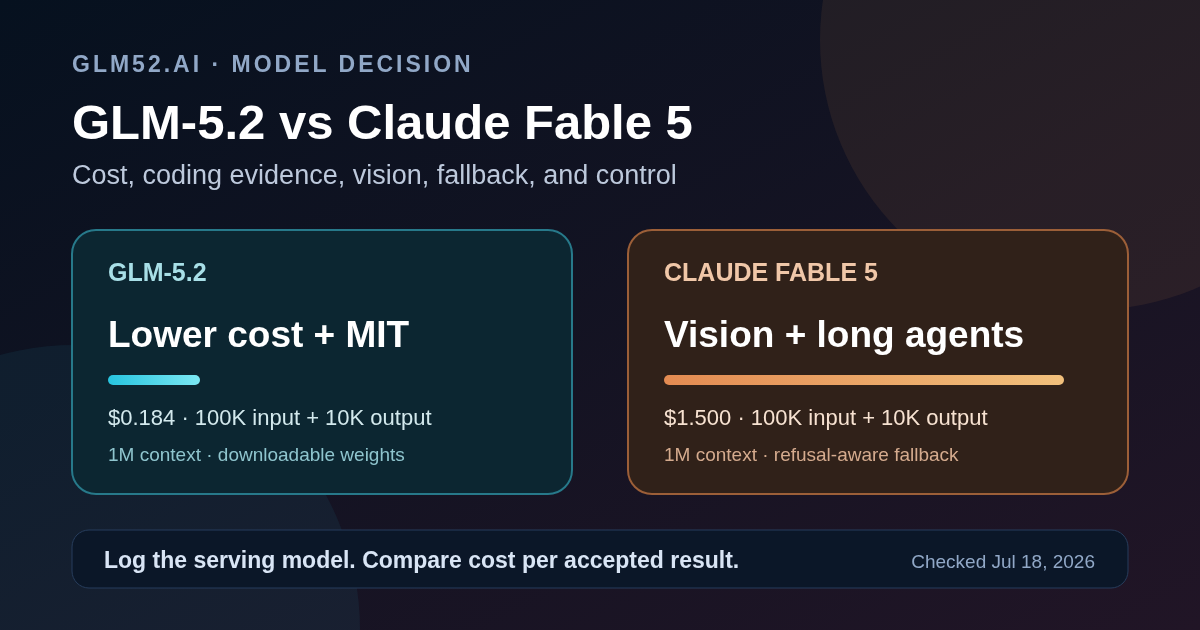
We checked the specifications, prices, benchmark tables, safeguards, and availability on this page against first-party sources on July 18, 2026.
The useful GLM-5.2 vs Fable 5 question is not which launch post sounds stronger. It is which system clears the workload’s hard constraints and delivers accepted work at the lower total cost. A visual coding agent, a high-volume text pipeline, a regulated deployment, and an unsupervised multi-day task can point to different answers.
This comparison separates four evidence layers:
- documented facts from Z.ai and Anthropic;
- publisher benchmark claims, with harness and fallback limits named;
- cost arithmetic that can be reproduced with different token counts;
- selection guidance inferred from those facts.
GLM52.ai did not buy either API or run an independent benchmark for this article. We do not present a provider score as our own test.
In this comparison
Section titled “In this comparison”- Quick verdict
- Specifications at a glance
- What the coding evidence says
- Direct API cost comparison
- Why Fable fallback changes model identity
- Context, vision, and output
- Reasoning and tool controls
- Open weights, retention, and deployment
- Which model should you choose?
- How to test both models
- Common questions
- Sources and method
Quick verdict
Section titled “Quick verdict”Fable 5 is the stronger first test for a difficult managed agent. Anthropic reports 80.0% on SWE-bench Pro and 84.3% on Terminal-Bench 2.1. Fable accepts images, is designed for long-running asynchronous work, and can use Anthropic’s managed agent capabilities. Those features are useful when a model must inspect a design, work across many stages, and verify its own changes.
GLM-5.2 is the stronger first test for price and control. Z.ai charges $1.40 per million fresh input tokens and $4.40 per million output tokens, versus $10 and $50 for Fable. GLM’s official 753B checkpoint uses MIT, giving teams a downloadable and modifiable deployment path that the cited Fable product pages do not provide.
The public coding scores are not a clean head-to-head test. Z.ai and Anthropic published separate runs. Their Terminal-Bench results use different harnesses, and Anthropic reports that 20.9% of Fable trials hit a classifier refusal and continued on Opus 4.8. That is a valid product result, but not a pure Fable-only score.
Start with five hard gates:
- If the base model must inspect screenshots, diagrams, or PDFs, test Fable first.
- If downloadable MIT weights are mandatory, test GLM first.
- If zero-data-retention terms are mandatory, the cited Fable service does not qualify.
- If equal-token direct API cost dominates, test GLM first.
- If one hard autonomous task can justify a higher bill, test Fable first and measure the acceptance gain.
Specifications at a glance
Section titled “Specifications at a glance”| Decision factor | GLM-5.2 | Claude Fable 5 | Why it matters |
|---|---|---|---|
| Publisher | Z.ai | Anthropic | Separate APIs, policies, regions, and support paths |
| Direct API ID | glm-5.2 |
claude-fable-5 |
Pin the exact requested and returned model in tests |
| Input | Text | Text, image | Fable can inspect pixels in the base request |
| Output | Text | Text | Neither cited endpoint is an audio or video generator |
| Advertised context | 1M tokens | 1M tokens | Capacity matches at headline level; retrieval still needs testing |
| Maximum output | 128K | 128K | Both can return long artifacts, subject to request limits |
| Fresh input / MTok | $1.40 | $10.00 | Equal-token Fable input costs 7.14× as much |
| Cached input / MTok | $0.26 | $1.00 cache read | Cache eligibility and write charges still matter |
| Output / MTok | $4.40 | $50.00 | Fable output costs 11.36× as much per token |
| Reasoning control | Thinking off/on; high or max effort | Adaptive thinking always on; effort controls depth | The APIs cannot be made identical by renaming settings |
| Managed tools | Function calling, MCP, structured output | Code execution, programmatic tool calling, memory, compaction, vision | Integration effort can outweigh token price |
| Safeguard fallback | No equivalent Fable classifier flow documented | Refusal response plus optional fallback to another Claude model | Monitoring must distinguish requested and serving model |
| Data retention | Depends on access route; self-hosting is possible | Required 30-day retention on the cited Fable service | A procurement hard gate for some workloads |
| Checkpoint | 753B weights published under MIT | No downloadable checkpoint on cited product pages | Determines self-hosting and modification options |
These are direct-provider facts. A coding subscription, cloud marketplace, gateway, or third-party host can expose another price, context limit, retention term, or tool surface.
What the coding evidence says
Section titled “What the coding evidence says”No checked source publishes a controlled independent run of GLM-5.2 and Fable 5 in one disclosed harness. The closest shared benchmark labels come from two publisher tables:
| Benchmark | GLM-5.2 in Z.ai’s table | Fable 5 in Anthropic’s system card | What can be inferred |
|---|---|---|---|
| SWE-bench Pro | 62.1% | 80.0% | Fable is 17.9 points higher in separate publisher runs |
| Terminal-Bench 2.1 | 81.0% with Terminus-2 | 84.3% with mini-SWE-agent | Fable is higher, but harness and model routing differ |
Anthropic states that its SWE-bench Pro result is the average of five trials. Its Terminal-Bench run used 89 tasks with five attempts each at high effort. In that terminal evaluation, 20.9% of Fable trials hit a safety refusal and fell back to Claude Opus 4.8 for the remaining trajectory.
That leaves two defensible conclusions. Fable has the stronger publisher evidence for difficult software engineering, so it deserves a quality-first evaluation. The numbers do not establish a universal 17.9-point advantage, and the Terminal-Bench row cannot be called a pure base-model comparison.
Use this model of accepted work:
accepted result = requested model + serving model + prompt + context policy + tools + permissions + effort + retries + timeout + testsIf a task depends on screenshots, Fable’s native vision removes a separate handoff. If it is a bounded text transformation with deterministic tests, GLM may pass while preserving a large cost advantage. Preserve failed runs instead of reporting only each model’s best output.
Direct API cost comparison
Section titled “Direct API cost comparison”Z.ai’s pricing page lists $1.40 fresh input, $0.26 cached input, and $4.40 output per million tokens for GLM-5.2.
Anthropic’s Fable page lists $10 input and $50 output per million tokens, with a 90% input-token discount for valid prompt-cache reads. US-only inference carries a 1.1× input and output multiplier.
For 100,000 fresh input tokens and 10,000 output tokens:
GLM-5.2 = 0.10 × $1.40 + 0.01 × $4.40 = $0.184Fable 5 = 0.10 × $10.00 + 0.01 × $50.00 = $1.500GLM costs 87.7% less, or Fable costs 8.15× as much, for this equal-token request shape.
If all 100,000 input tokens earn the cache-read rate:
GLM-5.2 = 0.10 × $0.26 + 0.01 × $4.40 = $0.070Fable 5 = 0.10 × $1.00 + 0.01 × $50.00 = $0.600GLM costs 88.3% less, or Fable costs 8.57× as much, in this full-cache-read case. Repeated text does not guarantee a hit; include cache creation and invalidation in the real bill.
Eight GLM attempts fit under one Fable attempt
Section titled “Eight GLM attempts fit under one Fable attempt”Eight GLM runs of the fresh-input example cost $1.472. Nine cost $1.656 and cross the $1.500 Fable bill. This 8.15-run break-even is arithmetic, not a quality claim. The models can tokenize the same files differently and consume different reasoning or repair tokens.
For a longer request with 500,000 fresh input tokens and 20,000 output tokens:
GLM-5.2 = 0.50 × $1.40 + 0.02 × $4.40 = $0.788Fable 5 = 0.50 × $10.00 + 0.02 × $50.00 = $6.000GLM costs 86.9% less, or Fable costs 7.61× as much, for this equal-token long-context shape. Anthropic documents standard pricing across Fable’s default 1M context. Measure cost per accepted result, including tool fees, fallback attempts, latency, review, and repair.
Why Fable fallback changes model identity
Section titled “Why Fable fallback changes model identity”Fable’s safety classifiers create an integration requirement that a price table cannot show. When a classifier declines a request, the Messages API returns a successful HTTP 200 response with stop_reason: "refusal". An error monitor that watches only 4xx and 5xx responses will miss it.
Anthropic documents three retry paths:
- a beta server-side
fallbacksparameter on the Claude API and Claude Platform on AWS; - SDK middleware for supported clients across platforms;
- a manual retry using fallback credit to avoid paying the prompt-cache switching cost twice.
Server-side fallback is not available on every named cloud surface or the Message Batches API. A before-output refusal is not billed. A mid-stream refusal bills input and generated output, and partial output should be treated as incomplete. Configure every agent and sub-agent request path, not only the main happy path.
Instrument at least these fields:
requested_model, returned_model, stop_reason, refusal_category,fallback_used, input_tokens, output_tokens, accepted_resultThis is not an argument against safeguards. It is an argument for reporting the product that did the work. If a Fable request returns an Opus answer, the user may still receive a useful result, but the log and evaluation must not label it Fable-only.
Context, vision, and output
Section titled “Context, vision, and output”Both providers document a 1M-token context window and up to 128K output. Capacity is not proof of recall or completion. Test whether each model locates the right file, preserves early constraints, resists stale evidence, and finishes after tool failures. Long prompts also increase prefill latency, cache sensitivity, and billable input.
The modality difference is harder:
- Fable accepts image input and Anthropic describes work with diagrams, charts, tables, files, PDFs, and visual checks of coding output.
- GLM-5.2’s base endpoint is text-only. An application can route pixels through a separate vision model or MCP tool, but the result is a multi-model system.
- Both return text from the cited base endpoints.
Use our GLM-5.2 image support guide to distinguish native image input from OCR, captions, and tool-mediated vision. For a screenshot-driven frontend loop, test the complete Fable workflow against the complete routed GLM workflow, including handoff latency and pixel provenance.
Reasoning and tool controls
Section titled “Reasoning and tool controls”GLM lets an application disable thinking or enable it with documented high and max effort settings. Our GLM-5.2 reasoning-effort guide explains the accepted values and cost implications. Fable uses adaptive thinking whenever thinking is unset and does not support disabling it. Anthropic’s effort parameter changes depth; raw chain-of-thought is not returned, while summarized or omitted thinking displays are supported.
Those labels are product controls, not comparable quality units. GLM max and a Fable effort setting can use different compute, latency, and output. Start with each provider’s recommended setting, then tune against accepted results and cost.
The managed tool stacks also differ. Fable documents code execution, programmatic tool calling, memory, context editing, compaction, and vision. GLM documents function calling, MCP, structured output, streaming, and caching, while a developer often supplies more of the execution environment.
That can justify part of Fable’s premium when managed tools remove engineering work. It can also add provider-specific behavior and make migration harder. Include tool fees, orchestration code, failure recovery, and observability in the comparison.
Open weights, retention, and deployment
Section titled “Open weights, retention, and deployment”GLM-5.2 publishes a 753B-parameter checkpoint under MIT. The official card provides Transformers, vLLM, and SGLang routes. Teams can pin the artifact, inspect the serving stack, modify the model, and keep inference within approved infrastructure.
Fable’s cited pages offer Claude products, the Claude API, and cloud marketplaces, not a downloadable Fable checkpoint. Anthropic also states that Fable requires 30-day data retention for safety monitoring and is not available under zero-data-retention terms. Those facts can decide regulated or sensitive deployments before quality testing begins.
GLM openness is not a cheap local-hosting promise. A 753B checkpoint demands substantial storage and accelerator memory before KV cache, runtime buffers, concurrency, and redundancy. See the GLM-5.2 local hardware guide before treating MIT as a workstation deployment plan.
Choose weights when data locality, offline operation, modification, provider independence, or reproducible version pinning justifies the infrastructure. Choose managed Fable when Anthropic’s tools, operations, global service, and time-to-market matter more than owning the weights.
Which model should you choose?
Section titled “Which model should you choose?”Choose Fable 5 for a managed, quality-first agent
Section titled “Choose Fable 5 for a managed, quality-first agent”Start with Fable for screenshot-based frontend work, ambitious migrations, long-running research or coding, and tasks where its publisher evidence justifies a higher evaluation budget. Configure refusal handling before production, record the model that served every answer, and review the 30-day retention requirement with security and legal teams.
Choose GLM-5.2 for cost, MIT weights, and control
Section titled “Choose GLM-5.2 for cost, MIT weights, and control”Start with GLM for high-volume text work, license-sensitive products, self-hosted experiments, and bounded coding tasks with strong tests. Its direct API costs 86.9% to 88.3% less in the equal-token cases above.
Route by task instead of declaring one default
Section titled “Route by task instead of declaring one default”A practical policy can use both:
- route visual-reference and high-stakes long-horizon tasks to Fable;
- route bounded text transformations to the cheaper model that passes the suite;
- keep deployment-controlled work on an approved GLM checkpoint;
- send a fixed sample of hard coding tasks to both during evaluation;
- route Fable refusals through an explicit fallback policy and label the serving model.
How to test both models
Section titled “How to test both models”Select 10 to 20 tasks from the real backlog. Include a small bug, cross-file refactor, test repair, tool failure, long-document question, and screenshot task if the product uses pixels.
Hold these conditions constant where the APIs permit:
- repository commit, selected files, and system instructions;
- acceptance tests and grading rubric;
- tool permissions, network access, and destructive-action policy;
- wall-clock, turn, context, and retry limits;
- fresh input, cache reads and writes, output tokens, and tool cost;
- human intervention, failure severity, and fallback policy.
Keep native settings visible. Do not pretend Fable’s always-on adaptive thinking equals GLM max, or count an Opus-served fallback as a Fable-only pass. Run multiple trials for nondeterministic tasks, preserve failures, and report the harness beside every score.
Rank accepted outputs first. Then compare spend, elapsed time, manual corrections, refusal rate, fallback rate, and severe failures. Fable’s 8.15× equal-token price gap must be covered by higher acceptance, lower token use, less integration work, faster delivery, or reduced review burden.
Common questions
Section titled “Common questions”Is GLM-5.2 cheaper than Claude Fable 5?
Section titled “Is GLM-5.2 cheaper than Claude Fable 5?”Yes at the standard direct-API rates checked July 18, 2026. A 100K fresh-input and 10K-output request costs $0.184 on GLM and $1.500 on Fable. Equal-token GLM cost is 87.7% lower in that example.
Is Fable 5 better than GLM-5.2 for coding?
Section titled “Is Fable 5 better than GLM-5.2 for coding?”Anthropic’s separate publisher material reports higher Fable results on SWE-bench Pro and Terminal-Bench 2.1. The runs are not a controlled head-to-head comparison, and part of Fable’s Terminal-Bench result used Opus 4.8 after classifier refusals. Test both in the same repository, tool policy, budget, and grader.
Does Fable 5 always answer the request itself?
Section titled “Does Fable 5 always answer the request itself?”No. A classifier can return stop_reason: "refusal". Managed applications may route some flagged work to Opus 4.8, while API developers must configure fallback. Log both the requested and returned model.
Does Fable 5 support images?
Section titled “Does Fable 5 support images?”Yes. Anthropic documents image input and vision for diagrams, charts, PDFs, and coding checks. GLM-5.2’s cited base endpoint accepts text, so a GLM product needs a separate vision route for pixels.
Can I self-host both models?
Section titled “Can I self-host both models?”GLM-5.2 publishes MIT-licensed weights and serving examples. Anthropic’s cited Fable pages offer managed products and APIs, not a downloadable checkpoint. GLM self-hosting still needs substantial infrastructure because the checkpoint is 753B parameters.
Do both models have a one-million-token context window?
Section titled “Do both models have a one-million-token context window?”Yes at headline level, and both document up to 128K output. Capacity does not guarantee perfect retrieval, stable agent behavior, low latency, or an affordable request. Test the full context path with provider-reported token counts.
Is Fable 5 the same comparison as Claude Opus 4.8?
Section titled “Is Fable 5 the same comparison as Claude Opus 4.8?”No. Fable 5 is Anthropic’s current most capable generally available model. Opus 4.8 is a separate model and a documented fallback target for some Fable refusals. Read the GLM-5.2 vs Opus 4.8 comparison when that older model is the actual endpoint or budget tier under review.
Sources and method
Section titled “Sources and method”Primary sources checked July 18, 2026:
- Z.ai GLM-5.2 guide — model ID, modalities, context, output limit, effort, and API capabilities.
- Z.ai model pricing — GLM fresh input, cached input, and output rates.
- GLM-5.2 official model card — benchmark table, checkpoint size, serving paths, and MIT license.
- Anthropic’s Claude Fable page — positioning, pricing, vision, availability, safeguards, fallback, retention, and model ID.
- Fable 5 model integration guide — context, output, price, availability, reasoning behavior, tools, refusal handling, and retention.
- Anthropic context-window guide — default 1M context and 128K maximum output.
- Anthropic refusal and fallback guide — HTTP response shape, billing, server and client retry paths, and observability requirements.
- Fable 5 and Mythos 5 system card — benchmark methods, scores, and Terminal-Bench fallback rate.
- Anthropic’s Fable redeployment notice — access suspension, safeguard context, lifted controls, and July 1 restoration.
Fresh exact-pair search results showed a current comparison gap and demand around coding, price, vision, safeguards, and availability. No keyword-volume tool was available, so this article makes no monthly-volume claim.
The three cost cases hold billed token counts constant and use standard direct rates. They exclude tax, credits, cloud premiums, Batch discounts, tokenization differences, tool fees, fallback costs, retries, review, and self-hosting. We did not purchase either endpoint or run a controlled benchmark. The Z.ai link is marked sponsored; Anthropic has no commercial relationship with GLM52.ai.