
GLM-5.2 vs Claude Opus 4.8: Which Model Fits the Job?
Independent research — not an official Z.ai publication.Identity and provider disclosure

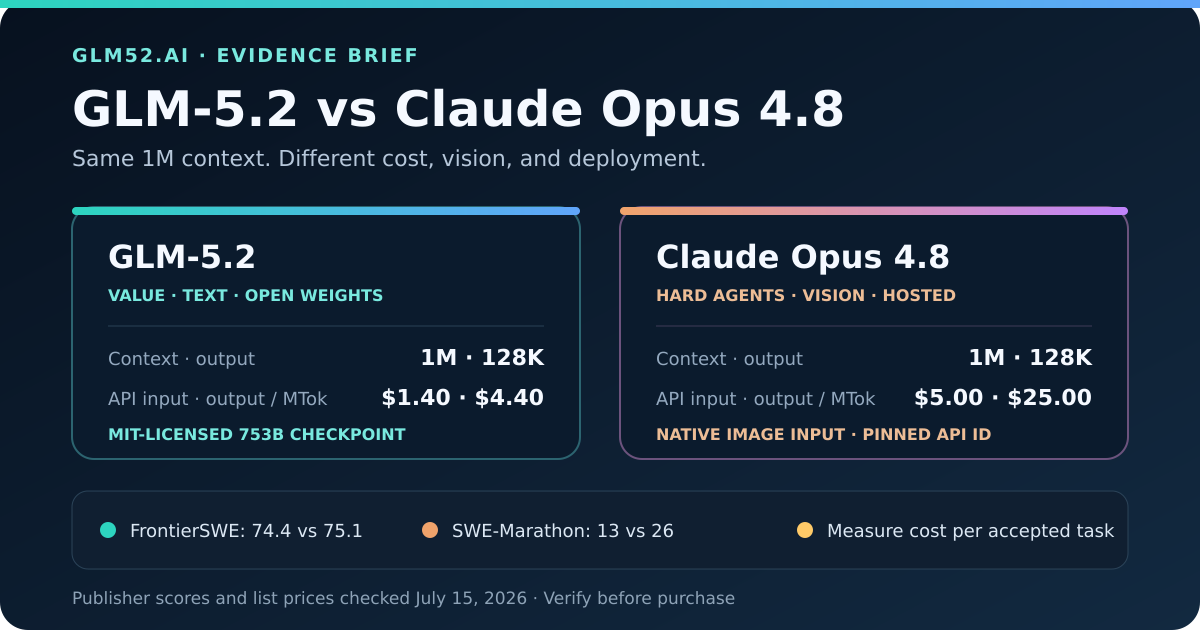
Specifications, vendor-published benchmark results, and list prices checked July 15, 2026. This page does not present vendor scores as an independent benchmark.
The useful version of GLM-5.2 vs Opus 4.8 is not “which model is smarter?” That question hides the workload, agent harness, effort setting, tools, retry budget, latency target, and price. Change any of those and the practical winner can change too.
This comparison separates four kinds of evidence:
- documented product facts, such as context, modalities, model IDs, prices, and license;
- publisher benchmark results, which are useful but come from a party selling one of the models;
- transparent arithmetic, so the cost examples can be checked or replaced with your own usage;
- decision guidance, explicitly labeled as an inference rather than a measured universal result.
One more freshness warning matters. Opus 4.8 launched on May 28, 2026, but Anthropic’s current catalog now describes Claude Fable 5 as its most capable widely released model. Anthropic still recommends Opus 4.8 for complex agentic coding and enterprise work. This page compares the two models in the search query; it does not imply that Opus 4.8 is Anthropic’s newest model in every category. Use the GLM-5.2 vs Fable 5 comparison when Anthropic’s current flagship, its higher price, native vision, retention rule, and classifier fallback are the actual decision.
In this comparison
Section titled “In this comparison”- Quick verdict
- Specifications at a glance
- What the benchmarks actually show
- Why the harness can change the winner
- API pricing and real task cost
- One-million-token context is not a tie
- Coding agents and tool use
- Vision, computer use, and multimodal work
- Open weights, deployment, and control
- Migration and operational differences
- Which model should you choose?
- A cheaper hybrid routing strategy
- How to run a fair evaluation
- Frequently asked questions
- Sources and methodology
Quick verdict
Section titled “Quick verdict”The evidence supports a split decision, not a knockout.
Opus 4.8 has the stronger published ceiling on difficult, long-horizon engineering. In Z.ai’s own comparison table, Opus leads GLM-5.2 by 7.1 points on SWE-bench Pro, 20.8 on NL2Repo, and 13 on SWE-Marathon. Those are material gaps, especially when a task must stay coherent across many edits, tests, and recovery steps.
GLM-5.2 is much less expensive at official API list rates and is competitive on several bounded agent benchmarks. It comes within 0.7 points on FrontierSWE and 1.0 point on the public MCP-Atlas set in the same Z.ai table. Its standard rates are $1.40 per million input tokens and $4.40 per million output tokens, compared with $5 and $25 for Opus 4.8.
Vision and deployment control are hard dividing lines. Opus 4.8 accepts images; the base GLM-5.2 endpoint is documented as text in and text out. GLM-5.2’s 753B-parameter weights are downloadable under MIT; Opus 4.8 is a hosted model whose weights are not available.
The most defensible buying rule is therefore:
- start with GLM-5.2 when tests can cheaply catch failures and text-only throughput dominates;
- start with Opus 4.8 when the task is unusually long, visually grounded, expensive to fail, or difficult to supervise;
- route between them when your workload contains both kinds of task.
Specifications at a glance
Section titled “Specifications at a glance”| Decision factor | GLM-5.2 | Claude Opus 4.8 | Practical meaning |
|---|---|---|---|
| Publisher | Z.ai | Anthropic | Separate APIs, policies, regions, and support paths |
| Release timing | June 2026 | May 28, 2026 | Both are recent, but model catalogs continue to change |
| Direct API model ID | glm-5.2 |
claude-opus-4-8 |
Do not assume one provider’s request body works unchanged on the other |
| Input and output | Text → text | Text/image → text | Opus can directly inspect screenshots and diagrams |
| Context window | 1M tokens | 1M tokens | Capacity is similar; tokenization and retrieval quality are not proven equal |
| Maximum synchronous output | 128K tokens | 128K tokens | Both can return long artifacts, but long output increases cost and review burden |
| Thinking control | Thinking on/off plus effort levels | Adaptive thinking plus effort levels | The parameter names and accepted settings differ |
| Tools and structured output | Function calling, MCP, structured output | Tool use, structured output, computer-use workflows | Support does not guarantee equal tool-selection accuracy |
| Prompt caching | $0.26/M cached input; storage listed as limited-time free | $0.50/M hit; $6.25/M five-minute write; $10/M one-hour write | Cache-hit prices omit the cost and rules for creating the cache |
| Standard API input/output | $1.40 / $4.40 per MTok | $5 / $25 per MTok | Opus is 3.57× the input rate and 5.68× the output rate |
| Model access | Hosted API and MIT-licensed weights | Hosted APIs only | GLM can be pinned and self-hosted; Opus avoids hosting work |
| Model size disclosure | 753B total parameters | Not published | Parameter count is not a quality score |
| Best starting point | Cost-sensitive, text-only, controllable deployments | Hard long tasks, vision, managed frontier workflow | Validate on accepted results, not feature count |
“1M” and “128K” are rounded labels. Z.ai’s other pages express the limits as 1,048,576 context tokens and 131,072 output tokens. Anthropic documents 1M context and 128K synchronous output. A third-party gateway, IDE plan, cloud platform, or account tier may expose a different limit, so check the endpoint you will actually call.
What the benchmarks actually show
Section titled “What the benchmarks actually show”The table below uses one source for both columns: Z.ai’s GLM-5.2 release table. That is more coherent than stitching each model’s best score from unrelated leaderboards, but it remains vendor-published evidence from GLM’s publisher, not an independent evaluation by GLM52.ai.
| Benchmark | What it probes | GLM-5.2 | Opus 4.8 | Reported gap |
|---|---|---|---|---|
| SWE-bench Pro | Repository issue resolution | 62.1 | 69.2 | Opus +7.1 |
| NL2Repo | Building a repository from a natural-language specification | 48.9 | 69.7 | Opus +20.8 |
| Terminal-Bench 2.1, Terminus-2 | Terminal-based agent tasks under a common harness | 81.0 | 85.0 | Opus +4.0 |
| FrontierSWE dominance | Open-ended technical projects lasting hours | 74.4 | 75.1 | Opus +0.7 |
| SWE-Marathon | Ultra-long software-engineering work | 13.0 | 26.0 | Opus +13.0 |
| MCP-Atlas public set | Agent tool use across MCP tasks | 76.8 | 77.8 | Opus +1.0 |
| AIME 2026 | Competition mathematics | 99.2 | 95.7 | GLM +3.5 |
Three conclusions are justified; stronger claims are not.
First, Opus 4.8 leads every selected coding and agent benchmark in the common table. The lead is small on FrontierSWE and MCP-Atlas, moderate on Terminal-Bench and SWE-bench Pro, and large on NL2Repo and SWE-Marathon. Saying only “GLM is within one point of Opus” cherry-picks the favorable rows. Saying “Opus crushes GLM at coding” ignores the close rows and the cost difference.
Second, the largest Opus gaps appear on tasks intended to capture longer or broader engineering work. That pattern supports using Opus as the safer starting hypothesis for hard autonomous runs. It does not prove that every long task will succeed, or that a seven-point benchmark gap is worth a 5.68× output-token rate in your system.
Third, GLM’s AIME advantage shows why a single aggregate “intelligence” label is weak. Competition math, repository repair, tool selection, visual debugging, and production migration are different jobs. A math result cannot stand in for coding-agent reliability.
Scores are not probabilities for your next ticket
Section titled “Scores are not probabilities for your next ticket”A score of 69.2 does not mean your next repository task has a 69.2% chance of success. Benchmark datasets have particular languages, repositories, graders, timeouts, tool permissions, and contamination risks. A model can also pass a benchmark while producing code your team would reject for security, maintainability, or scope.
Use the public table to form a hypothesis. Use your own acceptance suite to make the purchase decision.
What the public evidence still cannot answer
Section titled “What the public evidence still cannot answer”The checked sources do not provide a controlled, independent comparison of time to first token, sustained output speed, regional availability, outage rate, throttling under concurrency, or quality after a full 1M-token prompt. They also do not establish that one provider’s safety behavior, retention terms, or support response fits your organization. Those are procurement questions, not gaps that can be filled with a benchmark score.
Before committing meaningful traffic, run a short production-shaped pilot in the region and service tier you intend to buy. Record queue time separately from generation time, test both normal and peak concurrency, force tool and network failures, and review the exact data-use and retention terms attached to the account. Ask each provider how model updates, deprecations, capacity incidents, and snapshot availability are communicated. A model can win every offline task and still be the wrong production dependency if its operational envelope does not match the system around it.
Why the harness can change the winner
Section titled “Why the harness can change the winner”Z.ai’s release table contains a useful warning inside the numbers. Under the shared Terminus-2 harness, Opus 4.8 scores 85.0 and GLM-5.2 scores 81.0. A separate “best reported harness” row lists GLM-5.2 at 82.7 and Opus 4.8 at 78.9. That second row mixes best-reported agent configurations and should not replace the common-harness comparison.
The model is only one component in an agent run:
result = model + system prompt + agent shell + tools + permissions + context management + effort + retries + time limit + graderThe API settings are not symmetrical either. Anthropic documents that Opus 4.8 rejects non-default temperature, top_p, and top_k values, and supports adaptive thinking rather than a fixed manual thinking-token budget. Z.ai’s GLM-5.2 examples expose temperature, thinking mode, and reasoning_effort. Forcing identical sampling fields is not “fair” if one API rejects them.
A rigorous comparison should run two separate experiments:
- Model-isolation test: same repository snapshot, tools, permissions, task, stopping rule, and grader; provider-recommended model settings are recorded rather than artificially made identical.
- Product-workflow test: each model runs in its strongest supported real product, such as Claude Code or a GLM-compatible coding plan. This measures user experience, but the result belongs to the whole product stack—not the base model alone.
Do not run GLM in one agent, Opus in another, give one internet access, and publish the outcome as a clean model benchmark.
API pricing and real task cost
Section titled “API pricing and real task cost”These are first-party list prices per million tokens, checked July 15, 2026. Taxes, regional premiums, data-residency multipliers, third-party gateway margins, server-side tools, subscriptions, and self-hosting costs are separate.
| Token or service category | GLM-5.2 | Claude Opus 4.8 |
|---|---|---|
| Standard input | $1.40 | $5.00 |
| Cache hit / cached input | $0.26 | $0.50 |
| Five-minute cache write | Not separately listed | $6.25 |
| One-hour cache write | Not separately listed | $10.00 |
| Standard output | $4.40 | $25.00 |
| Batch input / output | Not listed on the checked GLM page | $2.50 / $12.50 |
| Fast mode input / output | Not a like-for-like listed mode | $10 / $50 |
For a successful task using 100,000 uncached input tokens and 10,000 output tokens:
GLM-5.2 = 0.10 × $1.40 + 0.01 × $4.40 = $0.184Opus 4.8 = 0.10 × $5.00 + 0.01 × $25.00 = $0.750Opus costs about 4.08× more in that exact request shape. This blended ratio is lower than the 5.68× output-rate difference because input is a larger share of the example.
If all 100,000 input tokens are valid cache hits, while output remains 10,000 tokens:
GLM-5.2 cached-read request = 0.10 × $0.26 + 0.01 × $4.40 = $0.070Opus 4.8 cached-read request = 0.10 × $0.50 + 0.01 × $25.00 = $0.300That Opus figure excludes the earlier cache write. Writing the same 100,000-token prefix into a five-minute Opus cache costs $0.625 before output; a one-hour write costs $1.00. One five-minute cache hit already makes the prefix cheaper than sending it uncached twice, while a one-hour entry needs at least two hits to beat repeated uncached input. Real reuse timing and cache invalidation determine whether those savings materialize.
Batch and fast modes change the quote, not the model
Section titled “Batch and fast modes change the quote, not the model”Anthropic’s Batch API halves Opus 4.8’s token rates to $2.50 input and $12.50 output for asynchronous work. In the 100K/10K example, that is $0.375—still above GLM’s checked standard-rate $0.184, but far below standard Opus. Fast mode is a research preview advertised at up to 2.5× higher output speed and doubles the standard rates to $10/$50.
Compare the mode that meets the latency requirement. A nightly migration analysis can use batch; an interactive agent may not be able to wait. “Opus costs $25/M output” and “Opus costs $12.50/M output” can both be true under different service modes.
Token rates are not the whole bill
Section titled “Token rates are not the whole bill”Anthropic says the newer tokenizer used by Opus 4.8 can produce about 30% more tokens for the same text than earlier Claude models, with workload-dependent variation. That statement does not tell us how Opus tokenization compares with GLM. It does show why multiplying one corpus size by two advertised rates can be misleading.
Run representative prompts through both endpoints and record provider-reported input, cache, thinking, tool, and output tokens. Then use:
cost per accepted result = model + tool + infrastructure spend + human review and repair cost ---------------------------------- outputs that pass acceptanceIf an Opus run saves an engineer an hour, its higher token bill may be trivial. If both models pass the same automated test and GLM handles millions of tasks, the rate difference can dominate.
One-million-token context is not a tie
Section titled “One-million-token context is not a tie”Both direct model pages advertise a 1M-token context and about 128K maximum synchronous output. That removes the simple “one model fits and the other does not” distinction, but it does not make their long-context behavior equal.
One million tokens is capacity, not guaranteed recall
Section titled “One million tokens is capacity, not guaranteed recall”Long context creates at least five separate questions:
- Does the provider accept the request at the documented size?
- Can the model retrieve the right evidence at different positions?
- Does it preserve constraints across many tool turns and compactions?
- What are prefill latency and time-to-first-token at your request size?
- What does the full prompt cost, and which prefixes can be cached?
A giant repository dump can be worse than a smaller, curated working set. Irrelevant files dilute attention, secrets may be sent unnecessarily, and every edit can invalidate a large cached prefix. Start with architecture, contracts, task-relevant files, tests, and repository instructions; expand only when the agent is missing evidence.
“One million tokens” is not the same number of files
Section titled ““One million tokens” is not the same number of files”GLM and Claude use different tokenizers. The same codebase can produce different token counts, especially across code, English, Chinese, minified files, and generated artifacts. Measure the actual request on each provider rather than translating 1M tokens into a universal line count.
Output ceilings need a review strategy
Section titled “Output ceilings need a review strategy”A 128K output ceiling can hold a long report or patch stream, but requesting the maximum by default is rarely wise. Large outputs cost more, are harder to review, and can hide duplicated or out-of-scope changes. Prefer incremental commits or artifacts with tests between stages. Use the ceiling for exceptional work, not as a normal target.
Coding agents and tool use
Section titled “Coding agents and tool use”The benchmark pattern suggests three practical workload tiers.
Bounded work with strong tests
Section titled “Bounded work with strong tests”Examples include adding a well-scoped endpoint, updating a dependency, converting a small module, writing unit tests, or fixing an error with a reproducible failing test. GLM-5.2 is an attractive first runner here because several published agent scores are close and automated verification can cheaply reject bad output.
Long repository work with many failure points
Section titled “Long repository work with many failure points”Examples include a cross-service migration, compiler work, large refactor, multi-platform feature, or task that must recover from repeated tool failures. Opus 4.8’s larger leads on NL2Repo and SWE-Marathon support paying for a trial when failure consumes hours or corrupts a wide change set.
High-risk work that requires judgment
Section titled “High-risk work that requires judgment”Security changes, financial logic, destructive data migrations, authorization boundaries, and production incident response require human review regardless of model. Opus may be the stronger starting model, but a benchmark lead is not permission to remove change control.
Both models advertise tool use. The harder problem is not producing a syntactically valid call; it is choosing the right tool, supplying safe arguments, interpreting failure, and knowing when to stop. Test:
- exact JSON-schema compliance and unsupported schema features;
- parallel tool calls and streamed arguments;
- retries after timeouts, partial output, and non-zero exit codes;
- refusal, truncation, and maximum-turn behavior;
- whether the agent verifies its own edits before claiming completion.
Vision, computer use, and multimodal work
Section titled “Vision, computer use, and multimodal work”Claude Opus 4.8 accepts text and image input. This is a decisive advantage when the model must inspect a screenshot, design, chart, diagram, photographed error, or visual state produced by a browser or device.
The base GLM-5.2 model guide lists text input and text output. A GLM coding product can add a separate vision model or MCP tool, and a custom agent can use OCR or a vision service before handing text to GLM. That can be a valid architecture, but it is not native GLM-5.2 vision and adds another model, latency path, failure mode, and bill.
“Computer use” also belongs to the system, not only the model. A vision-capable model still needs screenshots, coordinate mapping, browser or desktop tools, permission boundaries, and recovery logic. Test the complete loop:
observe → interpret → act → verify the new state → recover or stopChoose Opus directly when pixels are primary evidence. Choose GLM with a separate vision stage when text-heavy execution dominates and the extra orchestration is worth the cost savings.
Open weights, deployment, and control
Section titled “Open weights, deployment, and control”GLM-5.2’s official weights are published under the MIT license. You can download them, pin a repository revision, modify the model, fine-tune it, and serve it inside infrastructure you control, subject to the license and your other legal obligations.
That freedom is operationally expensive. The official repository reports 753B total parameters. The published BF16 checkpoint is roughly 1.5 TB and the official FP8 files are about 756 GB before runtime memory, KV cache, storage duplication, networking, and concurrency headroom. Our GLM-5.2 local hardware guide explains why “open weights” does not mean “runs comfortably on a workstation.”
Opus 4.8’s weights are not downloadable. Anthropic operates the model through its API and supported cloud platforms. The upside is no cluster provisioning, checkpoint download, serving framework, kernel compatibility, or capacity planning. Anthropic also documents claude-opus-4-8 as a pinned snapshot rather than an evergreen alias, which helps API reproducibility.
Self-hosting is not automatically private or cheaper. It is private only if network access, storage, logs, backups, operator permissions, telemetry, and incident response are correctly controlled. It is cheaper only when utilization and engineering cost beat the hosted alternative.
Use the free and GPU-cloud guide to compare evaluation and hosted deployment paths before renting a large node.
Migration and operational differences
Section titled “Migration and operational differences”Wire-format similarity should not be confused with behavioral compatibility.
Z.ai documents an OpenAI-style chat-completions endpoint and SDK path for glm-5.2. Anthropic uses the Messages API for claude-opus-4-8. Coding subscriptions can add compatibility layers, but an application migration still needs deliberate testing.
Before moving traffic, verify:
- System instructions: placement, mid-conversation updates, and cache preservation differ.
- Thinking and effort: Opus 4.8 uses adaptive thinking; GLM exposes its own thinking and effort controls.
- Sampling: Opus rejects non-default temperature/top-p/top-k values; remove copied GLM or legacy settings.
- Tool schemas: compare supported JSON Schema, tool choice, parallelism, and streaming deltas.
- Stop behavior: handle truncation, tool-use stops, refusals, paused turns, timeouts, and provider errors.
- Token accounting: do not combine visible output, hidden thinking, cached input, and tool tokens into one guessed number.
- Model identity: record API model ID, provider, region, date, agent version, and self-hosted revision.
- Operational policy: review data use, retention, residency, rate limits, support, and incident history for the exact service.
Do not reuse a prompt tuned to one model, change only the model name, and call the comparison complete. First run the shared baseline; then allow a documented model-specific prompt pass and report both results.
Which model should you choose?
Section titled “Which model should you choose?”| Your primary requirement | Better starting point | Why |
|---|---|---|
| Lowest checked API token cost | GLM-5.2 | Lower standard input, cache-hit, and output rates |
| Hardest multi-hour repository task | Opus 4.8 | Larger leads on several vendor-published long-horizon tests |
| Screenshots, diagrams, or visual browser state | Opus 4.8 | Native image input |
| Downloadable weights or on-premises serving | GLM-5.2 | MIT-licensed checkpoint available |
| Same 1M capacity at lower prompt cost | GLM-5.2 | $1.40/M standard input versus $5/M |
| Managed asynchronous bulk work | Test Opus Batch against GLM standard | Opus Batch halves its standard rates; latency contract differs |
| Fast interactive output at premium cost | Opus 4.8 Fast mode | Up to 2.5× output speed in research preview |
| Existing Anthropic Messages API stack | Opus 4.8 | Lower migration and operational change |
| Existing OpenAI-compatible text pipeline | GLM-5.2 | Z.ai documents an OpenAI-style endpoint |
| High-stakes correctness | Neither without controls | Require tests, review, rollback, and task-specific evidence |
If two rows conflict, price a pilot instead of arguing from the table. The correct unit is not “best model”; it is “lowest-risk accepted result under the required latency and control constraints.”
A cheaper hybrid routing strategy
Section titled “A cheaper hybrid routing strategy”Many teams do not need Opus for every ticket or GLM for every ticket. A simple escalation policy can preserve an expensive model for the cases most likely to benefit:
- Send bounded, text-only tasks to GLM-5.2.
- Run deterministic tests, lint, type checks, security checks, and scope checks.
- Escalate to Opus 4.8 when the task contains images, crosses critical services, fails twice, exceeds a time budget, or requires unusually high judgment.
- Preserve the original task, evidence, failed attempts, and acceptance criteria so the second model does not restart blind.
For 100 requests shaped like the earlier 100K-input/10K-output example:
| Routing plan | Transparent token cost |
|---|---|
| 100% GLM-5.2 | 100 × $0.184 = $18.40 |
| 100% Opus 4.8 | 100 × $0.750 = $75.00 |
| 80% GLM, 20% Opus | 80 × $0.184 + 20 × $0.750 = $29.72 |
The illustrative 80/20 route is 60.4% cheaper than all-Opus and $11.32 more expensive than all-GLM. It is not automatically better: routing logic, retries, larger escalation prompts, and human repair can erase the saving. The point is that model selection can happen per task rather than per company.
How to run a fair evaluation
Section titled “How to run a fair evaluation”A useful internal evaluation can start with 20–50 tasks sampled from real work. Include easy, medium, hard, visual, and long-running cases rather than selecting only tasks that flatter one model.
Freeze the evidence before each run
Section titled “Freeze the evidence before each run”- repository commit or artifact checksum;
- task statement and hidden acceptance tests;
- allowed tools, network policy, credentials, and write boundaries;
- agent and plugin versions;
- wall-clock, turn, token, and retry budgets;
- provider, region, model ID, effort setting, and date.
Grade outcomes, not confidence
Section titled “Grade outcomes, not confidence”Use deterministic checks first: build, tests, lints, security scanners, expected files, API contracts, performance thresholds, and forbidden-change checks. Then conduct blind human review for architecture, clarity, maintainability, and risk.
Track at least:
| Metric | Why it matters |
|---|---|
| Accepted-task rate | The output passed the actual bar |
| Regression count | Success did not break unrelated behavior |
| Human repair minutes | Token savings can be consumed by cleanup |
| Wall-clock time | A cheap run may be too slow for the workflow |
| Input, cache, thinking, tool, and output tokens | Explains the bill and prompt shape |
| Tool calls and failed calls | Shows agent efficiency and recovery |
| Total cost per accepted task | Combines price with usable quality |
Run stochastic tasks more than once and report variance. Randomize model order to reduce evaluator fatigue and environment drift. Keep failed runs; deleting them creates survivorship bias.
Finally, write the decision rule before seeing the results—for example, “choose GLM if its accepted-task rate is within five percentage points and cost per accepted task is at least 40% lower.” A predeclared rule makes it harder to move the goalposts after a favorite model loses.
Frequently asked questions
Section titled “Frequently asked questions”Is GLM-5.2 better than Claude Opus 4.8 for coding?
Section titled “Is GLM-5.2 better than Claude Opus 4.8 for coding?”Not as a universal statement. Opus 4.8 leads the selected coding and agent rows in Z.ai’s own published comparison, with especially large margins on NL2Repo and SWE-Marathon. GLM-5.2 is close on FrontierSWE and MCP-Atlas and costs much less at standard API rates. Use Opus as the stronger hypothesis for the hardest long tasks; use GLM as the value hypothesis for bounded, testable work.
How much cheaper is GLM-5.2 than Opus 4.8?
Section titled “How much cheaper is GLM-5.2 than Opus 4.8?”At the checked standard list rates, GLM input is $1.40/M versus $5/M, and output is $4.40/M versus $25/M. That makes Opus 3.57× the input rate and 5.68× the output rate. A 100K-input/10K-output example costs $0.184 on GLM and $0.750 on Opus before tools, retries, regional modifiers, or human repair.
Which model has the larger context window?
Section titled “Which model has the larger context window?”Neither on the first-party headline specification: both advertise 1M tokens. Both also advertise roughly 128K maximum synchronous output. Tokenization, provider limits, retrieval accuracy, prefill latency, context management, and caching still differ, so equal capacity is not equal behavior.
Can GLM-5.2 understand screenshots or images?
Section titled “Can GLM-5.2 understand screenshots or images?”The base GLM-5.2 API is documented as text-only. A separate vision model or MCP tool can convert visual evidence into text for GLM, but that is a multi-model workflow. Opus 4.8 accepts image input directly.
Is GLM-5.2 really open source?
Section titled “Is GLM-5.2 really open source?”The official weights are released under MIT. We prefer the precise phrase open-weight because the public checkpoint and permissive license do not necessarily include every training dataset and pipeline artifact. The weights can be downloaded and deployed, but the 753B model has unusually large hardware requirements.
Is Opus 4.8 Anthropic’s newest or strongest model?
Section titled “Is Opus 4.8 Anthropic’s newest or strongest model?”It is a current model positioned for complex agentic coding and enterprise work, but Anthropic’s July 2026 catalog describes Claude Fable 5 as its most capable widely released model. The comparison remains useful because Opus 4.8 is widely available, has published pricing, and is the model named in the search intent.
Can I use GLM-5.2 in Claude Code?
Section titled “Can I use GLM-5.2 in Claude Code?”Z.ai’s Coding Plan documents support for Claude Code and other coding agents through its product-specific integration. That subscription and endpoint are not the same thing as Anthropic’s Claude subscription or Z.ai’s general pay-as-you-go API. Confirm the current model mapping, quotas, and endpoint before comparing bills.
Should I trust the benchmark winner?
Section titled “Should I trust the benchmark winner?”Trust the result only for the documented dataset and setup. The published table is useful evidence, but agent shell, tools, effort, permissions, timeouts, and grading can change outcomes. Reproduce representative work with your own acceptance criteria before a large commitment.
Bottom line
Section titled “Bottom line”GLM-5.2 makes frontier-adjacent text coding economically accessible and deployable under an MIT license. Claude Opus 4.8 asks a much higher token price in exchange for native vision, a managed Anthropic stack, and a stronger published ceiling on several difficult long-horizon engineering tests.
The highest-value conclusion is not “cheap model wins” or “premium model wins.” It is this:
Use GLM-5.2 where verification is cheap and volume is high. Use Opus 4.8 where failure is expensive, visual evidence matters, or the task must survive a long chain of uncertain decisions. Measure both in cost per accepted result.
That rule is more durable than any single leaderboard position.
Sources and methodology
Section titled “Sources and methodology”Primary product and publisher sources:
- Z.ai GLM-5.2 model guide
- Z.ai GLM-5.2 release and full benchmark table
- Z.ai API pricing
- Official GLM-5.2 weights and MIT license
- Anthropic Claude Opus 4.8 announcement
- Claude Opus 4.8 model changes and API constraints
- Anthropic model specifications and versioning
- Anthropic API, prompt-cache, Batch, and fast-mode pricing
- Claude Opus 4.8 System Card
We searched the exact comparison query and close variants on July 15, 2026, then checked decision-changing claims against first-party sources. The benchmark table above is reproduced selectively from Z.ai’s publisher evaluation so both models remain in one stated comparison; it is labeled as vendor-published and is not represented as our own run. Arithmetic is derived from first-party list prices. Inferences—such as workload recommendations and the hybrid route—are explained from those facts rather than presented as measured universal outcomes.
Google Search Console and GA4 returned no data for glm52.ai in the preceding 28-day review window. The page therefore targets visible search intent and evidence gaps rather than claiming traffic conclusions that do not exist. Specifications, prices, models, and service modes can change; re-check the linked provider pages before procurement or deployment.