
GLM-5.2 Speculative Decoding: Configure and Validate MTP
Independent research — not an official Z.ai publication.Identity and provider disclosure

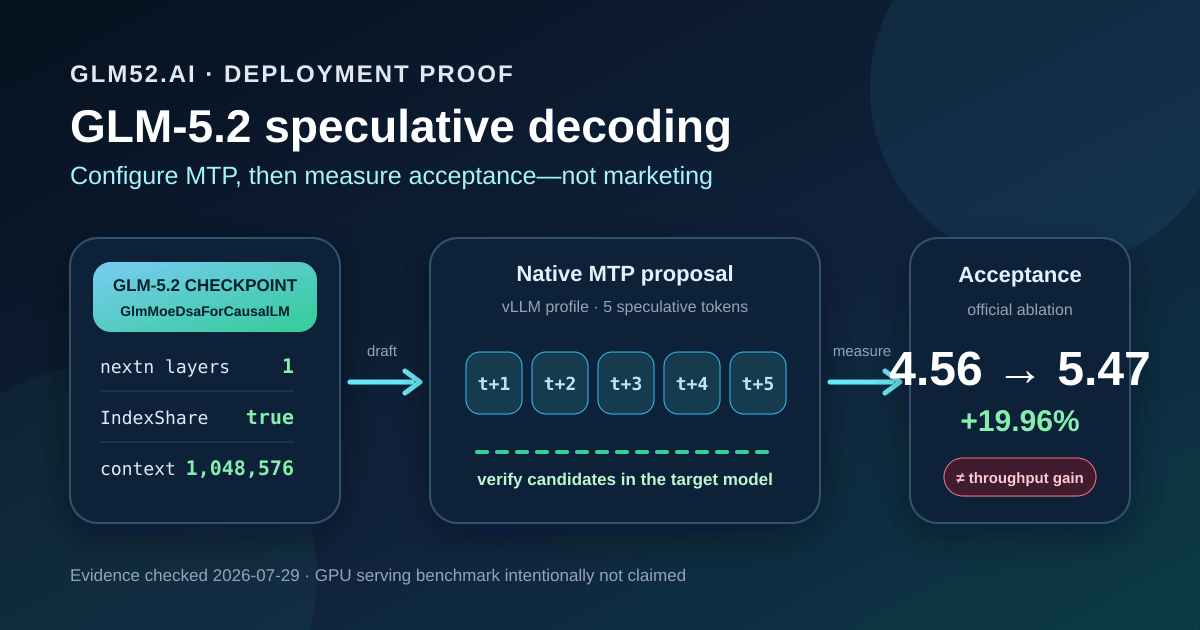
Original editorial diagram of the deployment path. It is not a Z.ai, vLLM, SGLang or Hugging Face product screen. The later terminal image is rendered from the archived container receipt.
GLM-5.2 ships a native multi-token prediction head. A serving engine can use that head to propose several future tokens, verify them with the target model, and commit the accepted prefix. When the draft work costs less than the target work it replaces, decoding may become faster.
The word may matters. Z.ai reports that its training changes raised acceptance length by up to 20% in one ablation. That does not mean every deployment gains 20% throughput. Draft depth, prompt shape, output entropy, batch size, tool traffic, GPU topology and engine commit all change the result. A bad profile can spend more compute verifying rejected tokens than it saves.
This guide turns the feature into an operational contract: inspect the checkpoint, copy the right engine-specific flags, run MTP off/on against the same workload, watch acceptance and user-visible latency, and retain a one-change rollback.
Follow the MTP deployment proof
Section titled “Follow the MTP deployment proof”- Keep native MTP separate from AngelSpec
- Inspect the checkpoint contract
- Interpret the publisher ablation
- Copy the vLLM profile
- Translate the setup for SGLang
- Design a falsifiable A/B run
- Read our preflight receipt
- Estimate the cluster floor
- Choose a starting depth
- Define rollback signals
- Compare the available methods
- Promote a canary
- Audit the sources
- Resolve practical questions
Separate native MTP from AngelSpec
Section titled “Separate native MTP from AngelSpec”This investigation began with an AI HOT item about Tencent’s AngelSpec announcement. The announcement is useful evidence that speculative decoding remains an active inference-engine topic. It is not evidence that AngelSpec supports GLM-5.2.
The verified GLM path comes from a different chain:
- the Z.ai GLM-5.2 release post describes the model’s native MTP changes;
- the official checkpoint config exposes the relevant architecture fields;
- the vLLM GLM-5.2 recipe and SGLang GLM-5.2 recipe publish engine-specific launch profiles.
Do not combine unrelated draft frameworks merely because they share the term “speculative decoding.” AngelSpec’s DFly path, vLLM native MTP, SGLang’s EAGLE-style MTP flags and vLLM’s optional DSpark speculator have different weights, code paths and validation requirements. Until a project publishes a GLM-5.2 compatibility matrix or reproducible run, treat the relationship as unverified.
Read the checkpoint before choosing an engine
Section titled “Read the checkpoint before choosing an engine”The model config is the first gate. Our July 29 probe pinned GLM-5.2 revision
b4734de4… and observed:
| Checkpoint field | Observed value | Why it matters |
|---|---|---|
architectures |
GlmMoeDsaForCausalLM |
The engine needs the GLM MoE + DSA implementation, not a generic causal-LM path. |
model_type |
glm_moe_dsa |
Model-family dispatch must recognize this exact type. |
num_nextn_predict_layers |
1 |
The checkpoint contains a native next-token prediction layer for MTP. |
index_share_for_mtp_iteration |
true |
Draft iterations can reuse the DSA indexer’s selected positions as designed. |
max_position_embeddings |
1,048,576 |
This is native position capacity, not proof that a chosen cluster can serve 1M tokens. |
One nextn layer does not mean “only one draft token.” The head is applied recursively across speculative steps. It also does not authorize an arbitrary depth: each extra proposal can add useful accepted work or wasted verification work. Engine support and measured acceptance set the practical depth.
Fail the deployment before downloading hundreds of gigabytes if any of these conditions is false:
assert config["architectures"] == ["GlmMoeDsaForCausalLM"]assert config["model_type"] == "glm_moe_dsa"assert config["num_nextn_predict_layers"] >= 1assert config["index_share_for_mtp_iteration"] is Trueassert config["max_position_embeddings"] == 1_048_576Pin the checkpoint revision as well as the engine. A branch name such as
main can move between tests even when your command is unchanged.
Translate acceptance length without inventing speed
Section titled “Translate acceptance length without inventing speed”Z.ai’s release post reports an ablation using the GLM-5.1 backbone and training data with seven MTP steps. The sequence was:
| Publisher ablation stage | Acceptance length |
|---|---|
| Baseline | 4.56 |
| Add IndexShare + KV sharing | 5.10 |
| Add rejection sampling | 5.29 |
| Add end-to-end TV loss | 5.47 |
The final arithmetic is reproducible:
absolute gain = 5.47 - 4.56 = 0.91relative gain = 0.91 / 4.56 × 100 = 19.96%rounded publisher claim = 20%Acceptance length conventionally includes the bonus target token. vLLM’s current speculative metrics code computes it as:
1 + accepted draft tokens / draft iterationsThat metric tells you how much of each proposal survives verification. It does not contain elapsed time, batch occupancy, interconnect cost or memory pressure. A 19.96% increase in acceptance length can coexist with a smaller speed gain, no gain, or a regression. It is not a measured throughput increase.
Label the 4.56-to-5.47 row as publisher evidence. It is not our result, not a GLM-5.2 end-to-end comparison, and not a promise for your code-generation traffic.
Preflight the vLLM 0.23.0 profile
Section titled “Preflight the vLLM 0.23.0 profile”The current GLM repository lists vLLM 0.23.0 or newer. The vLLM recipe makes speculative decoding opt-in and publishes a five-token native MTP profile. This is the copyable command our preflight serialized and parsed back into the same argument vector:
vllm serve zai-org/GLM-5.2-FP8 \ --tensor-parallel-size 8 \ --kv-cache-dtype fp8 \ --speculative-config '{"method":"mtp","num_speculative_tokens":5}' \ --tool-call-parser glm47 \ --reasoning-parser glm45 \ --enable-auto-tool-choice \ --served-model-name glm-5.2-fp8The recipe pairs the profile with vllm/vllm-openai:v0.23.0. That image name
is a publisher configuration reference, not a claim that our lightweight
metadata container loaded the model or launched the vLLM server.
Use the JSON form as one shell argument. The
vLLM speculative-decoding guide
defines num_speculative_tokens as a positive integer and explains that
native MTP can omit a separate draft model. Do not put sampling parameters
such as temperature inside this object.
The profile passing our preflight means:
- the checkpoint declares its MTP head;
- the public recipe currently names vLLM 0.23.0;
method=mtpand five speculative tokens match that recipe;- shell quoting preserves the JSON;
- the tool and reasoning parser names are present.
It does not mean the process will fit, kernels will compile or tool JSON will
remain correct. The current vLLM recipe specifically advises using the latest
main branch when MTP and tool calling are enabled together. Treat that as a
versioned compatibility warning: pin the exact working commit in production,
not an indefinitely moving branch.
Start with a shorter --max-model-len and low --max-num-seqs during the
first load if your cluster has little KV-cache headroom. Raising either knob
changes the memory test and requires another canary.
Configure SGLang as a different engine
Section titled “Configure SGLang as a different engine”Do not translate vLLM’s JSON key names mechanically into SGLang. Its current
GLM-5.2 recipe exposes an EAGLE-style low-latency profile, while the official
GLM repository lists SGLang 0.5.13.post1 or newer as the version floor:
sglang serve \ --model-path zai-org/GLM-5.2-FP8 \ --tp-size 8 \ --speculative-algorithm EAGLE \ --speculative-num-steps 5 \ --speculative-eagle-topk 1 \ --speculative-num-draft-tokens 6 \ --tool-call-parser glm47 \ --reasoning-parser glm45 \ --served-model-name glm-5.2-fp8The apparent five-versus-six difference is not enough to declare the recipes inconsistent. vLLM describes five speculative tokens in its current native MTP profile. SGLang expresses a five-step, top-k-one, six-draft-token low-latency route. Compare engine semantics and observed logs, not just one integer.
The SGLang recipe says the checkpoint’s IndexShare setting is effective with
--speculative-eagle-topk 1, and tells operators to tune the draft length
against acceptance length. Preserve those two constraints in your
configuration review.
IndexShare creates a different constraint in Vime/Megatron pipeline training: each pipeline stage must begin on a full index-computing layer. Use the GLM-5.2 IndexShare pipeline-split validator before adapting the published PP8 layout; that boundary check is separate from serving-time draft-token tuning.
Benchmark one workload with MTP on and off
Section titled “Benchmark one workload with MTP on and off”A useful test changes exactly one serving feature. Keep the same:
- checkpoint revision and precision;
- engine image or commit;
- GPU type, count, clocks and topology;
- tensor/expert parallel plan;
- KV-cache dtype, context cap and concurrency;
- prompt/output dataset, request order and random seed;
- sampling parameters, chat template and parser flags;
- warmup count and measurement interval.
Run the baseline without --speculative-config, stop it, clear only the
documented benchmark state, then launch the same profile with MTP. Sequential
runs avoid loading two copies and changing GPU contention.
The vLLM recipe offers this bounded starting workload:
vllm bench serve \ --model zai-org/GLM-5.2-FP8 \ --dataset-name random \ --random-input 8000 \ --random-output 1024 \ --request-rate 10 \ --num-prompts 32 \ --ignore-eosUse it to shake out the harness, not to forecast coding-agent traffic. The same recipe warns that random prompts can produce low acceptance and under-report MTP’s value. Add a second dataset drawn from your real, sanitized prompt distribution.
Store one row per run:
| Field | Baseline | MTP candidate | Promotion rule |
|---|---|---|---|
| Successful responses | measure | measure | no new failures |
| Output tokens/s | measure | measure | improvement exceeds run variance |
| Median / p95 time per output token | measure | measure | neither regresses beyond budget |
| Median / p95 end-to-end latency | measure | measure | workload-specific limit passes |
| Mean acceptance length | 1 by definition | measure | stable near the chosen depth |
| Draft acceptance rate | not applicable | measure | no collapse by prompt class |
| Tool-call parse pass rate | measure | measure | exactly equal or better |
| GPU memory and power | measure | measure | remains inside reserved headroom |
Do at least three repeated runs after warmup and retain raw per-request data. One average hides tail regressions and prompt classes with poor acceptance.
Inspect the container preflight receipt
Section titled “Inspect the container preflight receipt”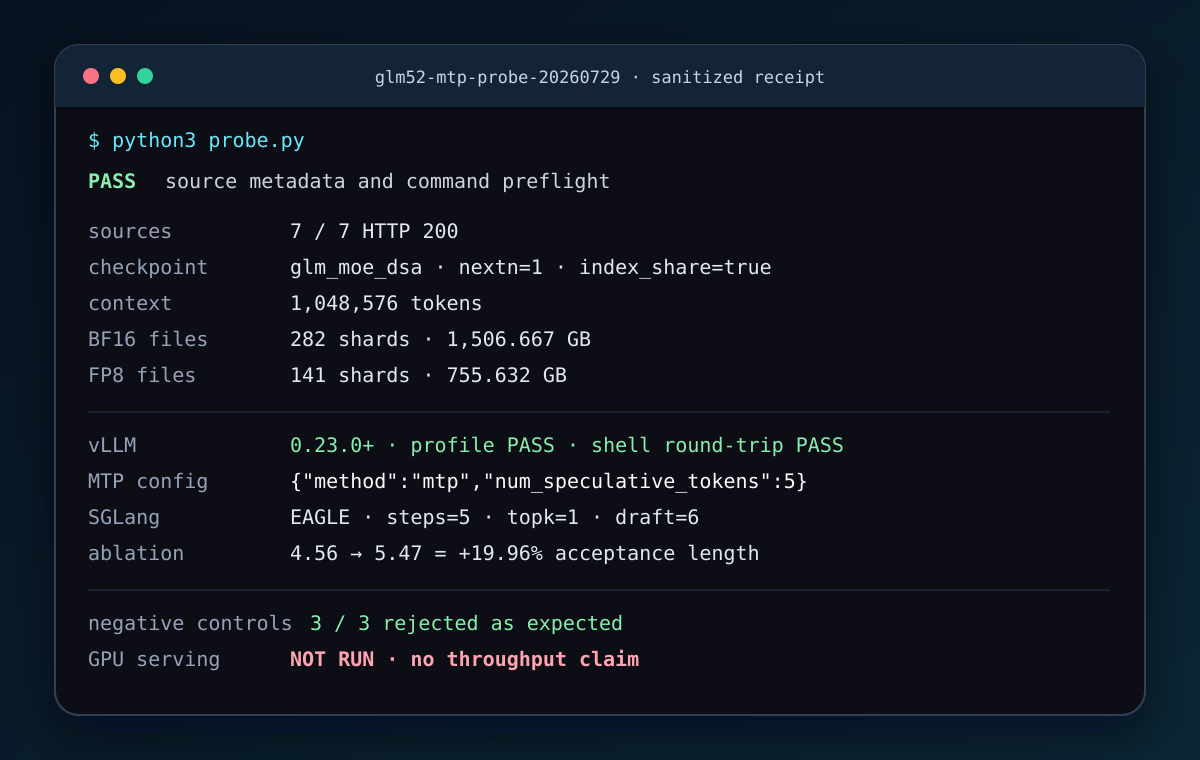
The terminal is reconstructed from the archived JSON result. It is not a staged server run. Source bodies, model weights, credentials and provider responses are absent.
The disposable container recorded:
| Preflight case | Observed result |
|---|---|
| Public documents | 7/7 returned HTTP 200 |
| Pinned config | architecture, 1M position cap, one nextn layer and MTP IndexShare matched |
| vLLM contract | version floor, five-token JSON and shell round trip passed |
| SGLang contract | EAGLE 5 / 1 / 6 markers matched the published recipe |
| Zero draft tokens | rejected |
Generic draft_model method |
rejected for the native-MTP profile |
| Missing nextn layer | rejected |
| GPU serving and throughput | intentionally not run |
Download the
sanitized machine-readable receipt.
It includes the checked source URLs, response hashes, revisions, file totals
and scope flags. A status: pass in that file means “safe to begin a
hardware canary,” not “safe to send production traffic.”
Budget model files before KV cache
Section titled “Budget model files before KV cache”The Hugging Face APIs reported 282 BF16 safetensor shards totaling 1,506.667 decimal GB and 141 FP8 shards totaling 755.632 GB. The current vLLM recipe lists planning minimums of 1,786 GB and 893 GB respectively.
FP8 = 893.000 - 755.632 = 137.368 GB (18.18% over file bytes)BF16 = 1,786.000 - 1,506.667 = 279.333 GB (18.54% over file bytes)Do not call that difference “free KV cache.” Checkpoint bytes and runtime VRAM are different quantities. Weight loading, quantization metadata, CUDA or ROCm graphs, DSA kernels, communication buffers, fragmentation, KV dtype, context and concurrent sequences all consume memory.
The local GLM-5.2 hardware guide covers the broader storage and quantization decision. For MTP, leave additional graph and verification headroom and start with a representative long-output request before raising concurrency.
Choose an initial speculative depth
Section titled “Choose an initial speculative depth”The vLLM recipe’s five-token profile is a documented starting point, not an optimization result for your traffic. Use this decision ladder:
- begin at the current recipe depth only on the engine version the recipe names;
- log mean acceptance length and per-position acceptance;
- split metrics by prompt class, output length and tool versus plain text;
- reduce depth if later positions are usually rejected or latency rises;
- increase depth only when acceptance remains near saturation and the engine documents the higher value;
- rerun output-integrity and stability tests after every change.
For a conservative first canary, depth one can reduce the number of moving parts. vLLM’s generic MTP documentation suggests a small value as a safe starting point. The GLM-specific recipe publishes five because the checkpoint was designed for a longer native path. Which starting point is better depends on whether your immediate goal is compatibility isolation or recipe-level performance.
Record the reason with the value:
model_revision: b4734de4facf877f85769a911abafc5283eab3d9engine: vllmengine_version: 0.23.0speculative_method: mtpnum_speculative_tokens: 5selection_basis: official GLM-5.2 recipe checked 2026-07-29promotion_dataset: sanitized-coding-agent-v3rollback: remove speculative_config and restart the same imageStop or roll back on six failure signals
Section titled “Stop or roll back on six failure signals”Server rejects the profile before loading
Section titled “Server rejects the profile before loading”Confirm the engine floor and checkpoint architecture. Validate the JSON as one argument and require a positive integer. Our zero-depth control failed before hardware work. Do not “fix” native MTP by supplying an unrelated draft model.
Model loads but the first long request runs out of memory
Section titled “Model loads but the first long request runs out of memory”Lower --max-model-len, sequence concurrency or graph-capture scope before
changing weight precision. Record startup free memory and the first
representative request peak. A 1M config value is capacity metadata, not a
promise that one chosen topology can allocate the KV cache.
Acceptance collapses below the chosen draft depth
Section titled “Acceptance collapses below the chosen draft depth”Break the aggregate down by workload. Natural prose, repetitive code, reasoning and tool JSON can have different predictability. Lower the draft count when later positions are mostly rejected. If mean acceptance remains near one, disable MTP: the verifier is committing little extra work.
Tail latency rises despite a faster average
Section titled “Tail latency rises despite a faster average”Inspect p95/p99 time per output token and end-to-end latency, not tokens per second alone. Batch scheduling and speculative verification may help throughput while hurting an interactive user. Promote separate profiles for batch and chat if their objectives differ.
Tool JSON or reasoning delimiters corrupt
Section titled “Tool JSON or reasoning delimiters corrupt”Compare exact parser success with MTP off. vLLM issue #34449 documented a historical GLM-5 malformed-tool regression under MTP; later discussion describes it as fixed in 0.20.0. That does not prove a current GLM-5.2 bug, but it establishes a valuable regression test. Require valid JSON, exact tool name, schema-valid arguments and a complete reasoning boundary before promotion.
Workers hang under sustained traffic
Section titled “Workers hang under sustained traffic”Run a soak test longer than the expected failure interval and alert on an engine that restarts while its outer container remains alive. The open GLM-5.1 vLLM report #40926 describes MTP-related hangs under sustained traffic. It is not a measured GLM-5.2 incidence rate. Use it to design the canary: request timeout, engine health probe, restart counter and a ready rollback profile with MTP removed.
Decide between native MTP, DSpark and no speculation
Section titled “Decide between native MTP, DSpark and no speculation”| Route | Extra model | First reason to choose it | First reason to reject it |
|---|---|---|---|
| Native MTP | none beyond GLM-5.2 | Current official vLLM and SGLang recipes support the checkpoint’s built-in head. | Acceptance or latency fails your A/B gate; parser/stability regression appears. |
| vLLM DSpark | external RedHatAI/GLM-5.2-speculator.dspark in the current recipe |
You have the exact supported image, hardware and workload to test the separate seven-token route. | Adds another checkpoint and compatibility surface; not equivalent to native MTP. |
| No speculation | none | Lowest-complexity control, rollback target, or workload with poor acceptance. | Leaves a measured native-MTP gain unused when latency or throughput is constrained. |
| AngelSpec/DFly | project-specific draft assets | Only after Tencent or an independent reproducer publishes GLM-5.2 compatibility and a complete recipe. | No GLM-5.2 compatibility evidence was found in this operation. |
Keep “off” as a first-class production profile. A rollback that requires editing several unrelated flags is not a safe rollback.
Move from preflight to production canary
Section titled “Move from preflight to production canary”Use four gates:
[ ] Source gate    exact model and engine revisions are pinned    checkpoint exposes nextn and IndexShare fields
[ ] Load gate    all ranks start and report healthy    representative long prompts fit with reserved memory
[ ] Correctness gate    plain text, reasoning and tool fixtures match the baseline contract    malformed, truncated and duplicate tool actions remain zero
[ ] Performance gate    repeated real-workload runs beat variance    p50 and p95 latency stay inside their separate budgets    acceptance stays healthy by prompt class    a sustained soak completes without engine restart
Canary a small traffic slice and retain both profiles. Capture engine commit, GPU topology, driver, kernels, speculative config and dataset hash beside each result. A later image, model revision or parser change invalidates the old acceptance conclusion.
The decisive metric is accepted work per constrained resource—not the largest draft number or one synthetic tokens-per-second headline.
Audit the MTP sources and measurement boundary
Section titled “Audit the MTP sources and measurement boundary”Primary and authoritative references:
- Z.ai GLM-5.2 architecture and MTP ablation
- Z.ai GLM-5 series repository and serving floors
- Pinned GLM-5.2 checkpoint config
- vLLM GLM-5.2 recipe
- vLLM speculative-decoding configuration
- vLLM speculative metrics implementation
- SGLang GLM-5.2 deployment recipe
The complete sanitized probe, exact revisions, hashes, bridge failure,
approved network exception and cleanup receipt live under
docs/evidence/glm-5-2-mtp-speculative-decoding-2026-07-29/.
We did not use a hosted Z.ai or OpenRouter request because a managed API response cannot reveal whether its provider enabled MTP. We did not download weights or rent a qualifying cluster. Performance fields in this guide are therefore either labeled publisher evidence, reproducible arithmetic, or instructions for the reader’s own A/B run.
Answer common GLM-5.2 MTP questions
Section titled “Answer common GLM-5.2 MTP questions”Does GLM-5.2 support speculative decoding?
Section titled “Does GLM-5.2 support speculative decoding?”Yes. The official config exposes one nextn prediction layer and MTP IndexShare, while current vLLM and SGLang GLM-5.2 recipes publish native speculative profiles. Engine and hardware compatibility still need a versioned test.
Is GLM-5.2 twenty percent faster with MTP?
Section titled “Is GLM-5.2 twenty percent faster with MTP?”That conclusion is not supported by the cited ablation. The reported number is a 19.96% acceptance-length increase, rounded to 20%, in a specified training experiment. Measure end-to-end speed on your own engine, hardware and workload.
Should vLLM use five or SGLang use six draft tokens?
Section titled “Should vLLM use five or SGLang use six draft tokens?”Use the current recipe for the chosen engine as a starting point. The engines express their paths differently. Tune against observed acceptance and user-visible latency instead of trying to make the numbers look identical.
Can I verify MTP through the Z.ai or OpenRouter API?
Section titled “Can I verify MTP through the Z.ai or OpenRouter API?”No reliable client-side response field proves the provider’s internal serving configuration. You can benchmark a hosted route, but you cannot attribute its latency to MTP without provider evidence.
Do I need a separate draft model?
Section titled “Do I need a separate draft model?”Not for native GLM-5.2 MTP. vLLM’s native profile omits a draft model. Optional routes such as DSpark do add an external speculator and must be tested as a separate deployment.
What is the safest rollback?
Section titled “What is the safest rollback?”Remove only the speculative configuration, restart the exact same pinned engine image with the same model and parser flags, and route canary traffic back after health and correctness checks pass. Keep that baseline profile tested before enabling MTP.