
GLM-5.2 Coding Plan vs API vs Self-Hosting: Choose by Workload
Independent research — not an official Z.ai publication.Identity and provider disclosure

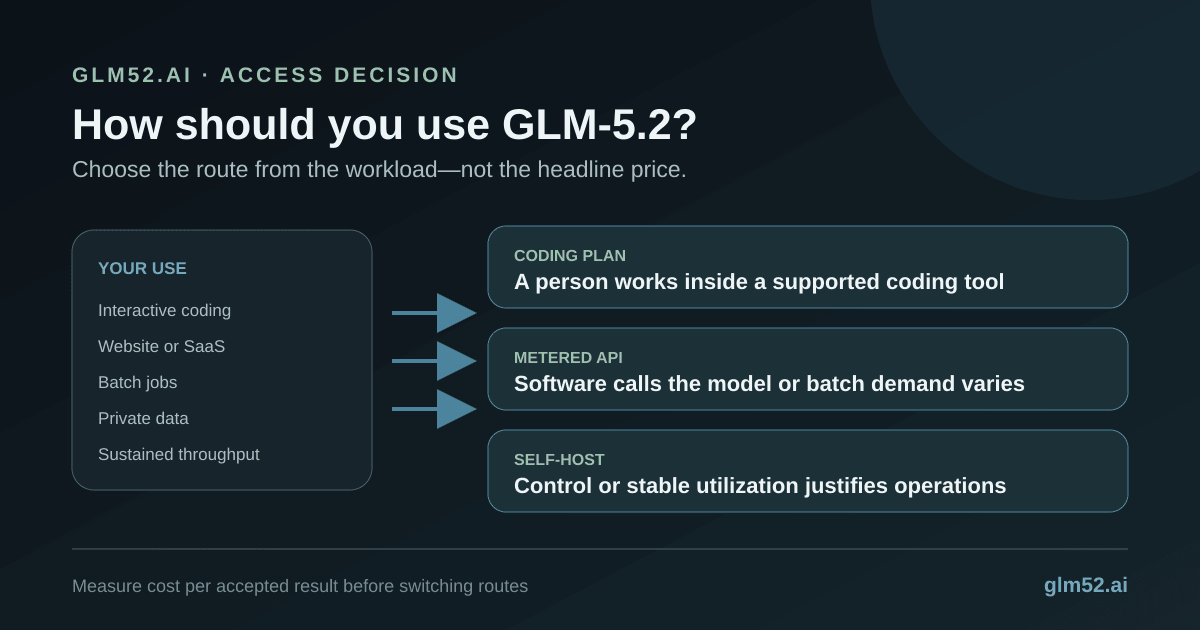
GLM-5.2 Coding Plan, API and self-hosting solve different jobs. The plan sells a quota for supported coding tools. The API sells model tokens to software. Self-hosting gives you the weights and the operations burden. Comparing only their headline monthly prices produces the wrong answer.
This guide begins with what you do, then sends you to one next step.
In this guide
Section titled “In this guide”- Choose from five workload paths
- Path 1: interactive coding tools
- Path 2: website or SaaS calls
- Path 3: batch tasks
- Path 4: private data
- Path 5: sustained high throughput
- The three options at a glance
- When to switch routes
- A safe buying sequence
- Affiliate disclosure
Choose from five workload paths
Section titled “Choose from five workload paths”Path 1: interactive coding tools
Section titled “Path 1: interactive coding tools”Your use looks like this
Section titled “Your use looks like this”You open Claude Code, OpenCode, Cline or another supported agent. You ask it to inspect a repository, edit files, run tests and continue a task. A person reviews the work. Usage arrives in bursts during a workday.
Choose Coding Plan
Section titled “Choose Coding Plan”The GLM Coding Plan starts at $18 per month and uses a dedicated coding endpoint. Z.ai applies rolling five-hour and weekly quotas, with higher concurrency guidance for higher tiers. It restricts the subscription to supported tools and individual use.
That product boundary matters. A Coding Plan API key can look like a normal key, but the subscription is not a cheap token bucket for your SaaS backend. Z.ai documents separate base URLs for supported coding tools and general API use.
Choose the plan when:
- one developer or operator uses the model interactively;
- your tool appears in Z.ai’s current supported list;
- a predictable subscription matters more than per-request accounting;
- rolling quota and peak-hour limits fit your work pattern;
- you want the plan’s current MCP services for supported environments.
Stay with a metered API when your tool is unsupported, a team shares one backend, or a workflow needs guaranteed application-level capacity.
If Claude Code is your client, use the GLM-5.2 Claude Code setup guide for the Anthropic-compatible endpoint, [1m] model map, context budget, /status verification, and safe failure checks. If OpenCode is your client, follow the GLM-5.2 OpenCode setup guide for a copyable opencode.json, the Coding Plan endpoint, a real read-tool verification, and focused 401 or context-limit fixes.
Path 2: website or SaaS calls
Section titled “Path 2: website or SaaS calls”Your use looks like this
Section titled “Your use looks like this”Your server sends requests after a user action, a webhook or an application event. You need separate API keys, budgets, logs, timeouts, retries and an uptime plan. Many users may share the same model integration.
Choose a metered API
Section titled “Choose a metered API”An API matches this job because software pays for measured token use. It lets you set per-request ceilings, isolate environments, record usage and switch providers. Coding Plan terms do not fit this shared application traffic.
Start with two decisions:
- Use the provider comparison and Z.ai quick-access table to choose first-party behavior, a direct third-party route or a gateway, then open the correct login, key or endpoint route.
- Use the cost calculator with real input, output, cache and retry estimates.
The direct Z.ai and Novita list rates in our July 17 snapshot are $1.40/M fresh input, $0.26/M cached input and $4.40/M output. OpenRouter’s balanced route was lower in its dynamic catalog, then adds a 5.5% pay-as-you-go funding fee.
Choose Z.ai direct when publisher alignment and a simple route matter. Choose Novita for an OpenAI-compatible FP8 endpoint with account-level metrics. Choose OpenRouter for quick model switching, fallback and provider-policy controls.
For production, validate JSON and tool calls, cap automatic retries, store provider and model IDs, and add a fallback that cannot create an unlimited cost loop.
Path 3: batch tasks
Section titled “Path 3: batch tasks”Your use looks like this
Section titled “Your use looks like this”You process a document archive, migrate repositories, classify records, generate tests or run research jobs. Work can queue. The deadline matters more than interactive latency. Volume may change from one month to the next.
Measure an API first
Section titled “Measure an API first”Batch work benefits from the API during discovery:
- you pay only when jobs run;
- you can replay a sample through several providers;
- queueing smooths RPM and concurrency limits;
- you can stop after the batch without leaving GPUs idle;
- per-job logs reveal actual prompt, output and retry distributions.
Do not estimate one giant average. Separate short, medium and long jobs. Use the calculator once for each group, then add the totals. Set the cache rate to zero until the billing response confirms hits.
Move toward self-hosting or a dedicated endpoint only when several months show stable demand and the API bill approaches a measured infrastructure alternative. A single large migration often remains cheaper on API because a full GLM-5.2 node has a high hourly floor and a cold-start cost.
Next step: calculate the batch with retry and cache assumptions.
Path 4: private data
Section titled “Path 4: private data”Your use looks like this
Section titled “Your use looks like this”Prompts contain source code, customer records, contracts, security findings, health information or other confidential data. Your organization may require a region, processor list, deletion term, audit right or private network.
Choose the data boundary first
Section titled “Choose the data boundary first”The strongest control path is self-hosting inside an environment you secure and operate. The strongest practical managed path is an enterprise API contract that names the region, processors, retention, support access, incident duties and deletion process.
Provider statements in our comparison offer useful starting points:
- Z.ai’s business API DPA says request content is processed in real time and not stored, with customer data generally processed in Singapore.
- Novita’s terms say it does not log, store or retain inputs and outputs without prior written consent.
- OpenRouter says it does not store prompt content by default, supports ZDR routing, and offers EU in-region routing to approved enterprise accounts; the selected model provider remains in the chain.
Do not turn these summaries into a compliance claim. Obtain the current contract and have the responsible security or legal owner review it.
Choose self-hosting when a managed route cannot meet a hard boundary, you need a fixed checkpoint, or network isolation outweighs the operations burden. The hardware guide explains why the official FP8 deployment begins at a datacenter-class multi-GPU node.
Path 5: sustained high throughput
Section titled “Path 5: sustained high throughput”Your use looks like this
Section titled “Your use looks like this”Traffic runs through most hours, token mix stays stable, the queue keeps accelerators busy, and the monthly API bill repeats. Your team can operate inference, security, monitoring and failure recovery.
Benchmark API and self-hosting on accepted output
Section titled “Benchmark API and self-hosting on accepted output”The companion calculator uses a transparent RunPod floor: 8×H200 SXM at $4.31 per GPU-hour for 730 hours, or $25,170.40 per month before storage, network and staff. That node follows the official FP8 recipe with a 131,072-token serving limit. Full one-million-token service needs a different capacity plan.
A spend crossover does not prove a throughput crossover. Benchmark:
- accepted tasks per hour, not raw generated tokens;
- p50, p95 and p99 latency at target concurrency;
- time to first token and output tokens per second;
- tool-call and structured-output pass rate;
- model-server crashes, out-of-memory failures and restarts;
- GPU utilization, queue time and idle hours;
- full cost for storage, network, monitoring and on-call work.
Self-host only when a rented pilot meets the workload. Keep an API fallback for maintenance and unexpected bursts.
The three options at a glance
Section titled “The three options at a glance”| Decision | Coding Plan | Metered API | Self-hosted |
|---|---|---|---|
| Primary user | A person in a supported coding tool | Software, teams and products | Infrastructure team |
| Billing unit | Subscription quota | Input, cache and output tokens | GPU time plus operations |
| Starts near | $18/month for Lite | $0 when idle; pay for usage | Tens of dollars per hour for an official FP8 node |
| Context | Tool and plan rules apply | Provider contract applies | Your runtime and hardware limit |
| Concurrency | Tier and dynamic limits | Account RPM/TPM and provider capacity | Your server throughput and queue |
| Data path | Z.ai coding service and connected tools | Provider and any gateway | Infrastructure you control |
| Best advantage | Simple budget for interactive coding | Low commitment and elastic usage | Fixed weights and maximum control |
| Main risk | Quota, supported-tool and peak-hour limits | Cost growth, routing and provider failure | Idle capacity, complexity and large hardware floor |
| Wrong use | SaaS backend or shared general API | Pretending list price proves reliability | Buying GPUs before a workload benchmark |
When to switch routes
Section titled “When to switch routes”Coding Plan → API
Section titled “Coding Plan → API”Switch when a workflow leaves the supported tool, serves multiple end users, needs application keys and budgets, or requires capacity beyond plan rules. Do not bypass Coding Plan restrictions with an unsupported integration.
API → Coding Plan
Section titled “API → Coding Plan”Switch a developer’s interactive agent work when the $18 subscription fits the tool and quota. Keep product traffic on the API.
API → self-hosted
Section titled “API → self-hosted”Begin a pilot when the API bill remains close to a realistic dedicated cost for several months, privacy requires control, or a fixed checkpoint matters. Complete the pilot before migration.
Self-hosted → API
Section titled “Self-hosted → API”Move variable, low-utilization or burst traffic back to an API when GPUs sit idle, queue delays grow, or operations cost exceeds the token premium. A hybrid route often works better than an all-or-nothing choice.
A safe buying sequence
Section titled “A safe buying sequence”- Name the workload: interactive coding, SaaS, batch, private data or sustained throughput.
- Create an acceptance set: real prompts, tool schemas, expected outputs and failure rules.
- Measure tokens: record input, cached input, output, retries and accepted results.
- Calculate cost: use the cost calculator with conservative inputs.
- Check the operating contract: context, output, rate limits, region, retention, logs, support and SLA.
- Start with the reversible route: a subscription month, prepaid API credit or a rented node.
- Switch only from evidence: compare cost per accepted task and the operational burden.
This sequence prevents the most expensive error: choosing an access route from a model benchmark or headline price before measuring the work it must perform.
Sources and limits
Section titled “Sources and limits”Product details were checked on July 17, 2026 against the Z.ai Coding Plan overview, usage policy, GLM-5.2 model guide, API pricing, official Hugging Face repository, vLLM deployment recipe, Novita model page and RunPod pricing.
We did not purchase the products, run a paid provider load test or audit any provider’s controls. Selection guidance combines published facts with transparent engineering judgment. Verify current checkout price, quota, region and capacity before purchasing.
Affiliate disclosure
Section titled “Affiliate disclosure”This page contains affiliate links to Z.ai, Novita, RunPod and Vast.ai. GLM52.ai may receive compensation after qualifying referrals. Each CTA states the buyer benefit we could verify or says when no link-only benefit was found. Affiliate relationships did not change the decision paths, price math or warnings. Provider terms control every discount, credit, price and eligibility rule.