
GLM-5.2 vs DeepSeek V4: 1M Context Cost
Independent research — not an official Z.ai publication.Identity and provider disclosure

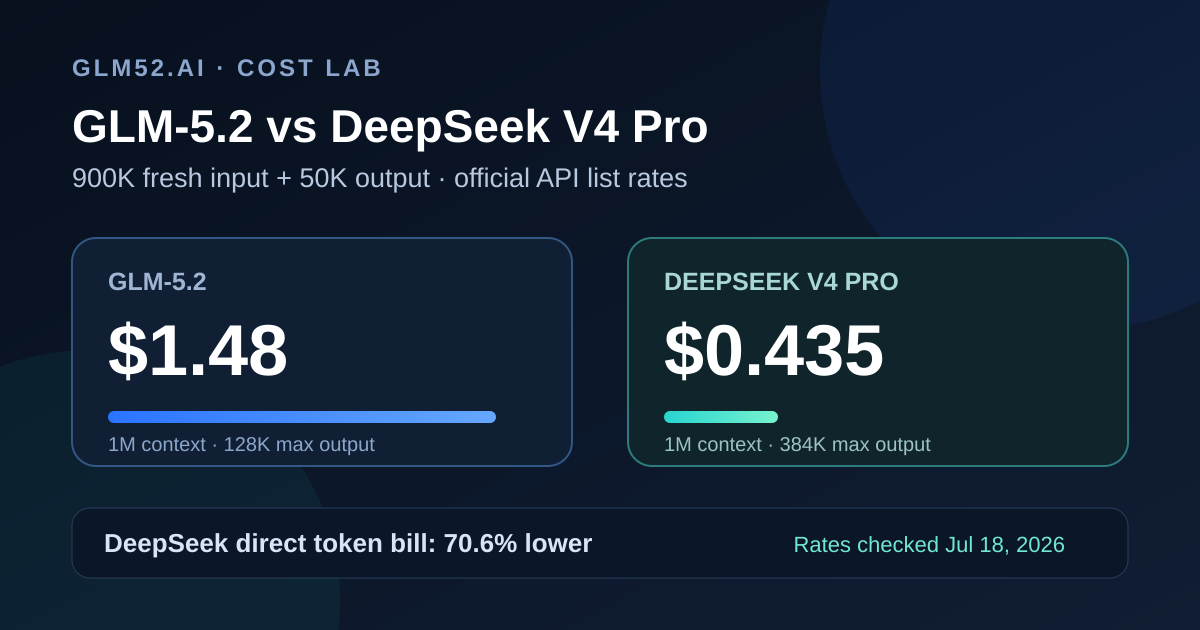
Both GLM-5.2 and DeepSeek V4 Pro advertise a one-million-token context window. That shared headline invites a useful, narrow question: what does the same long-context job cost?
This article answers that question with official direct-API prices and visible arithmetic. It does not claim an independent quality, latency, or reliability test. We label product facts, calculations, and selection advice so you can audit each step.
In this guide
Section titled “In this guide”- The direct answer
- The official rates
- A 950K-token worked example
- What a cache hit changes
- The retry break-even point
- What 1M context means
- Which model fits each case
- Questions people ask
- Sources and method
The direct answer
Section titled “The direct answer”DeepSeek V4 Pro wins this direct token-price comparison. The gap comes from all three billing lines: fresh input, cached input, and output.
| 900K input + 50K output | GLM-5.2 | DeepSeek V4 Pro | DeepSeek saving |
|---|---|---|---|
| Fresh input | $1.4800 | $0.4350 | 70.6% |
| Cached input | $0.4540 | $0.0468 | 89.7% |
| Context window | 1M | 1M | Same stated capacity |
| Maximum output | 128K | 384K | DeepSeek adds 256K |
The fresh-input example makes GLM-5.2 3.40 times the direct token cost of DeepSeek V4 Pro. The cached-input example raises that ratio to 9.71 times.
Those ratios compare token bills, not accepted results. A cheap failed run can cost more than an expensive clean run. A provider can impose account limits, regional capacity, cache rules, or service terms that change the practical choice.
The official rates
Section titled “The official rates”Z.ai’s pricing page lists these GLM-5.2 rates per one million tokens:
- fresh input: $1.40;
- cached input: $0.26;
- output: $4.40.
DeepSeek’s pricing page lists these V4 Pro rates per one million tokens:
- cache-miss input: $0.435;
- cache-hit input: $0.003625;
- output: $0.87.
DeepSeek launched V4 Pro on April 24, 2026. Its release note and change log name the API model deepseek-v4-pro. The price page warns that rates can change. Treat this article as a dated calculation, then check both billing pages before a purchase.
The comparison uses each vendor’s standard direct endpoint. Gateways, coding plans, credits, discounts, and hosted open-weight services can quote another price.
A 950K-token worked example
Section titled “A 950K-token worked example”We use 900,000 input tokens and 50,000 output tokens. The combined 950,000-token shape sits below each stated one-million-token context ceiling and keeps output below the two published output limits.
The formula stays simple:
Cost = input tokens ÷ 1,000,000 × input rate + output tokens ÷ 1,000,000 × output rate
GLM-5.2
Section titled “GLM-5.2”(900,000 ÷ 1,000,000 × $1.40)+ (50,000 ÷ 1,000,000 × $4.40)= $1.26 + $0.22= $1.48DeepSeek V4 Pro
Section titled “DeepSeek V4 Pro”(900,000 ÷ 1,000,000 × $0.435)+ (50,000 ÷ 1,000,000 × $0.87)= $0.3915 + $0.0435= $0.435One DeepSeek run saves $1.045. One thousand jobs with the same billed token counts would cost $1,480 on GLM-5.2 and $435 on DeepSeek V4 Pro, a $1,045 gap before taxes, credits, and provider fees.
Use our GLM-5.2 cost calculator when your workload has another request count, cache rate, retry rate, or output ratio. The calculator covers GLM providers; this article adds the dated DeepSeek V4 Pro comparison.
What a cache hit changes
Section titled “What a cache hit changes”Prompt caching rewards repeated prefixes such as a system prompt, tool catalog, policy set, or stable document pack. The provider decides whether a token earns the cache rate. A repeated prompt does not create a valid hit by itself.
If all 900K input tokens in our example earn the published cache rate, the math becomes:
| Cached-input calculation | GLM-5.2 | DeepSeek V4 Pro |
|---|---|---|
| 900K cached input | $0.2340 | $0.0033 |
| 50K output | $0.2200 | $0.0435 |
| Total | $0.4540 | $0.0468 |
DeepSeek saves about $0.4072 per cached job. Its cache-hit price creates most of this gap. Output now forms 93% of the DeepSeek bill, so shorter answers can matter more than another cache gain.
This case describes a full input cache hit. Many workloads mix fresh and cached tokens. Read the usage fields in your API response or invoice, then split the input line:
Input cost = fresh input × fresh rate + cached input × cached rate
Tokenizers can count the same text in different ways. Compare billed input and output tokens from each endpoint when you move from planning to production.
The retry break-even point
Section titled “The retry break-even point”Cheap tokens create room for retries, but retries consume the price lead. Our fresh-input DeepSeek job costs $0.435. The GLM job costs $1.48.
$1.48 ÷ $0.435 = 3.40DeepSeek can fund three complete attempts plus 40% of a fourth before its same-token bill reaches one GLM attempt. The fourth complete DeepSeek attempt would cost $1.74 and cross the GLM bill.
This calculation gives teams a stronger metric than price per token:
Cost per accepted result = total cost of every attempt ÷ accepted outputs
If GLM passes your task in one attempt while DeepSeek needs four same-size attempts, GLM wins this narrow cost-per-success case. If both pass in one attempt, DeepSeek keeps the 70.6% price lead. Measure pass rate with the same prompt, tools, files, time limit, and acceptance test.
We did not run that test. The 3.40-attempt point is arithmetic, not a model-quality claim.
What 1M context means
Section titled “What 1M context means”Z.ai’s model guide lists a 1M context and 128K maximum output for GLM-5.2. DeepSeek’s model table lists a 1M context and 384K maximum output for V4 Pro.
The context number describes capacity. It does not promise equal recall, reasoning, speed, or useful output across the full window.
Two research results explain the gap:
- The peer-reviewed Lost in the Middle study found that information position can change long-context answer quality. Models often handled facts near the start or end better than facts in the middle.
- The RULER paper added multi-hop and aggregation tasks to simple retrieval tests. Its authors found large performance drops as context and task complexity grew across the models they studied.
These papers predate GLM-5.2 and DeepSeek V4, so they do not rank the two models. They support a sound buying rule: treat one million tokens as a capacity claim and test effective context on your task.
A smaller, selected context can improve cost and focus. Retrieval, document filters, source labels, and section summaries can remove text that does not help the answer. Keep key instructions and decision facts easy to find.
Which model fits each case
Section titled “Which model fits each case”Choose DeepSeek V4 Pro when token cost leads the decision
Section titled “Choose DeepSeek V4 Pro when token cost leads the decision”DeepSeek V4 Pro makes the stronger starting point for repeated long-document analysis, large codebase reads, batch research, and agents that need many attempts under a fixed API budget. Its 384K output limit can serve rare jobs that exceed GLM’s 128K limit.
Check privacy terms, region, rate limits, account access, and output quality before production. Low list prices do not replace those checks.
Choose GLM-5.2 when your tested workflow earns more than the price gap
Section titled “Choose GLM-5.2 when your tested workflow earns more than the price gap”GLM-5.2 can make sense when your prompts, tools, and acceptance tests produce a higher success rate in the GLM stack. It can fit teams that need GLM’s provider ecosystem or its downloadable MIT-licensed weights. The official GLM-5.2 model card documents the open checkpoint and license.
Compare direct endpoints in our GLM-5.2 API provider guide. For a broader delivery choice, use the Coding Plan, API, or self-hosting guide.
Keep the decision tied to accepted work
Section titled “Keep the decision tied to accepted work”Run five to ten representative tasks. Record input tokens, cache hits, output tokens, retries, pass rate, human corrections, latency, and error codes. Then compare cost per accepted result. This small test answers more than a broad benchmark table because it matches your tool shell and finish line.
Questions people ask
Section titled “Questions people ask”Is DeepSeek V4 Pro cheaper than GLM-5.2?
Section titled “Is DeepSeek V4 Pro cheaper than GLM-5.2?”Yes at the official direct-API rates checked on July 18, 2026. The worked 900K-input and 50K-output job costs $0.435 on DeepSeek V4 Pro and $1.48 on GLM-5.2. Check current rates before purchase.
Do both models support one million tokens?
Section titled “Do both models support one million tokens?”Yes. Both vendor guides list a 1M context. GLM lists 128K maximum output, while DeepSeek lists 384K. A gateway or product plan can expose another limit.
Does one million tokens equal one million words?
Section titled “Does one million tokens equal one million words?”No. A token can represent a word, part of a word, punctuation, code, or another text unit. Language and tokenizer choices change the count. Use the provider tokenizer or API usage report for budget work.
Does prompt caching make every repeated request cheap?
Section titled “Does prompt caching make every repeated request cheap?”The provider must report a cache hit for the lower rate to apply. Prompt order, prefix stability, cache lifetime, account rules, and endpoint behavior shape the hit rate. Plan with a measured cache ratio.
Which model gives better long-context answers?
Section titled “Which model gives better long-context answers?”This price comparison cannot answer that question. Test retrieval, synthesis, instruction recall, tool use, and accepted output on your own documents. Track the position of key facts and the number of retries.
Sources and method
Section titled “Sources and method”Primary sources and research checked July 18, 2026:
- Z.ai model pricing — GLM-5.2 fresh input, cached input, and output rates.
- Z.ai GLM-5.2 guide — context window, output limit, and product capabilities.
- GLM-5.2 model card — checkpoint, license, architecture, and vendor evaluation notes.
- DeepSeek model pricing — V4 Pro prices, context, output limit, and concurrency listing.
- DeepSeek V4 release note — release date, model names, architecture claims, and API availability.
- DeepSeek API change log — current model IDs and legacy alias retirement date.
- Lost in the Middle, TACL 2024 — peer-reviewed evidence on information position in long contexts.
- RULER, COLM 2024 — long-context tests beyond single-fact retrieval.
We searched the live sitemap and found no DeepSeek V4 page. We then reviewed current search results for GLM-5.2 and DeepSeek V4 comparisons; several fresh comparison pages and user discussions showed active demand. We chose the narrower cost question to avoid another broad benchmark article.
All calculations use the listed USD price per one million tokens. We held billed token counts constant, rounded the displayed totals to four decimal places, and excluded tax, credits, gateway fees, storage, network cost, human review, and self-hosting. We did not buy or benchmark either API for this article.