
Evaluate GLM-5.2 with Inspect AI
Independent research — not an official Z.ai publication.Identity and provider disclosure

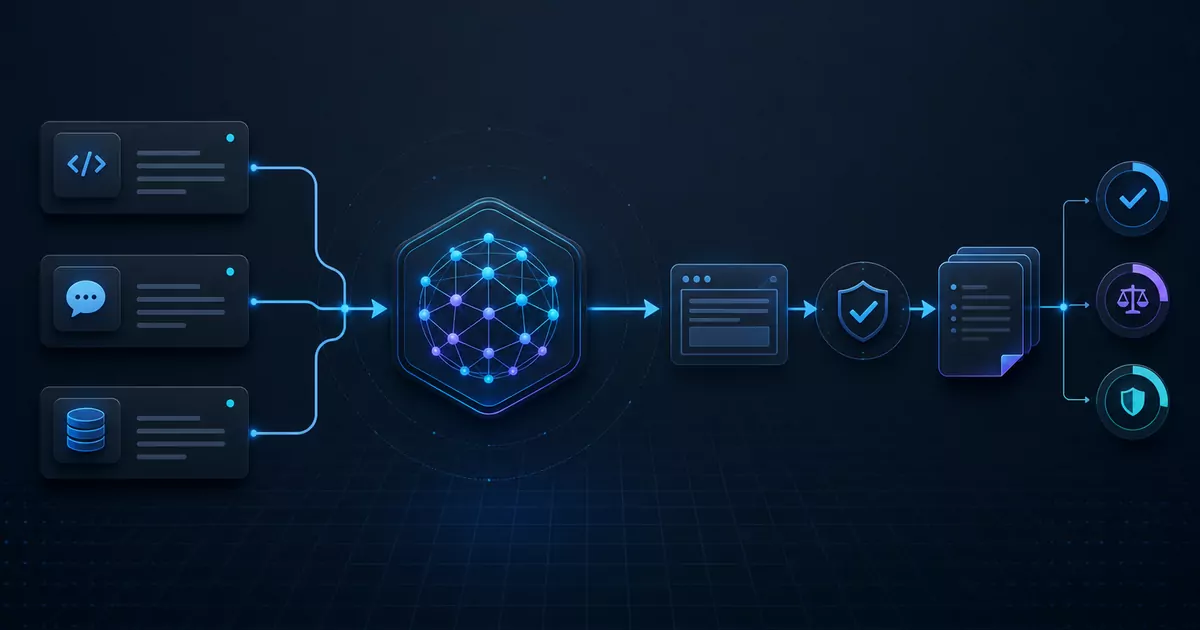
Original editorial diagram of the evaluation boundary: task cases enter one model route, the API envelope is verified, and only then do logs and scores become evidence. It contains no real dashboard data.
Use openai-api/zai/glm-5.2, set ZAI_API_KEY and
ZAI_BASE_URL=https://api.z.ai/api/paas/v4, and keep the Responses API off
until Z.AI documents that route. Start with one deterministic task, one
connection, a small output cap and no automatic retry. Inspect the first API
envelope and eval log before expanding the suite.
That configuration follows Inspect’s documented
OpenAI-compatible provider convention
and Z.AI’s documented general API endpoint.
Our no-network audit observed all three requests at
/api/paas/v4/chat/completions, preserved model: glm-5.2, applied bearer
authentication, forwarded max_tokens: 16 and temperature: 0, recovered
three exact completions, and finished the log with status success.
Follow the GLM-5.2 Inspect AI workflow
Section titled “Follow the GLM-5.2 Inspect AI workflow”- Choose Inspect for the right evaluation job
- Freeze the route and package versions
- Install a pinned environment
- Build the smallest auditable task
- Run one bounded evaluation
- Verify the request before trusting the score
- Read the eval log as evidence
- Design a scorer that matches the contract
- Graduate from fixture to live GLM-5.2
- Diagnose failures by layer
- Audit the dated sources and limits
- Resolve common Inspect AI questions
Choose Inspect for the right evaluation job
Section titled “Choose Inspect for the right evaluation job”Inspect AI is an evaluation framework from the UK AI Security Institute. A task combines a dataset, a solver that elicits model output, and one or more scorers. Each run writes an eval log that keeps task configuration, model events, samples, output and scores available for inspection.
That is useful when the question is not “is GLM-5.2 good?” but a smaller, testable contract:
| Production risk | Inspect task | Observable pass condition |
|---|---|---|
| A route silently points at the wrong API | one marker prompt | the captured path, model and response shape match the frozen profile |
| A parser accepts extra prose | one exact or schema-bound sample | the scorer rejects output outside the declared contract |
| A prompt revision changes behavior | a pinned dataset with stable sample IDs | the new log can be compared with the prior revision |
| A long agent trace fails | a task with tools, limits and event inspection | the log separates transport, generation, tool and scoring failures |
Do not begin with a giant benchmark. A hundred samples through the wrong base URL create a precise-looking answer to the wrong question. First prove that the model route, request fields, task revision and scorer are the ones you intended to test.
This page is deliberately distinct from the GLM-5.2 smevals workflow. That guide owns a small file-based runner, two real API receipts and offline rubric regrading. This guide owns Inspect’s provider adapter, Python task composition, model-event inspection and eval-log boundary.
Freeze the route and package versions
Section titled “Freeze the route and package versions”The checked profile is:
| Layer | Pinned value | Why it matters |
|---|---|---|
| Inspect AI | 0.3.249 |
freezes task, model-adapter, scorer and log behavior |
| OpenAI client | 2.48.0 |
freezes the compatible HTTP client used by the adapter |
| Inspect model name | openai-api/zai/glm-5.2 |
maps the provider label zai to scoped environment variables |
| API key variable | ZAI_API_KEY |
follows Inspect’s uppercased provider convention |
| Base URL variable | ZAI_BASE_URL |
prevents the request from falling back to another provider host |
| Z.AI general base | https://api.z.ai/api/paas/v4 |
selects the documented metered API, not Coding Plan |
| API family | Chat Completions | matches Z.AI’s published /chat/completions example |
| Responses API | false |
prevents an unverified API-family switch |
Inspect documents model names as
openai-api/<provider-name>/<model-name>. It derives the variables
<PROVIDER_NAME>_API_KEY and <PROVIDER_NAME>_BASE_URL; hyphens in the
provider name become underscores. Therefore zai resolves to the two ZAI_*
variables above. Calling the model openai/glm-5.2 would select a different
provider adapter and credential namespace.
Z.AI publishes https://api.z.ai/api/paas/v4 as its general endpoint and
shows glm-5.2 at /chat/completions with bearer authentication. Its
GLM-5.2 model guide describes a text-in,
text-out model with a one-million-token context and several reasoning controls.
Those capabilities do not make every Inspect feature automatically compatible;
test tools, structured output, streaming, reasoning fields and long context as
separate profiles.
Install a pinned environment
Section titled “Install a pinned environment”Use an isolated virtual environment and record the interpreter as well as the package versions:
python3 -m venv .venv. .venv/bin/activatepython -m pip install --upgrade pippython -m pip install "inspect-ai==0.3.249" "openai==2.48.0"python - <<'PY'from importlib.metadata import versionprint("inspect-ai", version("inspect-ai"))print("openai", version("openai"))PYThe dated PyPI metadata requires Python 3.10 or newer for this Inspect release. Our fixture used Python 3.12.11 inside the digest-pinned image recorded in the sanitized result JSON.
Pinning is not busywork. A change in the provider adapter can alter endpoint selection, request translation, default retry behavior or log fields even when the task file does not change. Preserve a lock file or image digest with every run you may later compare.
Build the smallest auditable task
Section titled “Build the smallest auditable task”Create one sample whose result can be checked without another model:
from inspect_ai import Task, taskfrom inspect_ai.dataset import Samplefrom inspect_ai.scorer import exactfrom inspect_ai.solver import generate

@taskdef glm52_route_check():    return Task(        dataset=[            Sample(                id="route-marker",                input="Return exactly: ROUTE-17",                target="ROUTE-17",            )        ],        solver=[generate()],        scorer=exact(),        name="glm52_route_check",        version="2026-08-18",    )
The sample ID distinguishes the case in logs. The target is deterministic.
generate() uses the evaluation’s selected model, while exact() compares
the completed output with the target. This checks the full dataset → solver →
model → output → scorer path without pretending that one marker measures
coding, reasoning or agent ability.
For a production task, replace the marker only after defining one observable failure. A JSON contract can use a deterministic custom scorer; a factual task can compare against a frozen answer set; a tool task can inspect the tool-call arguments and environment outcome. The structured-output guide covers the separate distinction between JSON mode, schema enforcement and application validation.
Run one bounded evaluation
Section titled “Run one bounded evaluation”Keep credentials outside the task file:
export ZAI_API_KEY="your-Z.AI-api-key"export ZAI_BASE_URL="https://api.z.ai/api/paas/v4"Then run one sample with the Chat Completions family explicit:
inspect eval glm52_route_eval.py \ --model openai-api/zai/glm-5.2 \ -M responses_api=false \ --max-tokens 16 \ --temperature 0 \ --max-connections 1 \ --max-retries 0 \ --log-model-apiThe low token cap matches the marker job. One connection avoids an accidental
burst, and zero automatic retries keeps an ambiguous submission from quietly
becoming another billable attempt. --log-model-api makes the first request
and response inspectable, but it also makes the log more sensitive. Store the
log as application data, not as a public build artifact.
The general metered API and Coding Plan are different products. Do not infer that a generic evaluation SDK is entitled to subscription quota merely because the payload is OpenAI-compatible. The Coding Plan versus API guide explains that access boundary.
Verify the request before trusting the score
Section titled “Verify the request before trusting the score”An exact score can be correct while the experiment is wrong. Inspect the first model event and confirm all of these before reading the aggregate:
| Envelope field | Required observation | Reject when |
|---|---|---|
| destination | official HTTPS Z.AI host and /api/paas/v4/chat/completions |
base URL is absent, doubled, redirected unexpectedly or points elsewhere |
| model | exactly glm-5.2 |
a gateway alias or fallback changed the tested model |
| API family | Chat Completions | a Responses request appears without a documented Z.AI contract |
| messages | the expected role and marker prompt | a system layer, template or prior history was inserted unexpectedly |
| generation cap | 16 for this marker | a client translated or dropped the bounded cap |
| sampling | temperature 0 for this deterministic check | the actual request differs from the frozen profile |
| authentication | bearer scheme applied | credentials are missing, copied into the body or exposed in an artifact |
Our isolated fixture observed three requests with this exact shape:
| Sample | Path | Model | Cap | Temperature | Completion | Exact score |
|---|---|---|---|---|---|---|
mint |
/api/paas/v4/chat/completions |
glm-5.2 |
16 | 0.0 | MINT-08 |
correct (C) |
orbit |
/api/paas/v4/chat/completions |
glm-5.2 |
16 | 0.0 | ORBIT-17 |
correct (C) |
pine |
/api/paas/v4/chat/completions |
glm-5.2 |
16 | 0.0 | PINE-42 |
correct (C) |
The fixture server listened only on loopback inside a container with
--network none. It returned deterministic OpenAI-compatible envelopes, not
model generations. The C is Inspect’s categorical value for correct; it is
not a letter grade or a claim that GLM-5.2 scored “C.”
Read the eval log as evidence
Section titled “Read the eval log as evidence”Inspect writes one eval log per evaluated task. The current default .eval
format is optimized for size and incremental access; use the log API or viewer
instead of treating it as hand-edited JSON.
from inspect_ai.log import list_eval_logs, read_eval_log
log_info = list_eval_logs("logs", descending=True)[0]log = read_eval_log(log_info)
assert log.status == "success"assert log.eval.model == "openai-api/zai/glm-5.2"assert len(log.samples or []) == 1
sample = log.samples[0]print(sample.id, sample.output.stop_reason, sample.scores)
Run inspect view when you need the message history, model events, scoring
decision and metadata together. The official
eval-log documentation notes that
Inspect logs raw model API requests and responses for the first few calls by
default when API logging is enabled. That is excellent for route verification
and a reason to protect logs containing private prompts, model outputs or tool
results.
Preserve at least these fields with a release decision:
- task name and version, sample ID and dataset revision;
- Inspect, client and Python versions;
- requested model, base host, API family and generation profile;
- start time, terminal status, error class and retry count;
- output, finish reason, score and scorer revision;
- usage and provider request identity when the live route returns them;
- a digest of sensitive raw logs when the logs cannot be published.
Do not publish API keys, authorization headers, private prompts, hidden reasoning, customer content or full provider responses. A sanitized summary should state exactly which fields were omitted.
Design a scorer that matches the contract
Section titled “Design a scorer that matches the contract”Scoring turns model output into an observable decision; it does not repair a vague task. Choose the least subjective scorer that actually matches the job:
| Output contract | First scorer to consider | Required negative control |
|---|---|---|
| exact marker or enum | exact() or a small deterministic matcher |
extra prose must fail |
| JSON object | parse, validate exact keys and compare required values | malformed JSON and extra keys must fail |
| numeric result | numeric normalization with declared tolerance | a plausible but out-of-tolerance result must fail |
| tool call | validate tool name, argument schema and environment outcome | wrong tool and unauthorized argument must fail |
| open-ended answer | rubric plus calibrated grader or human review | known bad and borderline answers must expose grader error |
Inspect’s scoring documentation separates raw output, scores and aggregate metrics. Keep that separation in your reporting. A transport error is not a zero-quality answer; a parsed answer that fails a rubric is not a runner error; and a changed scorer can alter the score without the model output changing.
Run positive and negative fixtures before spending on model calls. A scorer that marks both correct cannot validate a live run. For a model-graded scorer, pin the grader model separately, record its prompts and estimate agreement against known labels before using it as a release gate.
Graduate from fixture to live GLM-5.2
Section titled “Graduate from fixture to live GLM-5.2”The local route test removes one class of uncertainty. It does not authorize a provider call or a larger evaluation. Before the first live sample:
- confirm the account, region, current price, retention policy and rate limit;
- calculate the maximum prompt plus output exposure for one request;
- use a synthetic, non-sensitive prompt and a deterministic target;
- set one connection, a short bounded timeout, zero automatic retries and an explicit output cap;
- verify the rendered request and response event before increasing sample count;
- preserve the provider’s usage and request receipt without the credential;
- stop on an ambiguous timeout, unexpected redirect, wrong API family, unknown model or unrecognized response shape.
Once the single sample passes, grow deliberately: add a known-negative sample, repeat enough epochs to measure variability, then add production-shaped cases. Set a total request and token budget before parallelism. A million-token model context is a capacity claim, not a recommendation to start an eval at that size.
For self-hosted evaluation, point the same openai-api provider pattern at a
separately secured OpenAI-compatible server and change both the provider label
and model ID to match that server. Do not reuse zai for a local endpoint; the
name should keep credentials and receipts attributable to the actual route.
Diagnose Inspect AI failures by layer
Section titled “Diagnose Inspect AI failures by layer”| Symptom | Evidence to inspect first | Likely layer | Correct response |
|---|---|---|---|
missing ZAI_API_KEY error |
selected provider name and environment | configuration | use openai-api/zai/...; do not rename the variable to OPENAI_API_KEY |
| 404 or doubled path | base URL and captured destination | route construction | set the base to /api/paas/v4, not the full /chat/completions request path |
| 401 or 403 | account, bearer application and provider error class | authorization | stop; verify account and key scope without printing the key |
request reaches /responses |
model args and API event | API-family mismatch | set responses_api=false; do not retry until the route is documented |
run status error with no score |
transport exception and model event | provider or harness | fix the request layer; do not report a model-quality failure |
| run succeeds but exact score fails | completion, whitespace and target | output contract | inspect the actual output; revise prompt or scorer transparently |
| every model fails the same negative control | task and scorer fixture | evaluation bug | repair the task before comparing models |
| repeated calls after a timeout | retry setting and provider request IDs | ambiguity handling | stop automatic replacement; reconcile usage before retrying |
If tools are added, Inspect sets strict tool schemas by default for the OpenAI-compatible provider and offers controls for emulation and strictness. Do not disable strictness merely to make an error disappear. First compare the exact Z.AI function-calling contract, then run one harmless tool fixture. The GLM-5.2 tool-calling guide covers the full assistant-tool-assistant loop and route-specific compatibility boundaries.
Audit the dated sources and limits
Section titled “Audit the dated sources and limits”Checked on August 18, 2026 (Hong Kong time). Sixteen public receipts cover Inspect providers, tasks, logs, scoring, the pinned 0.3.249 repository and PyPI release; OpenAI 2.48.0; Z.AI’s API introduction, GLM-5.2 guide, Chat Completion reference and release page; the Hugging Face model API and pinned model card; the Zhipu research index; and the exact discovery pages.
The topic originated from AI HOT’s Inspect AI item, which points to a Google AI DEV article. Those pages are discovery attribution, not evidence that Inspect supports GLM-5.2. The provider contract comes from Inspect; the endpoint and model contract come from Z.AI and the pinned model card.
One exact Google query, GLM-5.2 Inspect AI evaluation, returned eight organic
results but no result that joined the provider name, Z.AI environment pair,
Chat Completions request evidence, eval log and scoring boundary. SerpAPI
request serpapi-ffa1bc559e5d4e24a33b7251b57721fe was evaluated
high-value because it confirmed this narrow supply gap.
The reproducible source audit stores hashes and HTTP receipts but no response bodies. The protocol script ran three fixture samples in a digest-pinned Python container with networking disabled. All 7 public-contract assertions and 13 protocol assertions passed. The result contains zero authenticated requests, zero real model calls, zero downloaded weights and no credential.
This evidence cannot establish live endpoint availability, model behavior, tokenization, latency, billing, retention, tool calling, structured output, streaming, sandboxing, grader validity or future compatibility. Recheck the current contracts and run an authorized bounded smoke test before using this profile as release evidence.
GLM-5.2 Inspect AI FAQ
Section titled “GLM-5.2 Inspect AI FAQ”What Inspect AI model name should I use for Z.AI GLM-5.2?
Section titled “What Inspect AI model name should I use for Z.AI GLM-5.2?”Use openai-api/zai/glm-5.2. Under Inspect’s provider convention, zai
selects ZAI_API_KEY and ZAI_BASE_URL; glm-5.2 remains the model sent in
the request body. Verify the first model event rather than trusting the string
alone.
What should ZAI_BASE_URL contain?
Section titled “What should ZAI_BASE_URL contain?”For Z.AI’s general metered API, set
https://api.z.ai/api/paas/v4. Do not append /chat/completions to the base
variable; the compatible client adds that request path. Coding Plan has a
separate endpoint and product boundary.
Should I enable the Responses API?
Section titled “Should I enable the Responses API?”Not for this verified profile. Inspect can opt into the Responses API, but the
Z.AI contract checked here publishes Chat Completions for glm-5.2. Keep
responses_api=false until the exact endpoint documents and passes a separate
Responses fixture.
Does a successful exact score prove GLM-5.2 is good?
Section titled “Does a successful exact score prove GLM-5.2 is good?”No. It proves that one output met one scorer. In our no-network fixture it also proves only that Inspect parsed and scored a deterministic compatible response. Model-quality claims require authorized live samples, a task-valid dataset, negative controls, repeated measurements and uncertainty reporting.
Are Inspect eval logs safe to publish?
Section titled “Are Inspect eval logs safe to publish?”Not by default. They can contain prompts, outputs, tool results, metadata and raw API request/response events. Keep raw logs private, remove secrets and personal data, and publish a sanitized receipt that states exactly what was omitted.
How is this different from smevals?
Section titled “How is this different from smevals?”This workflow focuses on Inspect’s Python task components, compatible-provider adapter and rich eval logs. The smevals guide focuses on a small external runner, inspectable task files, stored outputs and post-hoc regrading. Choose the workflow whose artifacts match the release decision; do not combine scores from different harnesses without validating both contracts.