
GLM-5.2 on Ascend: vLLM Setup and Verification Gates
Independent research — not an official Z.ai publication.Identity and provider disclosure

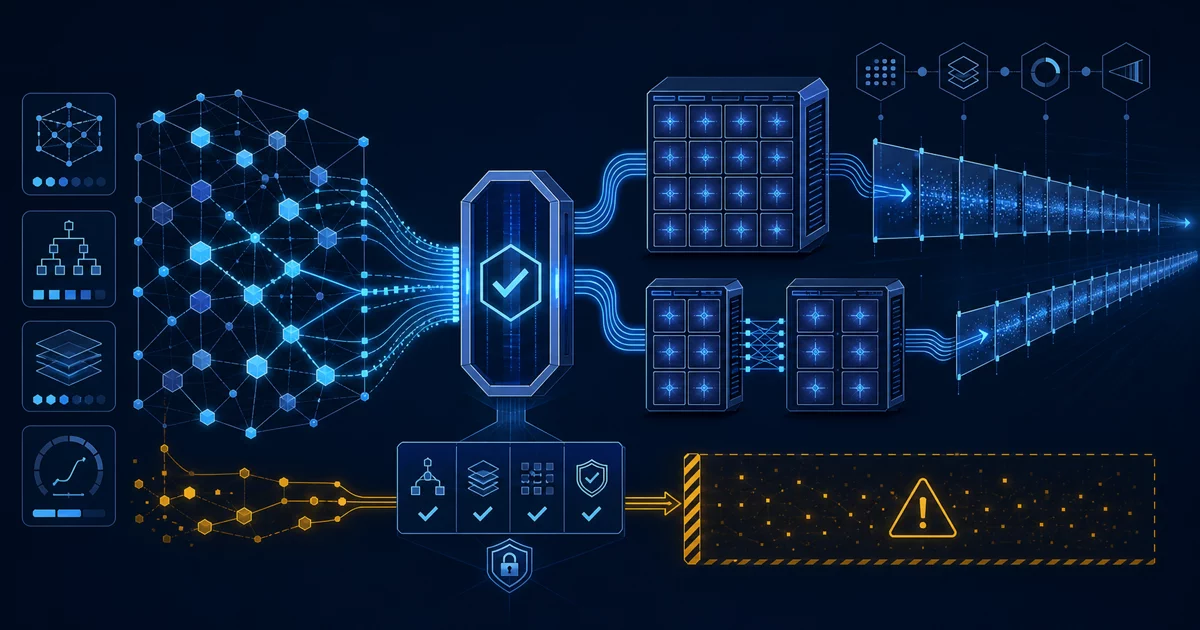
Original editorial illustration: the verification gate feeds one sixteen-rank node and a paired eight-rank route. The long-context lane continues only through the documented A3 path; the amber branch represents an experimental route that has not passed promotion gates.
Deploying GLM-5.2 on Ascend is not a one-command problem. Z.AI names vLLM Ascend as a supported NPU framework, and the project publishes commands for Atlas 800 A2 and A3, co-located serving, prefill/decode disaggregation, MTP, and one-million-token context. Yet the same source set also marks the model experimental, contains topology text that changed after the stable release, and records open quality and tool-call reports.
This guide turns those documents into a fail-closed deployment contract. It
pins vLLM Ascend v0.23.0, compares the release tutorial with the current
corrected tutorial, hashes three public ModelScope manifests, normalizes eight
topology rows, and reconciles four different context numbers. The audit made
zero model calls, zero NPU runs, and zero GPU runs. It does not claim
throughput, accuracy, or runtime fit. The
machine-readable audit receipt
contains all 17 source hashes, arithmetic, scenarios, boundaries, and limits.
In this guide
Section titled “In this guide”- Choose the Ascend route by evidence
- Pin the runtime and reconcile documentation
- Audit BF16, W8A8, and W4A8C8 artifacts
- Match the A2 or A3 topology
- Launch a conservative W4A8C8 canary
- Set the context cap from scenario evidence
- Keep DCP and prefill/decode symmetric
- Gate W4A8C8 accuracy and W8A8 migration
- Verify tool calling and response delivery
- Run the Ascend promotion sequence
- Use a non-Ascend control correctly
- Frequently asked questions
- Sources and method
Choose the Ascend route by evidence
Section titled “Choose the Ascend route by evidence”The shortest defensible starting point is one Atlas 800 A3 node with 16 64-GB NPUs, the W4A8C8 artifact, and a below-one-million context cap. That is not a production endorsement. It is the smallest current tutorial topology for which card count, rank layout, quantization flag, parser flags, and a concrete launch shape are all described together.
Use the following routing table before copying any command:
| Need | Evidence-backed starting route | Do not infer |
|---|---|---|
| Smallest documented A3 canary | 1 A3 node, 16 NPUs, W4A8C8, DP2/TP8, 135K tutorial cap | That W4 quality is stable for your tasks |
| Smallest documented A2 canary | 2 A2 nodes, 16 NPUs total, W4A8C8, DP2/TP8, 40K cap | That one A2 node can fit the service |
| Accuracy-sensitive service | Evaluate W8A8 on the exact target; preserve a W4 control | That W4 and W8 accept identical launch flags |
| One-million-token experiment | A3 only, one of three DCP layouts, command cap 1,024,000 | That A2 or every A3 workload is validated to 1M |
| Prefill/decode isolation | Use the exact A2 or A3 P/D row and symmetric DCP state | That asymmetric context parallelism is safe |
| BF16 accuracy control | Budget multiple nodes and measure full runtime memory | That file bytes alone prove process fit |
The word “documented” is deliberately weaker than “verified.” The current vLLM Ascend support matrix still marks GLM-5.2 experimental and lists a 200K maximum-model-length field. The tutorial supplies larger scenario recipes, including 1M on A3, but it does not convert the global support row into a production guarantee.
The route also depends on which artifact you can validate. The W4 file floor is dramatically smaller than W8 or BF16, but an open project issue reports repeat-to-repeat accuracy fluctuation in one W4 P/D configuration. W8 is the issue author’s accuracy-sensitive recommendation, but another open A2 W8 issue reports a tool response that did not reach the client. There is no artifact that lets you skip a local workload gate.
Pin the runtime and reconcile documentation
Section titled “Pin the runtime and reconcile documentation”The official vLLM Ascend v0.23.0 release
was published on 2026-08-16 at commit
5cb98caaadeff42b5b62b996e34bb2aaa29d20fd. Its dependency family is:
| Layer | v0.23.0 contract |
|---|---|
| Upstream vLLM | 0.23.0 |
| Python | >=3.10,<3.13 |
| CANN | 9.1.0 for A2 and A3 |
| PyTorch | 2.10.0 |
torch_npu |
2.10.0.post4 |
| Triton Ascend | 3.2.2 |
| A3 image tag | quay.io/ascend/vllm-ascend:v0.23.0-a3 |
| A2 image tag | quay.io/ascend/vllm-ascend:v0.23.0 |
Pin this family as one compatibility unit. Do not combine a newer plugin with an older CANN image merely because imports succeed. Resolve the container tag to a registry digest, record firmware and driver versions, and admit only that digest through staging. A mutable tag is useful for discovery, not sufficient provenance for rollback.
Then reconcile, rather than blindly trust, the versioned tutorial. The
tutorial at the release commit
describes the single-A3 prerequisite as 128GB × 8. But its ordinary
single-node command uses DP2 and TP8, a 16-rank layout. The
current pinned tutorial
corrects the machine description to 64GB × 16.
Both descriptions add up to 1,024 decimal GB. That makes the drift easy to miss
if capacity is the only check. A launch can have the right total memory and the
wrong device count. The A2 BF16 prerequisite text changed too: a per-node line
that said 64GB × 32 in the versioned material now says 64GB × 8.
Use a two-pin policy:
- Pin software and images to the stable release family.
- Pin the current tutorial revision used to interpret topology and known boundaries.
- Before launch, compare detected NPU count, memory per NPU, hostname count, HCCL rank table, DP, TP, PP, PCP, and DCP with the intended scenario.
- Reject the launch if the product of parallel dimensions or local rank count does not match the observed world size.
That policy does not imply that the newest documentation is always correct. It creates an auditable discrepancy instead of silently selecting whichever text was copied first.
Audit BF16, W8A8, and W4A8C8 artifacts
Section titled “Audit BF16, W8A8, and W4A8C8 artifacts”The public ModelScope manifests expose filename, byte size, revision, and SHA-256 for each shard. The receipt deterministically reduces every safetensors entry into these weight-file floors:
| Artifact | Primary shards | Additional safetensors | Total bytes | GiB |
|---|---|---|---|---|
| BF16 GLM-5.2 | 282 | none observed | 1,506,667,387,408 | 1,403.193 |
| W8A8 GLM-5.2 | 181 | rot.safetensors |
773,876,016,944 | 720.728 |
| W4A8C8 GLM-5.2 | 95 | rot.safetensors |
404,794,116,064 | 376.994 |
By observed file bytes, W8A8 is 48.64% smaller than BF16. W4A8C8 is 73.13% smaller than BF16 and 47.69% smaller than W8A8. Against the corrected one-node A3 aggregate of 1,024 decimal GB, those files alone consume 147.14%, 75.57%, and 39.53%, respectively.
Those percentages explain why quantization is operationally important, but they do not prove a process fits. The files exclude KV cache, graph capture, quantization metadata, communication workspaces, load-time duplication, allocator fragmentation, operating software, replicas, health reserve, and failover capacity. Even division across ranks is arithmetic, not evidence that MoE experts and auxiliary tensors are placed evenly.
W4 has another easy-to-miss boundary. Its observed config.json declares
max_position_embeddings: 1048576, while top-level quantization_config is
null. The Ascend path is supplied at runtime through --quantization ascend.
Do not let a generic loader see null and conclude that the artifact is an
ordinary unquantized checkpoint.
Create a local artifact receipt before a model process starts:
{ "repository": "Eco-Tech/GLM-5.2-w4a8c8", "repository_revision": "<pin-an-immutable-revision>", "manifest_response_sha256": "<record>", "primary_shards": 95, "auxiliary_safetensors": ["rot.safetensors"], "all_file_hashes_verified": false, "quantization_runtime": "ascend", "image_digest": "sha256:<record>", "credentials_archived": false}Change all_file_hashes_verified only after every staged file matches its
manifest. Never put model-access credentials, registry credentials, private
prompts, or sensitive customer output in this receipt.
Match the A2 or A3 topology
Section titled “Match the A2 or A3 topology”The current tutorial contains eight useful scenario rows. Normalize one row into your deployment manifest instead of composing flags from several rows:
| Scenario | Nodes / NPUs | Parallel layout | Tutorial context cap | Draft tokens |
|---|---|---|---|---|
| A3 single, ordinary | 1 / 16 | DP2 TP8 | 135,000 | 3 |
| A3 dual, co-located | 2 / 32 | DP4 TP8 | 66,000 | 3 |
| A3 P/D, ordinary | 4 / 64 | P: DP4 TP8; D: DP32 TP1 | 133,120 | P1 / D5 |
| A2 dual, co-located | 2 / 16 | DP2 TP8 | 40,000 | 5 |
| A2 P/D, ordinary | 8 / 64 | P: DP4 TP8; D: DP8 TP4 | 256,000 | P1 / D3 |
| A3 single, 1M | 1 / 16 | DP1 TP16 DCP16 | 1,024,000 | 3 |
| A3 dual, 1M | 2 / 32 | DP4 TP8 DCP8 | 1,024,000 | 3 |
| A3 P/D, 1M | 4 / 64 | P and D: DP4 TP8 DCP8 | 1,024,000 | P1 / D3 |
The caps are scenario settings, not a monotonic hardware ranking. The A3 dual-node ordinary throughput profile uses 66K, below the 135K single-node example, because the recipes optimize different admission and parallelism objectives. The A2 P/D row reaches 256K while the co-located row uses 40K. Do not replace the scenario cap with the largest number seen anywhere on the page.
For each host, record:
- detected product name, NPU count, and memory per NPU;
- hostname, management IP, HCCL interface, and rank range;
- image digest, driver, firmware, CANN, PyTorch,
torch_npu, vLLM, and plugin; - local and global DP ranks, TP, PP, PCP, DCP, and expert-parallel state;
- checkpoint revision and every shard hash;
- requested context, batched-token cap, sequence cap, and memory utilization;
- parser flags, MTP draft count, quantization mode, graph mode, and additional Ascend configuration.
Do not expose a public socket while this receipt is incomplete. Multi-node launches should first pass the project’s bounded communication check on the same NIC and rank assignment. HCCL success on a different interface or smaller world size does not validate the production topology.
Launch a conservative W4A8C8 canary
Section titled “Launch a conservative W4A8C8 canary”The tutorial’s optimized command enables MTP, DSA context parallelism, graph capture, balance scheduling, shared-expert overlap, and a large context in one step. That is useful as a project recipe, but it creates a wide diagnostic surface. Begin with a derived, loopback-only canary that keeps the model, quantization, DP/TP, expert parallelism, and parsers while reducing context and omitting speculative and optional overlap features:
export HCCL_OP_EXPANSION_MODE=AIVexport HCCL_TRANSFER_TIMEOUT=600export HCCL_EXEC_TIMEOUT=3600export HCCL_CONNECT_TIMEOUT=3600export OMP_PROC_BIND=falseexport OMP_NUM_THREADS=1export PYTORCH_NPU_ALLOC_CONF=expandable_segments:True
vllm serve /models/GLM-5.2-w4a8c8 \  --host 127.0.0.1 \  --port 8077 \  --served-model-name glm-52 \  --api-server-count 1 \  --data-parallel-size 2 \  --tensor-parallel-size 8 \  --enable-expert-parallel \  --quantization ascend \  --tool-call-parser glm47 \  --reasoning-parser glm45 \  --enable-auto-tool-choice \  --max-model-len 32768 \  --max-num-seqs 4 \  --max-num-batched-tokens 4096 \  --gpu-memory-utilization 0.80 \  --seed 1024 \  --trust-remote-code \  --safetensors-load-strategy prefetch
This is a GLM52.ai diagnostic derivation, not a command vLLM Ascend claims
to have benchmarked. Review the pinned remote code before allowing
--trust-remote-code, bind only to loopback, and run it inside the approved
network and host-isolation boundary. If the stripped path needs an additional
plugin setting on your exact image, add one field at a time and preserve the
failure receipt.
The first success criterion is not “the port opened.” Require:
- all expected ranks to initialize on the intended devices;
- every shard hash to match before readiness;
- no unexpected fallback, compilation error, or missing quantized operator;
- a deterministic greedy text fixture repeated across restarts;
- reasoning and plain-response content delivered to the client;
- native tool calls parsed with argument types intact;
- maximum-output, stop, cancellation, and malformed-request behavior;
- per-rank peak memory and a clean unload/reload cycle.
Only then add the upstream optimization layers. Add MTP and measure acceptance and output parity using the dedicated GLM-5.2 MTP guide. Add graph mode, DSA-CP, balance scheduling, and overlap individually. If several flags change together, a regression no longer has one attributable cause.
Set the context cap from scenario evidence
Section titled “Set the context cap from scenario evidence”Four context numbers appear in the pinned source set:
| Evidence layer | Tokens | Correct interpretation |
|---|---|---|
| Current support-matrix row | 200,000 | Experimental global support entry |
| 1M launch commands | 1,024,000 | Scenario-specific A3 service cap |
| 1M tuning table | 1,040,000 | A separate recommendation that disagrees with commands |
| W4 config native positions | 1,048,576 | Architecture/config ceiling, not a service promise |
The 1,024,000 command is 24,576 tokens below the native 1,048,576 field and uses 97.65625% of it. The 1,040,000 tuning-table value is 16,000 above the commands and 8,576 below native. The support-matrix value is 824,000 below the commands. None should be silently substituted for another.
For a first service, cap context at the smallest value that satisfies the real reader workload and passes memory plus retrieval tests. A nominal 1M route is appropriate only when all of these are true:
- the hardware is A3; the release says A2 was not validated for 1M;
- the exact single, dual, or P/D DCP topology is recorded;
- the command cap is 1,024,000 unless a separately reviewed revision changes the contract;
enable_sparse_sfa_c8remains off in v0.23.0;- long-prefix retrieval, position-sensitive reasoning, cancellation, and near-cap output behavior pass repeatedly;
- peak memory on every rank leaves a declared reserve under concurrency;
- queueing and prefill cost remain compatible with the service objective.
One successful short request after loading with --max-model-len 1024000
proves almost nothing about the cap. Test prompts near several boundaries,
plant uniquely identifiable facts across the prefix, vary output length, and
compare accepted results rather than mere HTTP 200 responses.
Keep DCP and prefill/decode symmetric
Section titled “Keep DCP and prefill/decode symmetric”The v0.23.0 release draws two explicit boundaries around decode context
parallelism. First, DCP and Sparse Flash Attention C8
(enable_sparse_sfa_c8) have known issues together and are not recommended in
this release. The 1M examples enable DCP and deliberately leave SFA C8 off.
Second, a P/D deployment using sparse flash attention must enable DCP on both
prefiller and decoder sides or disable it on both. Asymmetric state can cause
accuracy problems.
Treat this as a configuration invariant, not a tuning suggestion:
prefiller.dcp_enabled == decoder.dcp_enabledand not (dcp_enabled and enable_sparse_sfa_c8)The ordinary A3 P/D row and the 1M A3 P/D row are also different systems. The ordinary route assigns prefill DP4/TP8 and decode DP32/TP1, with different MTP draft counts. The 1M route uses DP4/TP8/DCP8 on both sides. Do not add DCP8 to the ordinary row without re-deriving the world size and quality contract.
P/D serving adds boundaries beyond model correctness:
- a request ID must map to exactly one prefill and one decode lineage;
- KV-transfer version, connector, ports, and role must be explicit;
- a failed handoff must not create a second user-visible side effect;
- backpressure must stop admission before KV or decode memory is exhausted;
- prefiller and decoder image, tokenizer, template, checkpoint, and parser revisions must be compatible;
- restart tests must cover each side independently and together;
- rollback must drain or invalidate transferred state safely.
Measure time to first token, time per output token, accepted-result throughput, transfer failures, queue delay, memory by rank, and recovery time separately. Raw tokens per second can rise while delivery quality falls.
Gate W4A8C8 accuracy and W8A8 migration
Section titled “Gate W4A8C8 accuracy and W8A8 migration”Open vLLM Ascend
issue #14378
reports approximately 2–3 percentage-point GPQA fluctuation across repeated
GLM-5.2 W4A8C8 P/D runs with enable_sparse_sfa_c8. It calls W4 experimental,
recommends W8A8 for production and accuracy-sensitive workloads, and advises
keeping SFA C8 off in P/D unless memory requires it and accuracy is carefully
evaluated.
This is a project report, not a GLM52.ai reproduction or a statement that every W4 route fluctuates. It nevertheless invalidates a one-pass accuracy gate. For the target application, run repeated trials with fixed dataset revision, prompt template, decoding settings, seed where applicable, parser, context distribution, and service topology. Report the distribution, not only the best run.
A useful gate has at least four layers:
| Layer | Example checks | Promotion rule |
|---|---|---|
| Deterministic integrity | exact arithmetic, code execution, JSON schema, stop tokens | Zero severe mismatches across repeated greedy runs |
| Application quality | labeled support, coding, retrieval, or agent tasks | Lower confidence bound must clear the declared threshold |
| Protocol quality | tool name/arguments, reasoning separation, streaming, cancellation | No lost, duplicated, or malformed user-visible event |
| Operational quality | memory, TTFT, TPOT, errors, restart, recovery | Pass the service SLO with reserve and rollback |
W8A8 is a candidate response to W4 instability, not a drop-in flag change. Its observed safetensors payload is 720.728 GiB, nearly twice W4’s 376.994 GiB. The tutorial’s detailed scenario commands use W4A8C8; they do not publish an interchangeable W8 block for each layout. Recalculate process fit, confirm the proper quantization loader, and start from a new canary receipt.
Keep BF16 as a separate control if you have enough hardware. Its observed 1,403.193 GiB file floor exceeds one corrected A3 node’s aggregate, before runtime allocation. It cannot be smuggled into a one-node plan by calling it a quality baseline.
Verify tool calling and response delivery
Section titled “Verify tool calling and response delivery”The tutorial uses --tool-call-parser glm47, --reasoning-parser glm45, and
--enable-auto-tool-choice. Loading those flags is not a tool-call test. The
client must receive a well-formed event with the expected name and typed
arguments, while non-tool answers, reasoning content, streaming fragments, and
finish reasons remain correct.
Open, triaged vLLM Ascend issue #12405 reports an A2 W8 path where generation appeared in internal output but the tool-call request returned no usable client result. The report is not proof of a universal W8 bug. It is evidence that server-side token generation and user-visible delivery require separate gates.
Test at least these fixtures against the exact production client:
- one required tool with two typed arguments;
- a choice between two tools with mutually exclusive schemas;
- a request that must answer normally and call no tool;
- malformed tool arguments that the client rejects safely;
- streamed arguments split across awkward chunk boundaries;
- parallel or sequential calls only if the application supports them;
- reasoning enabled and disabled, verifying no hidden content leaks into tool arguments or the visible answer;
- cancellation during arguments, timeout after execution, and retry with a stable idempotency key;
- maximum-length arguments and non-ASCII strings;
- server restart after generation begins but before the final response.
Record both the raw sanitized wire events and the parsed application object. An internal log containing plausible tokens is not success. Success is one correct, authorized, user-visible outcome without duplicate side effects. For general parser design, the separate GLM-5.2 tool-calling guide owns that broader reader job.
The older issue #12851 adds a version boundary. It reports a W4 load failure on a v0.22.1 release candidate and says v0.23.0rc1 started; it is now closed stale/not-planned. Use stable v0.23.0, not an RC, and keep cold-load, corrupt-shard, shutdown, and restart fixtures in the gate.
Run the Ascend promotion sequence
Section titled “Run the Ascend promotion sequence”Use one promotion ladder with explicit evidence and rollback:
- Freeze source revisions. Record the vLLM Ascend release commit, current tutorial commit, support-matrix commit, checkpoint revision, manifest hash, and container digest.
- Prove physical topology. Compare detected A2/A3 product, device count, memory, NICs, hosts, and HCCL ranks with one normalized scenario.
- Verify artifacts offline. Check every shard, auxiliary safetensors file, tokenizer, template, and remote-code revision before model load.
- Pass a loopback baseline. Start the stripped canary with a small context, no MTP, no DCP, no graph capture, and no public listener.
- Pass deterministic quality. Repeat exact-answer, code, stop, parser, and structured-output fixtures across clean restarts.
- Add one optimization. Introduce the intended graph, DSA-CP, MTP, overlap, scheduling, or sparse-attention field separately and replay the corpus.
- Raise context gradually. Test retrieval, memory, queueing, cancellation, and output at several caps; do not jump from 32K to 1,024K.
- Validate protocols. Capture sanitized request, stream, parser, tool, and finish events through the real client and gateway.
- Soak the exact workload. Mix prompt lengths, output lengths, concurrency, cache hits, failures, and restarts while measuring every rank.
- Rehearse rollback. Drain traffic, preserve idempotency, restore the prior digest, and prove the old route still accepts requests.
- Shadow before serving. Compare accepted results without allowing the candidate to create external side effects.
- Promote a small slice. Stop automatically on quality, parser, memory, availability, topology, or recovery breaches; expand only after the observation window closes.
Version the gate with the deployment. A new CANN, firmware, compiler, Triton,
torch_npu, vLLM, plugin, image, remote-code revision, checkpoint, tokenizer,
or parallel layout reopens the relevant evidence. A healthy process does not
grandfather an untested software stack.
Evaluate economics per accepted result, not per generated token. Include failed runs, retries, long-prefill queueing, idle reserve, checkpoint storage, networking, operational labor, and recovery capacity. Quantization wins only if its capacity benefit survives quality and protocol gates.
Use a non-Ascend control correctly
Section titled “Use a non-Ascend control correctly”A non-Ascend accelerator can validate client behavior, evaluation fixtures, idempotency, rollback orchestration, and some checkpoint-level expectations. It cannot validate CANN kernels, HCCL topology, vLLM Ascend quantization, A2/A3 memory behavior, ModelSlim artifacts, DSA context parallelism, or the project issues described above.
If you need an evidence-backed NVIDIA deployment rather than only a harness control, the NVFP4 SGLang guide owns that route. The AMD ROCm SGLang guide provides a third distinct hardware contract. Neither is an Ascend fallback with the same flags; each requires its own artifact, runtime, and acceptance receipt.
Frequently asked questions
Section titled “Frequently asked questions”Is GLM-5.2 production-ready on vLLM Ascend?
Section titled “Is GLM-5.2 production-ready on vLLM Ascend?”The current pinned support matrix marks it experimental, so this guide does not call it production-ready by default. The project publishes detailed deployment recipes, but a production decision requires the exact artifact, topology, context, parser, repeated quality, memory, recovery, and workload gates to pass.
Which vLLM Ascend version should I use?
Section titled “Which vLLM Ascend version should I use?”Start from stable v0.23.0 and its aligned dependency family: upstream vLLM
0.23.0, CANN 9.1.0, PyTorch 2.10.0, torch_npu 2.10.0.post4, and Triton Ascend
3.2.2. Resolve the image tag to a digest. Also pin the current tutorial because
topology wording was corrected after the release commit.
Can W4A8C8 fit on one Atlas 800 A3 node?
Section titled “Can W4A8C8 fit on one Atlas 800 A3 node?”Its observed 376.994-GiB safetensors floor is 39.53% of a corrected A3 node’s 1,024-decimal-GB aggregate, and the current tutorial provides a 16-NPU single-node recipe. That is not a full process-fit proof. Measure actual per-rank peak memory, KV cache, graphs, workspaces, fragmentation, concurrency, and reserve.
Can W4A8C8 fit on one Atlas 800 A2 node?
Section titled “Can W4A8C8 fit on one Atlas 800 A2 node?”The current tutorial says no and names two A2 nodes, 16 NPUs total, as the minimum W4 configuration. Do not treat the aggregate W4 file floor as proof of a supported one-node placement; rank layout and runtime allocation matter.
Should accuracy-sensitive deployments use W8A8?
Section titled “Should accuracy-sensitive deployments use W8A8?”W8A8 is the recommendation in open issue #14378 for accuracy-sensitive production, but it is not a drop-in replacement. Its observed artifact is 720.728 GiB, the detailed tutorial scenarios use W4, and an A2 W8 tool-delivery report remains open. Recalculate fit and rerun every gate.
Does GLM-5.2 support one million tokens on A3?
Section titled “Does GLM-5.2 support one million tokens on A3?”The tutorial provides three A3 DCP recipes with a 1,024,000 command cap, while the config’s native position field is 1,048,576 and a tuning table says 1,040,000. The support matrix still says experimental/200K. Use 1,024,000 only as scenario-specific A3 evidence, not a blanket promise, and validate the real workload near the cap.
Can A2 use the one-million-token recipe?
Section titled “Can A2 use the one-million-token recipe?”Not on the checked evidence. The v0.23.0 release explicitly says the 1M deployment was validated only on Atlas 800 A3 and that A2 was not validated. An A2 service should use its documented scenario cap and local tests.
Can DCP and Sparse Flash Attention C8 be enabled together?
Section titled “Can DCP and Sparse Flash Attention C8 be enabled together?”Not as a recommended v0.23.0 route. The project documents known issues when
DCP and enable_sparse_sfa_c8 are combined. The 1M recipes keep SFA C8 off,
and P/D deployments must keep DCP state symmetric across both sides.
Is this a hardware benchmark?
Section titled “Is this a hardware benchmark?”No. GLM52.ai used no NPU or GPU and made no model call. The page audits pinned documents, public file manifests, issue states, and deterministic arithmetic. All runtime, quality, and performance claims remain work the operator must measure on the exact target.
Sources and method
Section titled “Sources and method”Z.AI’s pinned Ascend deployment entry names vLLM Ascend, SGLang, and xLLM as GLM-5.2 NPU framework paths. The pinned GLM-5.2 FP8 model card also names Ascend NPU frameworks. These establish a direct GLM-5.2/Ascend link; they do not replace each framework’s exact artifact and launch contract.
The deployment contract comes from the v0.23.0 tutorial, the current corrected tutorial, the release support matrix, the current support matrix, and the v0.23.0 release. The three ModelScope pages supplied public file manifests; issues #14378, #12405, and #12851 supplied bounded project reports. The fixed per-round Z.AI release check and Zhipu research check were discovery inputs, not launch-command evidence.
The committed evidence packet stores the observed URL, byte count, and SHA-256 for 17 source responses. Its deterministic script calculates artifact totals, reductions, A3 file-floor shares, eight topology rows, and differences among the 200,000, 1,024,000, 1,040,000, and 1,048,576 context values. The public receipt is byte-identical to the committed result.
No checkpoint shard was downloaded, no container was started, and no Atlas
NPU, GPU, serving endpoint, grader, GLM, or MiniMax model was used. ModelScope
master manifests can change, so the audit freezes only the observed response
and deterministic per-file digest. Open issues are not GLM52.ai reproductions.
The broad local deployment guide remains the
place to choose among workstation experiments, accelerator clusters, and
managed access; this page owns only the Ascend vLLM deployment and promotion
decision.