
GLM-5.2 Factual Recall: Build a WikiProfile Test
Independent research — not an official Z.ai publication.Identity and provider disclosure

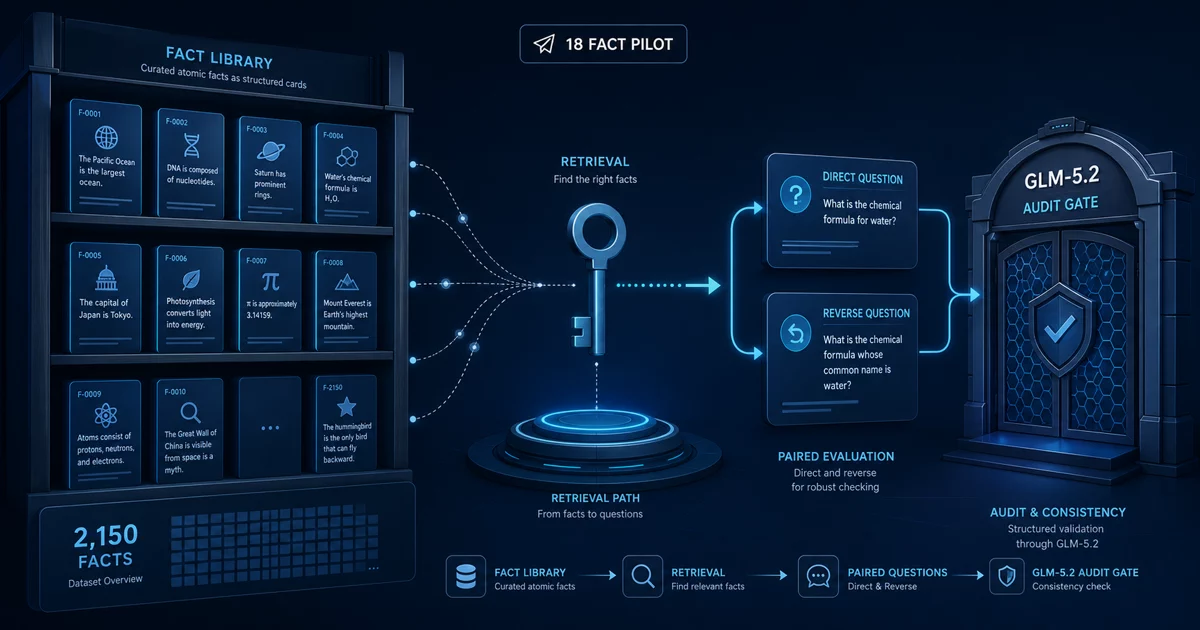
Original editorial illustration of the test design. The shelf represents the pinned fact set, the key represents access to encoded knowledge, and the paired cards represent direct and reverse questions. It is not a model dashboard or a reported GLM-5.2 result.
A wrong factual answer does not tell you whether GLM-5.2 never encoded the fact or failed to retrieve knowledge it can expose under another prompt. Treating both cases as “hallucination” hides the engineering decision. Missing knowledge may need retrieval or a different model. Unstable access may need a better prompt, thinking policy, verification step, or escalation route.
Google Research’s WikiProfile work supplies a useful diagnostic pattern: probe one fact through completion, direct questions, reverse questions, natural paraphrases, multiple choice, context, and thinking. The associated paper reports results for 13 models, including a model named GPT-5.2. That is OpenAI’s model: GPT-5.2 is not Z.ai GLM-5.2. This page transfers the method, not the published score.
Our independent preflight pins the public dataset at revision
0448b6abf3d6fb0a964e6935c0265dbd47584cda, verifies every row, and freezes a
small pilot before any model can influence sample selection. The output is a
test plan you can run later—not a favorable result invented from a paper about
another model. The evidence receipt records zero model calls.
Navigate the factual-recall test
Section titled “Navigate the factual-recall test”- Separate encoding from recall
- Keep GPT-5.2 and GLM-5.2 distinct
- Audit the pinned WikiProfile data
- Understand the page-count discrepancy
- Freeze the 18-fact pilot
- Pair direct and reverse questions
- Define the run matrix
- Grade without self-certification
- Classify failures
- Promote a production gate
- Choose the next operational step
- Audit sources and limits
- Resolve practical questions
Separate encoding from recall
Section titled “Separate encoding from recall”WikiProfile treats the fact, not an isolated question, as the unit of analysis. Its tasks ask whether a model can expose the same proposition across several access paths. That creates a more useful fault tree than one accuracy percentage.
| Observed pattern | Careful interpretation | Engineering response |
|---|---|---|
| Completion and contextual tasks fail | Possible encoding failure; the fact may not be available from model parameters | Retrieve a trusted source, change the task, or test another model |
| Completion/context pass, closed-book questions fail | Possible recall failure; access is unstable despite encoding evidence | Try a frozen thinking condition, phrasing controls, or retrieval |
| Direct passes, reverse fails | Directional access failure | Add reverse probes and avoid treating one familiar phrasing as coverage |
| Free response fails, multiple choice passes | Recognition exceeds generation | Do not convert recognition into a claim that the model can produce the fact reliably |
| Thinking recovers an encoded fact | Thinking-assisted recall for that fact and setup | Measure added tokens, delay, and whether the recovery repeats |
| Every format passes once | One successful sample | Repeat under the same route before calling it reliable |
These labels are behavioral. A completion success does not reveal a neuron or prove a fact is stored in one identifiable location. A failure does not reveal the model’s training corpus. The method is valuable because it separates observable access patterns while keeping mechanistic claims out of the result.
The distinction also changes a production fallback. If a rare customer-policy fact is not encoded, asking the model to “think harder” may increase cost without supplying missing evidence. If the fact is recoverable but unstable, a verified retrieval result may still be safer than spending variable reasoning tokens. Diagnose first; route second.
Do not transfer GPT-5.2 results to GLM-5.2
Section titled “Do not transfer GPT-5.2 results to GLM-5.2”The paper evaluates Gemini, GPT, and Gemma families. Its model list includes GPT-5.2 and contains no GLM-5.2 row. The paper’s finding that recall accounts for a large share of GPT-5.2 errors therefore supports a hypothesis to test on GLM-5.2, not a GLM result.
| Label in a source | Organization | Can it support a GLM-5.2 score? |
|---|---|---|
| GPT-5.2 | OpenAI | No |
| GLM-5.2 | Z.ai / Zhipu | Only with GLM-specific runs |
| WikiProfile aggregate | Google Research paper | Method and dataset context only |
| This article’s 32 assertions | GLM52.ai data audit | Dataset integrity and pilot design only |
The decimal is not a shared model lineage. Similar names also do not align tokenizer, training data, reasoning mode, provider, sampling policy, release date, or grading behavior. Search snippets that omit the first letter make this an easy attribution error, so record the full provider and model ID in every run.
Z.ai’s GLM-5.2 release page describes the model and its official evaluation claims. It does not claim a WikiProfile result. The official checkpoint card is the right source for checkpoint identity, but it also contains no WikiProfile run in the evidence reviewed here.
Audit the pinned WikiProfile data
Section titled “Audit the pinned WikiProfile data”The public WikiProfile dataset card documents 2,150 facts, ten question instances per fact, Wikipedia-derived source text, generated annotations, search-grounded filtering, manual validation, and a CC-BY-SA 4.0 license. Our preflight downloads the immutable CSV and card by revision, then fails if either SHA-256 changes.
| Audited field | Observed value | Why it matters |
|---|---|---|
| CSV bytes | 7,502,273 | Pins the complete downloadable artifact |
Unique fact_id rows |
2,150 | Prevents duplicate facts from inflating a run |
| CSV columns | 23 | Detects a silent schema change |
| Documented task instances | 21,500 | Ten formats per fact in the dataset design |
Distinct page_id values |
1,883 | Observed source-page identity in the CSV |
| Named pilot categories | 9 | Supports one low/high pair per named topic |
Rows labeled Other |
1 | Preserved, but excluded from the nine-topic pilot |
| Direct-answer equality | 2,150 / 2,150 | Every direct gold equals the object field |
| Reverse-answer equality | 2,150 / 2,150 | Every reverse gold equals the subject field |
The sanitized machine-readable receipt contains the category counts, popularity cutoffs, all 18 selected fact IDs, the 36 paired questions, empty result fields, source URLs, hashes, and assertion map. It omits the full copyrighted dataset; reproduce from the licensed source instead of republishing all rows here.
The audit ran as an ordinary-user, dependency-free Python process after the task-scoped Docker route was unavailable. It used no credential, wrote only the receipt, and downloaded no weights. That is weaker isolation than the planned digest-pinned container, so the execution mode is part of the record rather than hidden.
Preserve the source-page discrepancy
Section titled “Preserve the source-page discrepancy”The dataset card says the 2,150 facts come from 2,125 Wikipedia pages. The
pinned CSV contains 1,883 distinct values in each of page_id,
page_title, and item_id: a difference of 242 pages. Multiple facts can come
from one page, but that explains why facts exceed pages; it does not reconcile
the card’s 2,125 with the observed 1,883.
This is a documentation discrepancy, not evidence that the questions are wrong. It should still block the sentence “we independently verified 2,125 source pages.” The accurate statement is:
Dataset card claim: 2,125 source pagesPinned CSV observation: 1,883 distinct page IDsDifference: 242Status: unresolved documentation mismatchKeep both values in the receipt. If the publisher revises the card or dataset, create a new revision record instead of altering the old audit. A factuality benchmark loses credibility when its own provenance discrepancies are rounded away.
Freeze a balanced 18-fact pilot
Section titled “Freeze a balanced 18-fact pilot”Running 21,500 tasks with eight samples and multiple thinking conditions is an evaluation program, not a smoke test. Start with a pilot that can reveal a broken route, grader, or directional assumption before buying a large run.
Our selection rule is public and deterministic:
- Sort all 2,150 popularity values.
- Define the bottom quintile as
gbc ≤ 914and the top quintile asgbc ≥ 426,554for this pinned revision. - For each of the nine named categories, form one low- and one high-popularity candidate set.
- Rank each candidate by SHA-256 of the public seed
glm52-wikiprofile-v1, category, tier, andfact_id. - Select the first candidate from every set.
That produces 18 unique facts, two per category. The rule is not random at
runtime and does not inspect any GLM response. Another engineer with the same
CSV obtains the same sample. The one Other row stays in the full dataset but
cannot form a balanced low/high category pair, so it is excluded from this
pilot and reported explicitly.
The pilot is not statistically representative of every fact. It is a balanced diagnostic. Its low/high split tests the paper’s popularity hypothesis without letting the editor handpick easy examples. If the pilot works, predeclare a larger stratified sample, confidence interval, and stopping rule before examining results.
Pair direct and reverse questions
Section titled “Pair direct and reverse questions”A direct question usually travels from a familiar subject toward an object. The reverse question asks for the subject from the object-side description. Both address the same underlying proposition, but the access path changes.
One selected pilot record illustrates the structure:
fact_id: 3941070__1category: Artspopularity tier: low
direct:What is the identifier of the seventh DVD volume of Seven of Seventhat included a New Year's special episode?gold: KIBA-745
reverse:What Japanese anime television series has KIBA-745 as the identifierfor its seventh DVD volume?gold: Seven of Seven
The two answers cannot be compared as strings to each other; each has its own gold field. Normalize only formatting differences declared in advance. Do not award credit because the answer appears inside a long speculative paragraph, and do not ask the tested model whether its own response is correct.
For a first route check, the 18 facts yield 36 closed-book questions. Add the natural variants only after the exact pair works. Add completion, contextual, multiple-choice, and thinking conditions when you are ready to classify encoding and recall rather than just directional consistency.
Define a run matrix before calling GLM-5.2
Section titled “Define a run matrix before calling GLM-5.2”Freeze one row per model, route, condition, and sample. An API alias can move without warning; an open checkpoint can differ from a hosted route. Store the requested model, returned identity when available, endpoint class, date, temperature, seed support, thinking control, output cap, tokenizer or provider revision, and exact prompt hash.
| Stage | Facts | Tasks per fact | Samples | Model calls | Decision |
|---|---|---|---|---|---|
| Data preflight | 2,150 | 0 | 0 | 0 | Reject changed or inconsistent input |
| Paired smoke pilot | 18 | 2 | 1 | 36 | Verify transport, answer extraction, and directional failures |
| Repeatability pilot | 18 | 2 | 8 | 288 | Estimate per-question access probability |
| Encoding/recall pilot | 18 | selected completion, context, QA, choice tasks | predeclared | varies | Assign a behavioral profile |
| Full benchmark | 2,150 | all 10 | predeclared | large | Only after cost, grading, and stopping approval |
Do not jump from 36 calls to the paper’s full design because the endpoint accepts the request. Estimate cost from the actual route and include retries, reasoning tokens, grader calls, and human adjudication. Store failures; a timeout is an operational outcome, not a sample to discard silently.
The receipt’s run ledger begins with every answer, correct, and thinking
field set to null. A pipeline must change those values only after preserving
the raw response, finish reason, usage, and grading evidence. A blank score is
more useful than a fabricated baseline.
Grade answers without model self-certification
Section titled “Grade answers without model self-certification”Exact match is attractive but can reject valid aliases. An unconstrained LLM grader is flexible but can introduce its own bias. Use a staged policy:
- Apply Unicode normalization, whitespace folding, and case handling that you specified before the run.
- Accept an exact gold or an approved alias from a frozen list.
- Send only unresolved cases to an external grader that is not the tested response itself.
- Preserve grader model, prompt, raw label, and disagreement reason.
- Manually adjudicate a bounded disagreement sample before publishing an aggregate.
The paper generated eight responses at temperature 1 and used separate autoraters. Reproducing its headline method requires those details, not merely the dataset. A one-sample deterministic pilot answers a smaller operational question and must carry a different label.
Test the grader before testing GLM-5.2. Provide one exact answer, one valid alias, one wrong entity, one answer with extra unsupported detail, and one empty/timeout artifact. Confirm that transport failure remains ungraded rather than becoming “model does not know.” Version the grader and regrade saved outputs offline when the rubric changes.
Classify failures before changing the system
Section titled “Classify failures before changing the system”| Failure signature | What it supports | What it does not prove | Next test |
|---|---|---|---|
| Both direct and reverse wrong | Fact inaccessible in this condition | Permanent absence from parameters | Completion/context and retrieval control |
| Direct correct, reverse wrong | Directional asymmetry | General hallucination rate | Repeat reverse and natural reverse |
| No-thinking wrong, thinking correct | Thinking-associated recovery | Guaranteed benefit on other facts | Repeat samples; measure token and latency cost |
| Multiple choice correct, free answer wrong | Recognition without stable generation | Production answer reliability | Require cited retrieval or constrained choice |
| Contextual correct, completion wrong | Prompt-format sensitivity | Clean encoding classification by itself | Inspect task construction and repeat |
| HTTP error or truncation | Route/harness failure | Knowledge failure | Fix transport/cap and rerun under a new receipt |
Do not “repair” a failed question by adding the answer to the prompt and then counting it as recall. That becomes contextual extraction. Do not remove rare facts after seeing low scores. That changes the population. Do not combine hosted GLM and self-hosted checkpoint results under one row unless every deployment variable is truly shared.
When retrieval is allowed, label it as a separate system condition. A correct cited answer from a trusted source may be the production winner even if it no longer measures closed-book parametric recall. Product reliability and scientific attribution are different goals; report both honestly.
Turn a pilot into a production gate
Section titled “Turn a pilot into a production gate”Promote only behaviors tied to user risk. For a support assistant, you might freeze twenty product facts and require cited retrieval when closed-book confidence is not enough. For an agent, you might require exact recall of tool permission boundaries and reject action whenever the source is absent. The gate should specify severe errors separately from ordinary misses.
Promote the route only when:- every run records the exact model and route;- transport failures are separated from wrong answers;- severe policy facts have zero unsupported substitutions;- direct/reverse gaps stay within the declared tolerance;- thinking and retrieval costs fit the latency and budget caps;- unresolved answers fail closed or escalate to a trusted source;- raw outputs and grader revisions can reconstruct the decision.A pass does not authorize autonomous action. It establishes that a frozen system met a frozen factual contract. Keep tool authorization, prompt-injection defense, data policy, and rollback as separate gates. Our structured-output test covers typed response validation, while the tool-calling guide covers execution boundaries.
For broader score provenance and run-record fields, use the GLM-5.2 benchmark evidence hub. For a small runner that preserves outputs and supports offline rubric changes, the smevals workflow is the natural implementation companion.
Choose a commercial route only after the design gate
Section titled “Choose a commercial route only after the design gate”The factual test is route-sensitive. A direct API, gateway, and self-hosted checkpoint may expose different revisions, thinking controls, output limits, prices, and observability. Pick a route only after defining the pilot, because the route must preserve the evidence fields the decision needs.
If privacy or revision control requires self-hosting, the local hardware guide explains why the full checkpoint is a multi-accelerator project. Renting hardware is not evidence that the model will recall the facts; the same frozen questions and grader must still run against the deployed artifact.
Audit the sources, method and limits
Section titled “Audit the sources, method and limits”The topic was discovered through the AI HOT Google Research item. Its title and summary were treated as untrusted discovery hints. Claims were checked against these primary sources:
- Google Research: Empty Shelves or Lost Keys
- Original paper, arXiv:2602.14080
- Official google/WikiProfile dataset
- Official GLM-5.2 release page
- Official GLM-5.2 checkpoint card
The fixed Zhipu research discovery page was also checked as a required topic-discovery entry. It did not supply a WikiProfile result and is not used to support one.
The archived audit fetched the dataset CSV and card, verified exact hashes, parsed all rows with Python’s standard library, tested 32 invariants, and generated a deterministic sample. It made no GLM, OpenAI, Gemini, MiniMax, or grader request. The machine’s planned Docker run was abandoned after the ordinary bridge reproduced its known network hang and the one-shot privileged credential route later failed authentication; no repeated privilege attempt was made. All task-named containers were removed.
This page does not claim that WikiProfile measures all factuality, that Wikipedia facts match a production domain, that the benchmark is free of annotation error, or that thinking always improves recall. Its practical contribution is narrower: a pinned, inspectable GLM-5.2 test design with a balanced pilot, an explicit provenance discrepancy, and no invented score.
Answer common factual-recall questions
Section titled “Answer common factual-recall questions”Did Google test GLM-5.2 on WikiProfile?
Section titled “Did Google test GLM-5.2 on WikiProfile?”No. The paper’s similarly named row is OpenAI GPT-5.2. This audit found no published GLM-5.2 WikiProfile score in the checked primary sources.
Does a wrong answer mean GLM-5.2 never learned the fact?
Section titled “Does a wrong answer mean GLM-5.2 never learned the fact?”No. One failure can be missing knowledge, failed recall, phrasing sensitivity, sampling, truncation, route failure, or grading error. Use completion, contextual, direct/reverse, recognition, and thinking controls to narrow it.
Why use direct and reverse questions?
Section titled “Why use direct and reverse questions?”They probe the same proposition from opposite directions. A direct pass and reverse failure reveals access asymmetry that one familiar question would hide.
Is the 18-fact pilot a benchmark score?
Section titled “Is the 18-fact pilot a benchmark score?”No. It is a deterministic smoke sample spanning nine categories and low/high popularity tiers. No model has answered it in this receipt.
Why not run all 21,500 questions now?
Section titled “Why not run all 21,500 questions now?”The full design needs repeated samples, thinking conditions, grading, cost approval, storage, and failure handling. The 36-question pilot checks the pipeline before that commitment.
Can I use the public JSON as a score?
Section titled “Can I use the public JSON as a score?”No. Its answer and correctness fields are intentionally null. It is a data
and sampling receipt. A future model-run artifact must use a new revision and
preserve raw outputs and external grades.
Does the source-page discrepancy invalidate WikiProfile?
Section titled “Does the source-page discrepancy invalidate WikiProfile?”Not by itself. The dataset card reports 2,125 pages; the pinned CSV has 1,883 distinct page identities. The mismatch is unresolved and must be disclosed, but it does not prove the individual question pairs are invalid.
Should factual questions use thinking by default?
Section titled “Should factual questions use thinking by default?”Not automatically. Treat thinking as a separate test condition. Measure recovery rate, added tokens, latency, variance, and whether retrieval would be safer or cheaper for the production task.