
GLM-5.2 Offline Batch Inference with vLLM
Independent research — not an official Z.ai publication.Identity and provider disclosure

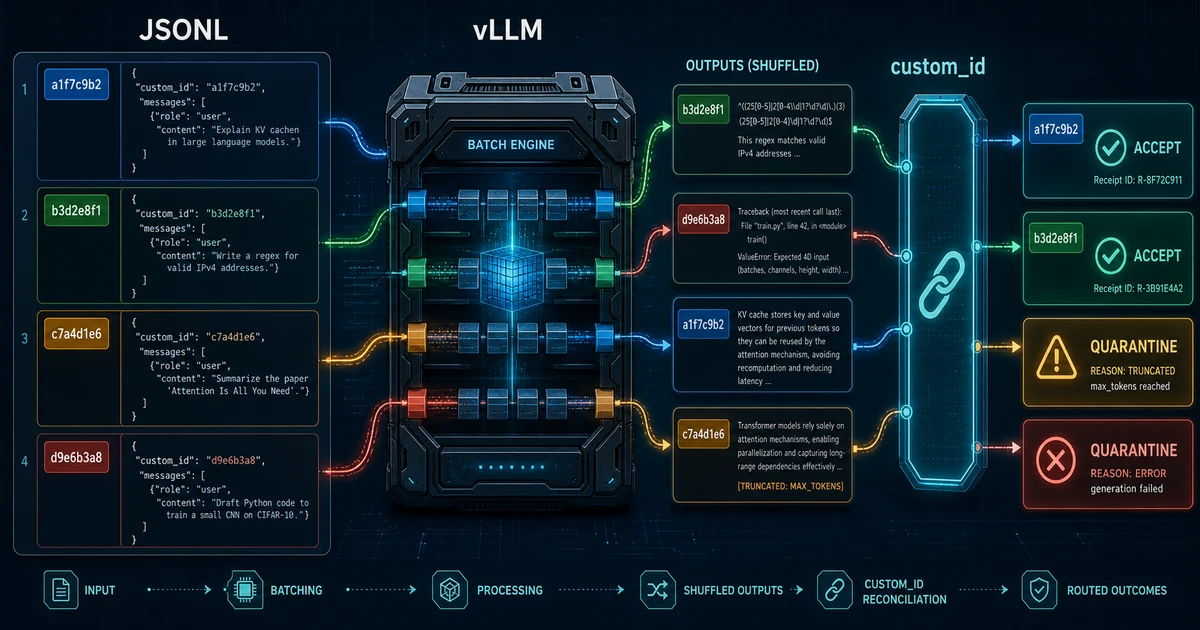
Original editorial diagram. It explains the intended reconciliation gate; it is not a vLLM screenshot, GPU run, model output, throughput measurement, or proof that any depicted request succeeded.
GLM-5.2 offline batch inference is useful when a finite set of prompts should
consume one already-provisioned engine without operating an HTTP service. The
safe unit of work is not “a folder of prompts.” It is a versioned JSONL input,
a pinned runtime and checkpoint, a fresh output path, and a reconciliation
receipt that accounts for every custom_id.
This guide uses the official FP8 checkpoint because the current
vLLM GLM-5.2 recipe names
zai-org/GLM-5.2-FP8 as its default variant and gives vLLM 0.23.0 as the
minimum stable version. That is a very large deployment: the recipe reports an
893 GB minimum VRAM figure for the FP8 variant, while the pinned repository is
755.7 GB on disk. Complete the
GLM-5.2 FP8 download and shard-verification gate
before letting the engine read those weights.
Our machine-readable offline-batch audit
hashes 17 official source snapshots, validates four request rows, rejects seven
deliberate input failures, and reconciles four shuffled synthetic outputs. Two
synthetic rows pass; an HTTP error and a finish_reason="length" row are
quarantined. The audit made zero model calls, started zero vLLM
processes, downloaded zero model-weight bytes, and ran on no GPU. Its
results test the file contract and release logic, not GLM-5.2 generation.
In this guide
Section titled “In this guide”- Choose offline batch only when the job fits
- Freeze runtime and model coordinates
- Treat JSONL as a release artifact
- Make thinking policy explicit per request
- Preflight seven failures before GPU startup
- Set batch and memory caps intentionally
- Run a small pinned batch
- Expect concurrency, not a durable queue
- Join every result by custom ID
- Quarantine errors and length truncation
- Reconcile usage and file receipts
- Make reproducibility an acceptance test
- Resume with chunk manifests
- Know when a server or hosted API is better
- Rent only after the fixture gate
- Frequently asked questions
- Sources and method
Choose offline batch only when the job fits
Section titled “Choose offline batch only when the job fits”vLLM describes its LLM class as the primary Python interface for inference
without a separate server. The vllm run-batch command adds a file-oriented
OpenAI-compatible layer: each JSONL line looks like one HTTP request, but the
runner invokes the local engine directly. That is a good match for bounded
evaluation, classification, extraction, code review, or content-processing
jobs whose complete request set can be frozen first.
It is not automatically the best route for every “batch” workload.
| Route | Best fit | What it gives you | What you must build or verify |
|---|---|---|---|
vllm run-batch |
Finite local job on one pinned engine | No separate HTTP server; JSONL in and JSONL out | Preflight, chunking, crash boundary, output audit, and capacity controls |
| vLLM OpenAI-compatible server | Ongoing or multi-client traffic | Request-time admission, client retries, health checks, and familiar HTTP calls | Service security, queueing, rate limits, observability, and idempotency |
Direct LLM.generate() or LLM.chat() |
Python application that owns prompt construction | Typed in-process control and direct result objects | Your own input schema, persistence, scheduling, and receipt format |
| Hosted asynchronous batch product | Work that should survive client or node loss | Provider-managed storage, status, quotas, and retry semantics when documented | Data boundary, price, retention, supported model/fields, and provider-specific result rules |
The distinction matters because “uses OpenAI batch file format” does not mean “implements OpenAI’s complete Batch API.” The vLLM 0.23.0 file-format guide says so directly. There is no job-creation endpoint, provider-side lifecycle, 24-hour window, or durable status object implied by this local command.
Choose the local runner when you can answer four questions before startup:
- What exact request IDs belong to this chunk?
- What immutable model and engine revisions will execute it?
- Which result conditions are safe to release automatically?
- What evidence proves the chunk is complete after a crash or operator handoff?
If any answer depends on live traffic or an external consumer, a server or a real durable workflow is usually easier to operate honestly.
Freeze runtime and model coordinates
Section titled “Freeze runtime and model coordinates”The audited coordinates are:
vLLM release: 0.23.0vLLM commit: 0fc695fc6d1d82e9a5ac6835ac8e4e1c83703665Recipe commit: 5943215a27acb4a243e9d27bd69daf491034cfeaModel: zai-org/GLM-5.2-FP8FP8 model revision: ba978f7d347eaf65d22f1a86833408afdb953541Base artifacts: b4734de4facf877f85769a911abafc5283eab3d9There is a documentation boundary worth preserving. The model table shipped
at the vLLM 0.23.0 tag does not contain GlmMoeDsaForCausalLM or GLM-5.2. The
official recipe nevertheless names 0.23.0 as the stable minimum, and the vLLM
model table at audited main commit
5f213ed1592903b7bc38f173d320dac1b2769303 now lists the architecture for
GLM-5, GLM-5.1, and GLM-5.2. Do not compress those facts into “the 0.23 model
table proves support.” It did not. Pin the recipe, engine build, model revision,
and a real startup canary together.
The pinned FP8 config reports GlmMoeDsaForCausalLM, 78 hidden layers,
1,048,576 maximum positions, and block FP8 (e4m3) quantization. Those fields
describe the artifact. They do not guarantee that your chosen kernel,
topology, context cap, or speculative-decoding path is correct.
Record the complete software environment beside every input manifest:
export GLM52_BATCH_MODEL='zai-org/GLM-5.2-FP8'export GLM52_BATCH_REV='ba978f7d347eaf65d22f1a86833408afdb953541'export GLM52_BATCH_DIR='/srv/glm52-batches/job-2026-08-28-001'
vllm --versionsha256sum "$GLM52_BATCH_DIR/requests.jsonl"
Also record the container digest or environment lock, driver, CUDA or ROCm stack, accelerator topology, engine arguments, and checkpoint-directory receipt. A package version alone is not a runtime identity.
Treat JSONL as a release artifact
Section titled “Treat JSONL as a release artifact”The upstream format is one JSON object per line. For chat generation, every
row needs a developer-selected custom_id, method, relative url, and
request body. The body uses the chat-completions schema.
{"custom_id":"extract-0001","method":"POST","url":"/v1/chat/completions","body":{"model":"zai-org/GLM-5.2-FP8","messages":[{"role":"system","content":"Return exactly one JSON object with keys risk and evidence."},{"role":"user","content":"Classify this fixture: the migration has no rollback test."}],"temperature":0,"top_p":1,"max_completion_tokens":128,"chat_template_kwargs":{"enable_thinking":false}}}Keep each physical JSONL line complete; pretty-printed multi-line objects are
not JSONL records. Use UTF-8, a final newline, and no comments. Generate the
file from structured data rather than interpolating untrusted prompt text into
a hand-built JSON string. A newline inside message content must be JSON-escaped
as \n, not emitted as a new record.
custom_id is the durable join key. Make it unique across the entire logical
job, not only within one file. A useful ID carries a task family and stable
sequence or source key—review-20260828-000042 is easier to investigate than
request-42. Do not put an email address, secret, customer name, or raw prompt
inside the ID because it will appear in input, output, logs, and receipts.
Our four-line fixture has these properties:
| Fixture field | Audited value | Release purpose |
|---|---|---|
| Request rows | 4 | Small enough to inspect manually |
Unique custom_id values |
4 | One-to-one reconciliation |
| Explicit non-thinking rows | 2 | Bounded extraction and classification |
| Explicit reasoning rows | 2 | Review and planning canary |
| Sum of completion ceilings | 1,472 tokens | Upper-bound planning before prompt tokens |
| Canonical JSONL size | 1,630 bytes | Detect accidental file change |
| Input SHA-256 | 85fda021…b63b865d |
Tie runtime receipt to exact bytes |
The completion-ceiling sum is not a usage forecast. A request may stop early, fail before generation, or consume its entire limit. It is simply the maximum configured completion allocation across this fixture.
Make thinking policy explicit per request
Section titled “Make thinking policy explicit per request”The pinned GLM-5.2 chat template selects high only when that exact
reasoning_effort is provided; otherwise its effective reasoning effort is
max. It also has an explicit non-thinking branch when
enable_thinking=false. Therefore, omitting both fields is a behavior choice:
it silently accepts the template default.
For an auditable batch, choose one policy per row:
"chat_template_kwargs": {"reasoning_effort": "high"}or:
"chat_template_kwargs": {"enable_thinking": false}Do not set both on the same row. A non-thinking extraction and a high-effort review are different acceptance profiles; mixing them accidentally can change latency, output length, visible content, and the risk of hitting the completion ceiling. The site’s vLLM thinking-budget guide owns the separate question of numeric reasoning sub-limits. This page only requires the batch file to declare its mode rather than inherit an unseen default.
The pinned generation config supplies temperature 1 and top-p 0.95 defaults. Our fixture explicitly uses temperature 0 and top-p 1 so the sampling policy is visible. Greedy decoding removes sampling randomness; it is not by itself a bitwise reproducibility guarantee across scheduling, kernels, hardware, or software changes.
Preflight seven failures before GPU startup
Section titled “Preflight seven failures before GPU startup”The upstream Pydantic models validate much of the request body, but an operator
needs stronger whole-file rules. A comment in the pinned vLLM source says
custom_id must be unique; the editorial preflight enforces it across lines.
It also prevents a mixed checkpoint, streaming request, implicit thinking
policy, and unsafe output ceiling from reaching expensive startup.
| Deliberate mutation | Required preflight result | Why it matters |
|---|---|---|
| Duplicate the first row | duplicate-custom-id |
Two outputs could claim one source record |
Change POST to GET |
method-must-be-post |
The file contract is POST-oriented |
Change URL to /v1/responses |
unsupported-endpoint |
This guide covers chat completions only |
| Change one body model to base GLM-5.2 | model-mismatch |
One engine cannot honestly represent mixed artifact coordinates |
Set stream=true |
streaming-not-allowed |
Pinned runner source rejects streaming output |
| Remove template kwargs | thinking-policy-must-be-explicit |
Avoid inheriting default max reasoning silently |
| Set completion ceiling to zero | invalid-max-completion-tokens |
Reject an unusable or malformed release job |
The exact fixture rejects all seven. A compact preflight can follow this shape:
import fs from 'node:fs';
const path = process.argv[2];const expectedModel = 'zai-org/GLM-5.2-FP8';const lines = fs.readFileSync(path, 'utf8').trim().split('\n');const rows = lines.map((line, i) => {  try { return JSON.parse(line); }  catch { throw new Error(`line ${i + 1}: invalid JSON`); }});const seen = new Set();
for (const [i, row] of rows.entries()) {  const id = row.custom_id;  if (typeof id !== 'string' || !id) throw new Error(`line ${i + 1}: invalid custom_id`);  if (seen.has(id)) throw new Error(`${id}: duplicate custom_id`);  seen.add(id);  if (row.method !== 'POST') throw new Error(`${id}: method must be POST`);  if (row.url !== '/v1/chat/completions') throw new Error(`${id}: unsupported endpoint`);  if (row.body?.model !== expectedModel) throw new Error(`${id}: model mismatch`);  if (row.body?.stream === true) throw new Error(`${id}: stream must be off`);  const cap = row.body?.max_completion_tokens;  if (!Number.isInteger(cap) || cap < 1 || cap > 8192) throw new Error(`${id}: invalid cap`);  const kwargs = row.body?.chat_template_kwargs;  const off = kwargs?.enable_thinking === false;  const effort = ['high', 'max'].includes(kwargs?.reasoning_effort);  if (off === effort) throw new Error(`${id}: choose exactly one thinking policy`);}
console.log(`validated ${rows.length} unique requests`);
Extend it with your message schema, source-record lookup, privacy policy, maximum prompt bytes, allowed tools, structured-output contract, and per-task completion ceiling. The preflight should run before loading 755.7 GB of weights, not after a malformed row consumes cluster time.
Set batch and memory caps intentionally
Section titled “Set batch and memory caps intentionally”“Offline” does not remove scheduling or memory pressure. The pinned source says all requests are submitted to the engine concurrently, and the scheduler then decides how tokens are batched. A file with 20,000 rows is not a promise that 20,000 full contexts fit simultaneously, but it is a large in-memory job and a large failure domain.
Start with three separate limits:
- File rows: how many logical jobs are lost or ambiguous if the process exits before the output file is written.
--max-num-seqs: how many sequences the scheduler admits concurrently; this competes for KV-cache capacity.--max-model-len: the context ceiling exposed by this run; do not default to the model’s one-million-token maximum unless the topology was sized and tested for it.
The official recipe’s Docker example caps the model at 131,072 tokens, and its H20 example uses 16 sequences and 32,768 batched tokens. Those are evidence that the controls matter, not universal production values. Our first canary uses 131,072 and 16 as explicit, conservative starting coordinates, then reduces them if engine startup or representative prompts lack headroom.
Inspect prompt-length distribution before launch. Four 1K-token prompts and four 100K-token prompts have the same row count but radically different cache and prefill demands. Cap prompt bytes in preflight, tokenize a sample with the pinned tokenizer, and preserve p50, p95, and maximum prompt-token counts in the batch manifest. Do not claim full 1M context because the model config advertises it; capacity belongs to the exact checkpoint, engine, parallel layout, concurrency, KV dtype, and hardware combination.
Run a small pinned batch
Section titled “Run a small pinned batch”Use a new task directory and verify that the output does not already exist. The following is a canary command, not a universal topology prescription:
export GLM52_BATCH_MODEL='zai-org/GLM-5.2-FP8'export GLM52_BATCH_REV='ba978f7d347eaf65d22f1a86833408afdb953541'export GLM52_BATCH_DIR='/srv/glm52-batches/job-2026-08-28-001'export VLLM_BATCH_INVARIANT='1'
node preflight-batch.mjs "$GLM52_BATCH_DIR/requests.jsonl"test ! -e "$GLM52_BATCH_DIR/results.jsonl"
vllm run-batch \  -i "$GLM52_BATCH_DIR/requests.jsonl" \  -o "$GLM52_BATCH_DIR/results.jsonl" \  --model "$GLM52_BATCH_MODEL" \  --revision "$GLM52_BATCH_REV" \  --tensor-parallel-size 8 \  --kv-cache-dtype fp8_e4m3 \  --max-model-len 131072 \  --max-num-seqs 16 \  --reasoning-parser glm45
Confirm those flags against vllm run-batch --help in the exact installed
image before allocating the full job. The static source audit found the
revision and reasoning-parser arguments in the pinned engine arguments, but it
did not execute the CLI.
Keep the first correctness canary simple. Do not simultaneously enable MTP, raise context, raise concurrency, change KV dtype, add tools, and add structured output. The official recipe documents five-token MTP for GLM-5.2, but speculative decoding is another acceptance variable. Establish plain output parity and result accounting first; introduce MTP in a one-change A/B with the same input hash.
Expect concurrency, not a durable queue
Section titled “Expect concurrency, not a durable queue”The v0.23.0 source reads the entire file, builds a future for each row, awaits
asyncio.gather(*response_futures), and only then calls the output writer. For
a local path, that writer opens the destination with "w" and prints all
responses. This creates four operational consequences:
- A pre-existing output file can be overwritten.
- A process or host failure before the final write can leave no durable per-row progress receipt.
- One huge input creates one huge recovery and investigation domain.
- Re-running the same file after an ambiguous exit can duplicate side effects if prompts or tools do anything beyond pure generation.
For pure text inference, duplication may only waste GPU time. For tool-enabled
requests, duplication can be consequential. This guide’s canary has no tools.
If a later batch does, require idempotency keys and a separate tool-effect
ledger; do not treat custom_id as automatic idempotency enforcement.
Use chunk directories such as chunk-0001, chunk-0002, and chunk-0003.
Each directory should contain the input JSONL, input hash, expected ID list,
engine coordinates, output JSONL, output hash, audit report, and promotion
state. Mark a chunk complete only after reconciliation. A progress bar reaching
100% is not the same as a durable release receipt.
Join every result by custom ID
Section titled “Join every result by custom ID”The pinned source describes custom_id as the developer-provided identifier
used to match outputs to inputs. Use it, even if one engine version happens to
write output in input order. Positional joins are fragile across engines,
chunk merges, retries, sorting, and future implementations.
Our synthetic result rows were deliberately shuffled. The audit still produced the correct mapping:
| Output position | custom_id |
HTTP status | Finish reason | Disposition |
|---|---|---|---|---|
| 1 | plan-0004 |
200 | stop |
Accept |
| 2 | classify-0003 |
400 | none | Quarantine |
| 3 | extract-0001 |
200 | stop |
Accept |
| 4 | review-0002 |
200 | length |
Quarantine |
The input order was extract, review, classify, plan. A line-number join would
attach every output to the wrong source record. The custom_id join finds two
accepted IDs—extract-0001 and plan-0004—and two quarantined IDs—
classify-0003 and review-0002.
Before inspecting content, enforce set equality:
expected IDs - observed IDs = emptyobserved IDs - expected IDs = emptyduplicate observed IDs = emptyAny non-empty set blocks chunk promotion. Do not fill a missing row with an empty string, assume an unknown row belongs to the nearest prompt, or silently keep the first duplicate.
Quarantine errors and length truncation
Section titled “Quarantine errors and length truncation”A non-empty assistant string is not sufficient for release. The result wrapper
can carry a non-200 response.status_code, a null body, or a non-null error.
Inside a successful chat response, the first choice can end with stop,
length, tool_calls, or another reason.
For the bounded text workflow here, a row is accepted only when all are true:
custom_idbelongs to the expected set and appears once;response.status_codeequals 200;- top-level
erroris null; response.bodyandchoices[0]exist;- assistant
contentis a non-empty string; finish_reasonequalsstop;- prompt plus completion tokens equal total tokens.
finish_reason="length" is a failure for release purposes. The synthetic
review row has content and exactly 512 completion tokens, but it stops mid-
sentence at its configured ceiling. The audit quarantines it instead of
presenting partial prose as a complete review. Raising the cap may be the right
remediation, but only after checking prompt length, reasoning policy, expected
answer reserve, and the task’s maximum safe cost.
An HTTP error also remains a separate row-level failure. Preserve its original ID, status, and error object. Retrying only failed rows can be safe for pure generation after the cause is understood; silently resubmitting the entire chunk destroys a clean one-run receipt.
Reconcile usage and file receipts
Section titled “Reconcile usage and file receipts”The synthetic audit sums 568 prompt tokens and 704 completion tokens for 1,272 total tokens. The arithmetic includes both accepted and quarantined rows when the response supplied usage. Excluding failed-quality rows from the bill or capacity report would understate what the engine generated.
For a real chunk, store at least:
| Receipt field | Why it is required |
|---|---|
| Input and output SHA-256 | Detects any later byte change |
| Expected, observed, missing, duplicate, and unknown ID counts | Proves whole-file accounting |
| Counts by HTTP status and finish reason | Separates transport, validation, truncation, and normal stop |
| Prompt, completion, and total tokens | Supports capacity and cost analysis |
| Accepted and quarantined ID lists | Makes promotion reviewable |
| Runtime, model, image, driver, and engine arguments | Defines the execution environment |
| Start, end, and audit timestamps | Establishes batch chronology |
Hash bytes after the writer closes and before moving the result into a released location:
sha256sum "$GLM52_BATCH_DIR/requests.jsonl"sha256sum "$GLM52_BATCH_DIR/results.jsonl"Do not hash a normalized JSON object and call it the file hash. Preserve both if normalization is useful: one SHA-256 for exact on-disk bytes, plus a clearly labeled semantic manifest for sorted IDs and derived counts.
Make reproducibility an acceptance test
Section titled “Make reproducibility an acceptance test”The official vLLM 0.23.0 batch-invariance example offers two controls: disable
V1 multiprocessing to make scheduling deterministic, or set
VLLM_BATCH_INVARIANT=1 for results intended to remain consistent across
scheduling. Those are upstream generic controls, not a published GLM-5.2 FP8
quality guarantee.
Canary them on the actual workload:
- Freeze input bytes, checkpoint revision, engine image, topology, arguments, and environment.
- Run the same small chunk twice into two fresh output paths.
- Join both outputs by
custom_id. - Compare status, finish reason, token IDs when available, normalized content, and task-level acceptance—not just file hash, because request IDs and timestamps may differ.
- Repeat after changing exactly one variable, such as batch-invariance mode or MTP.
If exact token identity is required, make that an explicit gate. If semantic equivalence is enough, define the metric and tolerance before seeing results. Temperature zero is useful, but floating-point kernels, parallel reduction, scheduler behavior, model changes, and parser changes remain separate sources of variation.
Resume with chunk manifests
Section titled “Resume with chunk manifests”There is no honest “resume from 63%” merely because the progress display reached that point before a crash. Resume from durable facts:
- If no output exists, the chunk is unfinished.
- If an output exists but its hash or ID audit is missing, the chunk is pending reconciliation.
- If the expected and observed ID sets differ, the chunk is incomplete and quarantined.
- If all IDs reconcile but some rows failed, preserve the original chunk and build a new retry chunk containing only approved IDs.
- If all rows pass, mark the original input/output pair complete and immutable.
Give the retry chunk a new job ID, path, input hash, and execution receipt while
retaining parent_custom_id or another explicit lineage field in your own
manifest. The runner’s file format only defines custom_id; lineage is an
operator responsibility.
Never append new requests to a completed input file or overwrite its result. That would make the old hashes and counts false. New work belongs in a new chunk, even when it uses the same prompt template.
Know when a server or hosted API is better
Section titled “Know when a server or hosted API is better”Move away from the local file runner when you need live admission, independent client retries, per-request timeouts, queue priority, cancellation, streaming, multi-tenant authentication, autoscaling, or durable progress across node loss. Those are service or workflow requirements, not JSONL formatting details.
A hosted API may also be cheaper than provisioning a 893 GB-class FP8 topology
for an occasional batch. Compare current token prices, data handling,
availability, maximum batch size, supported chat_template_kwargs, output
retention, and retry semantics. Do not assume a hosted provider accepts vLLM’s
extra request fields or the same model revision.
Use the local runner when checkpoint control, data locality, or already-owned capacity is worth the operational work. Use a server when requests arrive over time. Use a durable workflow when the job must survive process, host, or region failure with a trustworthy state machine.
Rent only after the fixture gate
Section titled “Rent only after the fixture gate”A four-row canary should prove startup, parser behavior, ID reconciliation, finish-reason handling, and cleanup before a large input is uploaded. A rented node does not turn static source evidence into runtime proof; preserve the actual engine log, input and output hashes, audit receipt, and resource-deletion confirmation.
Frequently asked questions
Section titled “Frequently asked questions”Does vLLM run-batch start an HTTP server?
Section titled “Does vLLM run-batch start an HTTP server?”No separate inference server is required for the file job. The command builds a local engine and applies OpenAI-compatible request handling to each JSONL row. Metrics can be exposed separately when enabled, but that does not turn the workflow into the complete Batch REST API.
Can one JSONL file mix GLM-5.2 and GLM-5.2-FP8?
Section titled “Can one JSONL file mix GLM-5.2 and GLM-5.2-FP8?”Not in this workflow. Start one engine for one pinned model coordinate and
require every body model field to match it. A mixed-model file weakens
capacity planning, receipt identity, and failure diagnosis. Create separate
chunks and separate output paths for different checkpoints.
Is output order guaranteed to match input order?
Section titled “Is output order guaranteed to match input order?”The audited v0.23.0 implementation gathers futures and currently writes the
result list after completion, but consumers should not use position as an
identity contract. The documented join field is custom_id. Sorting, merging,
retrying, using another engine, or changing implementation can break a
positional assumption.
Should a length-truncated row be retried automatically?
Section titled “Should a length-truncated row be retried automatically?”Quarantine it first. Determine whether the cap, prompt length, thinking mode, or requested answer shape caused truncation. Then create a new retry chunk with an explicit change and preserved lineage. Do not overwrite the original result or rerun every successful row.
Does VLLM_BATCH_INVARIANT guarantee identical GLM-5.2 text?
Section titled “Does VLLM_BATCH_INVARIANT guarantee identical GLM-5.2 text?”The vLLM example says the mode targets consistency across scheduling. This audit did not run GLM-5.2 or prove exact output identity on any topology. Treat the flag as a canary variable and compare actual token or task-level results on the pinned environment.
Can I use tools in the batch file?
Section titled “Can I use tools in the batch file?”The chat schema and GLM template can represent tools, but tools expand the
failure and side-effect surface. Establish text-only accounting first. A tool
batch needs a pinned tool-call parser, schema validation, effect idempotency,
authorization, network boundaries, and a separate ledger. Never assume
custom_id prevents a duplicated external action.
Is the synthetic receipt evidence that GLM-5.2 produced good output?
Section titled “Is the synthetic receipt evidence that GLM-5.2 produced good output?”No. The four outputs are deliberately synthetic fixtures for testing the auditor. They generated zero model tokens. The evidence proves that the audit accepts two well-formed stopped rows and quarantines an error plus a truncated row; it says nothing about model quality, speed, GPU fit, or batch invariance.
Sources and method
Section titled “Sources and method”Checked on August 28, 2026. The source audit pinned and hashed 17 public snapshots, including:
- the vLLM 0.23.0 offline batch guide and offline inference guide;
- the pinned
run_batch.pyimplementation, engine arguments, frontend arguments, release-era model table, and batch-invariance example; - the pinned
vLLM GLM-5.2 recipe
and current model-table source at audited commit
5f213ed1592903b7bc38f173d320dac1b2769303; - the official GLM-5.2 base artifacts and GLM-5.2 FP8 artifacts;
- the mandatory Z.ai GLM-5.2 release and Zhipu AI research index.
All seven AI HOT leads in this batch were classified as weak GLM links: the generic AI notebooks, Hy4 preview, Midjourney editor, Gemini transcription, NVIDIA revenue forecast, xAI litigation report, and Claude key-management note did not create a direct GLM-5.2 reader job. They remain recorded with their AI HOT permalinks in the public receipt. Proactive first-party research supplied the topic.
One exact Google query—GLM-5.2 vLLM offline batch inference JSONL—was sent
through the budgeted SerpAPI client. Request
serpapi-864ccd5a53dc4d74aa77f50bec6ef68b consumed one unit and returned an
HTTP error. It was evaluated failed, not retried, not paginated, and did not
change the decision.
The local evidence calculator parsed the pinned source markers and public model metadata, validated four request objects, applied seven mutations, and audited four shuffled synthetic result objects. Every invariant passed. It made zero model calls, downloaded no weights, started no vLLM process, ran no third-party CLI, and used no GPU. The article therefore separates source-supported file behavior, deterministic fixture behavior, and runtime properties still requiring a real canary.