
GLM-5.2 vLLM Sequence-Parallel MoE Rollout Audit
Independent research — not an official Z.ai publication.Identity and provider disclosure

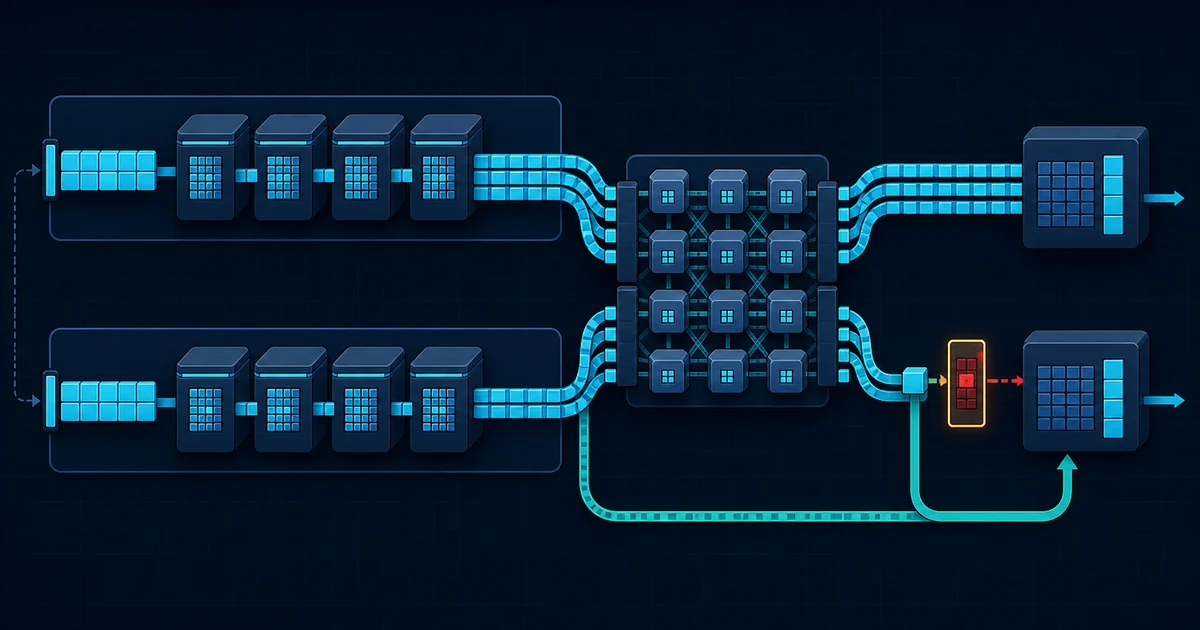
Original editorial illustration: cyan ribbons represent sharded token state, the small amber gate marks the one-token guard collision, and the teal route is a predeclared rollback. It explains the audit boundary; it is not a vLLM trace or performance result.
Sequence-parallel MoE is an internal communication optimization, not a flag a GLM-5.2 operator necessarily typed. In vLLM, the runtime derives it from the all-to-all backend and the TP, DP, EP, and PP layout. That makes a source audit important: two deployments can use the same checkpoint and both say “expert parallel,” while only one carries a local token shard between MoE layers and tries to infer that state from tensor shape.
The failure mode is unusually dangerous because the server can stay up and return HTTP 200 while text quality collapses. A health check that opens a port, loads weights, or generates any nonempty string does not protect the service. Low traffic can be the sharper canary than high traffic because a single active decode token on one DP rank is the exact arithmetic collision reproduced from the pinned source.
This guide pins vLLM v0.27.1
at commit
6e448d0ea9bf3d88d898b65449ca6dc2aec170ac
and GLM-5.2-FP8 revision
ba978f7d347eaf65d22f1a86833408afdb953541.
The machine-readable receipt
hashes twenty-seven public artifacts and enumerates forty-eight shape cells.
We made zero model calls, zero GPU runs, and zero local upstream-test runs.
Reporter observations remain reporter evidence; source arithmetic remains
source arithmetic.
In this guide
Section titled “In this guide”- Decide whether the runtime enters SP-MoE
- Follow state through one decoder layer
- Reproduce the one-token guard collision
- Separate the proven boundary from the issue claim
- Map stable releases and the nightly window
- Audit the open fix before trusting it
- Pin runtime provenance without importing CUDA
- Build a low-load content canary
- Grade output rather than process health
- Keep correctness and performance gates separate
- Choose a reversible control
- Rent only after the canary contract exists
- Troubleshoot ambiguous results
- Frequently asked questions
- Sources and method
Decide whether the runtime enters SP-MoE
Section titled “Decide whether the runtime enters SP-MoE”At the pinned v0.27.1 source, ParallelConfig.use_sequence_parallel_moe
becomes true only when four conditions hold:
eligible all-to-all backendAND expert parallelism enabledAND tensor parallel size > 1AND data parallel size > 1The default allgather_reducescatter backend is eligible. So are the pinned
DeepEP high-throughput and low-latency choices, both MoRI choices, and
nixl_ep. Changing from the default to one of those does not remove the
sequence-parallel state detector.
The GLM/DeepSeek decoder layer adds two more boundaries: the layer must be an
MoE layer, and pipeline parallel size must equal one. GLM-5.2’s pinned config
reports model type glm_moe_dsa, 78 decoder layers, 256 routed experts, and
eight selected experts per token. Those architecture facts establish that the
MoE branch exists; the parallel layout decides whether this particular state
path is active.
The reproduced topology matrix is:
| Topology at the audited stable source | Global SP-MoE property | Decoder-layer path | Decision |
|---|---|---|---|
| TP4, DP1, EP on, default backend, PP1 | Off | Off | Not exposed to this exact DP-dependent path |
| TP4, DP2, EP on, default backend, PP1 | On | On | Low-load output canary required |
| TP8, DP2, EP on, DeepEP low latency, PP1 | On | On | Backend choice does not remove the guard |
| TP1, DP2, EP on, default backend, PP1 | Off | Off | TP precondition absent |
| TP4, DP2, EP off, default backend, PP1 | Off | Off | EP precondition absent |
| TP4, DP2, EP on, default backend, PP2 | On | Off | Layer-level PP boundary blocks this exact path |
TP4, DP2, EP on, naive, PP1 |
Off | Off | Different communication implementation; not proof of safety |
This table is a source-path classifier, not a recommendation to choose a slow
or unsuitable topology. DP1 duplicates no model replica inside the audited
SP-MoE property, while DP2 can raise capacity and scheduling complexity. PP2
changes layer partitioning. naive changes expert exchange. Each alternative
has its own memory, communication, availability, and performance consequences.
For rank, slot, and redundant-expert sizing, use the separate GLM-5.2 expert-parallelism guide. That page answers “how should experts be placed and balanced?” This one answers “does the chosen vLLM graph preserve low-load output before it is promoted?”
Follow state through one decoder layer
Section titled “Follow state through one decoder layer”The pinned
deepseek_v2.py
captures the full local token count from positions.shape[0]. If the input is
recognized as already sequence parallel, it all-gathers the local hidden rows
before attention and trims padding back to the full token count.
After attention, an SP-MoE layer does the reverse:
- Pad the token axis to a multiple of TP.
- Reduce-scatter the hidden state across TP ranks.
- Chunk the residual to the same local length when the incoming state was not already recognized as sequence parallel.
- Run the local MoE with
already_sequence_parallel=True. - Carry local hidden and residual state into the next decoder layer.
The pinned
sequence_parallel_chunk
uses the same geometry: pad the sequence length to divisibility, then take one
equal chunk for the TP rank. If full token count is n and TP size is p, the
local row count after either operation is therefore:
local_rows = ceil(n / p)The next layer’s old detector does not carry an explicit state bit. It infers state with a shape comparison:
input_is_sequence_parallel = ( self.use_sequence_parallel_moe and residual is not None and hidden_states.shape[0] != full_num_tokens)Shape is normally an efficient signal. It fails when the scattered local row count and the original full count happen to be equal.
Reproduce the one-token guard collision
Section titled “Reproduce the one-token guard collision”Substitute the source geometry into the guard. The shape comparison is false when:
ceil(n / p) = nFor positive integer n and p > 1, that equality holds only at n = 1.
Once n is at least two, dividing by a TP size of at least two and rounding up
still produces fewer than n rows.
The deterministic audit enumerated token counts 1 through 16:
| TP size | Proven old-guard collision | Below-TP counts the old guard already detects | Counts changed by PR #50155 fallback |
|---|---|---|---|
| 2 | 1 | none | 1 |
| 4 | 1 | 2, 3 | 1 |
| 8 | 1 | 2, 3, 4, 5, 6, 7 | 1 |
At TP4 and n=1, padding produces four rows and reduce-scatter returns one row
per rank. The next layer sees one hidden row and one full token, so 1 != 1 is
false. At n=2, the local length is still one but the comparison is 1 != 2,
which is true. At n=3, it is 1 != 3, also true.
This is the article’s unique reproduced result. It proves neither how often a
live scheduler creates n=1 on a DP rank nor that every backend corrupts text.
It identifies the exact source cell where a shape-only state detector cannot
distinguish full from scattered state. That is enough to require a content
canary before an eligible graph handles production traffic.
Separate the proven boundary from the issue claim
Section titled “Separate the proven boundary from the issue claim”vLLM issue #50154 reports garbled GLM-5.2-FP8 completions on TP4, DP2, EP, two B200 nodes, hybrid DP load balancing, and eager execution. The reporter names two nightly builds and shows repeated country names, punctuation, and fragments instead of a clean short completion. That is relevant operational evidence.
The issue’s explanation then says the trigger covers one to three tokens with
TP4 because ceil(n/4) == n below TP. The pinned source arithmetic supports
that equality only for one token. It does not support the same equality for
two or three tokens.
Both statements can coexist if their evidence labels stay visible:
- Verified here: the old shape guard collides at exactly one full token per DP rank for every audited TP size greater than one.
- Reported upstream: short prompts produced garbled output in the named TP4/DP2/EP eager environment.
- Not established here: the per-rank token trace during each bad output, the frequency of failure, or a source proof that every count below TP fails.
- Required next evidence: record full and scattered token dimensions by DP rank while sweeping one through at least TP active decode tokens.
This distinction matters for incident response. Copying “all batches below TP
fail” could cause an operator to chase the wrong threshold. Copying only the
n=1 equation could miss a scheduler or backend interaction that the reporter
observed but the static audit cannot see. A bounded live sweep resolves both.
The reporter also says eager mode reproduced while one CUDA-graph setting did not, and explicitly leaves the mechanism unknown. Do not treat graph mode as a fix. Test eager and the exact production graph configuration as separate cells, with the same output grader and rank-level occupancy evidence.
Compilation activation is a different experiment again. Before attributing a
latency change to compilation, use the
GLM-5.2 vLLM torch.compile support audit
to pin the installed model class, reject unsupported eager fallback, and
require a positive compile receipt plus output parity.
Map stable releases and the nightly window
Section titled “Map stable releases and the nightly window”Release scope is easy to blur because several related PRs landed within days. The pinned tags separate two different problems:
| Runtime boundary | Decoder carry guard | DP1 activation | What the evidence supports |
|---|---|---|---|
| v0.24.0 | Later guard absent | SP-MoE property requires DP>1 | Different implementation; not declared safe or affected |
| v0.25.0 | Old shape guard present | Requires DP>1 | DP2+EP candidate path exists |
| v0.25.1 | Old shape guard present | Requires DP>1 | Published before the temporary DP1 removal |
| Main/nightly after PR #48036 | Old shape guard present | DP gate removed | Brief DP1 memory/performance regression window |
| Main/nightly after PR #48849 | Old shape guard present | DP gate restored | DP1 regression path closed again |
| v0.26.0 | Old shape guard present | Requires DP>1 | Published after the restore |
| v0.27.1 | Old shape guard present | Requires DP>1 | Open fix #50155 not included |
PR #48036 removed the
data_parallel_size > 1 condition on July 14 while fixing a different
DeepSeek-V3.2 MTP accuracy path. Issue #48656
then reported that SP-MoE had silently activated for TP4/EP/DP1. In the
reporter’s GLM-5.2-NVFP4 A/B, KV-cache capacity moved from 1,032,448 to 784,300
tokens, while completion throughput moved from 75 to 61 tokens/s at N=1, 407
to 353 at N=8, and 931 to 875 at N=32.
Our arithmetic reproduces the report’s rounded changes as −24.034915%, −18.666667%, −13.267813%, and −6.015038%. Those are reporter measurements on one main/nightly stack, not current v0.27.1 benchmarks and not universal costs of sequence parallelism.
PR #48849 restored the DP gate on July 17. Its separate Nemotron test reported a 5.62 GiB, 7.050558% loading-memory increase in the regression build and a return to its 79.71 GiB baseline after the fix. That is corroborating path evidence, not a GLM-5.2 measurement.
No audited stable tag was published inside the removal-to-restore window: v0.25.1 was released before removal; v0.26.0 was released after restoration. Therefore, do not label all v0.25 or v0.26 stable images with the DP1 regression. Conversely, the restored DP gate does not fix the DP2 low-load shape guard. They are separate incident boundaries.
Audit the open fix before trusting it
Section titled “Audit the open fix before trusting it”PR #50155 proposes adding a fallback to the old detector:
hidden_states.shape[0] != full_num_tokensor full_num_tokens < get_tensor_model_parallel_world_size()That fallback conservatively labels the entire below-TP range as incoming
sequence-parallel state. In the source equation, only n=1 changes the boolean
because the old shape comparison already returns true for 2 <= n < TP.
At the 2026-08-24 check:
| Patch fact | Observed state |
|---|---|
| PR state | Open, not draft, unmerged |
| Last PR update | 2026-07-30 |
| Head | c163980139bb7d88f03753d40d1a4cce2da1bd62 |
| Code commit | 7918bc80bac5d917089022e6da225acf8e5bf0ab |
| Changed files | 1 |
| Diff size | 4 additions, 1 deletion |
| Test files added | 0 |
| Fork-head pre-run check | Failure |
| Present in v0.27.1 | No |
There is another audit discrepancy: issue #50154 describes both the low-token fallback and a residual-shape comparison. The fetched PR file patch contains the guard fallback but not that second proposed change. A PR description is not the deployable diff.
The reporter says the patch restored clean output and approximately 0.94–0.95 GSM8K accuracy on its environment. That result is useful but is not an upstream test, a merged release guarantee, or our measurement. A local fork should be labeled with its own commit, image digest, patch hash, tests, and rollback. “Based on v0.27.1” is not precise enough once source differs.
Pin runtime provenance without importing CUDA
Section titled “Pin runtime provenance without importing CUDA”Record both package identity and source bytes before launching the model. This
Python preflight uses distribution metadata and hashes files without importing
vllm, initializing CUDA, or loading weights:
from hashlib import sha256from importlib.metadata import distribution, versionfrom pathlib import Path
dist = distribution("vllm")root = Path(dist.locate_file(""))print("vllm", version("vllm"))
for relative in (    "vllm/config/parallel.py",    "vllm/model_executor/models/deepseek_v2.py",    "vllm/model_executor/models/utils.py",):    path = root / relative    print(relative, sha256(path.read_bytes()).hexdigest())
The pinned v0.27.1 source hashes in our receipt are:
| File | SHA-256 |
|---|---|
vllm/config/parallel.py |
5ee765f980d8e371314caa38a27c5a21ab90f3865e697707d48e608ca4d17f3d |
vllm/model_executor/models/deepseek_v2.py |
bcbd9cde689ffe3f5f271aff3a5e01351b05a68371192cac9d65cb5ffc6b4ba9 |
vllm/model_executor/models/utils.py |
f2919647e35f73a8d540e8e5db0fecf2000bb52a6107c39e032a8ddd830e43a1 |
A wheel may legitimately differ from repository source because of packaging or a downstream patch. A mismatch is a prompt to inspect the installed predicate, not automatic proof of compromise. Archive the container digest, wheel filename and hash, vLLM version string, installed source hashes, checkpoint revision, Transformers version, CUDA/driver stack, graph mode, and every parallel flag in the canary receipt.
Also record resolved topology, not only CLI intent. The official pinned expert-parallel documentation defines EP size from the relevant TP and DP dimensions, and the pinned data-parallel documentation distinguishes internal, external, and hybrid load balancing. The scheduler route determines which DP rank actually reaches one active decode token.
Build a low-load content canary
Section titled “Build a low-load content canary”Start from a control that changes one activation condition and nothing else. For example, compare the candidate TP4/DP2/EP/PP1 service with an otherwise identical TP4/DP1/EP/PP1 control. That increases hardware or scheduling cost and does not prove DP1 is generally superior; it isolates the audited DP gate.
Use a fixed prompt corpus with several failure detectors:
- short facts whose normalized answer is stable;
- arithmetic with a machine-checkable final value;
- constrained JSON that must parse and satisfy a schema;
- a short tool call with an exact tool name and argument shape;
- multilingual and punctuation-heavy text;
- a repeated-token trap that exposes loops and phrase collapse; and
- a longer prompt that verifies the problem is low-load-specific rather than a universal model-quality failure.
Hold these variables fixed in the first comparison: checkpoint bytes, quantization, tokenizer, chat template, reasoning and tool parsers, sampling, maximum output, prefix caching, MTP, all-to-all backend, context cap, and graph mode. Disable optional MTP for the narrow target-path canary, then add it as a separate experiment using the GLM-5.2 MTP guide.
The occupancy sweep must be measured per DP rank. Client concurrency is only an input; hybrid balancing can send a different number of active sequences to each rank. Include at least these phases:
| Phase | Observed decode rows per DP rank | Purpose |
|---|---|---|
| Idle-to-one | Explicitly capture 1 | Exercise the proven guard collision |
| Below TP | Capture 2 through TP−1 where possible | Test the reporter’s broader low-batch observation |
| At TP | Capture TP | Cross the stated low-batch boundary |
| Above TP | Capture several multiples | Establish a healthy-load comparison |
| Drain | Let traffic fall back through one | Catch scale-down and queue-drain exposure |
Run each phase in eager mode and in the exact production graph mode. Repeat nonstreaming and streaming requests. A graph can mask, reshape, or fail to capture a condition differently; a passing graph cell does not repair a failing eager cell.
Write the manifest before the test:
{ "checkpoint_revision": "ba978f7d347eaf65d22f1a86833408afdb953541", "runtime_image_digest": "<record>", "vllm_source_hashes": "<record>", "tp_dp_ep_pp": "4_2_true_1", "all2all_backend": "allgather_reducescatter", "graph_mode": "eager|production-mode", "mtp": false, "per_dp_rank_decode_rows": "<time series>", "fixture_revision": "<record>", "control_output_artifact": "<sanitized path>", "candidate_output_artifact": "<sanitized path>", "content_parity": "pass|fail", "protocol_parity": "pass|fail", "service_slo": "pass|fail", "rollback": "pass|fail", "credentials_archived": false}Grade output rather than process health
Section titled “Grade output rather than process health”The primary gate is answer integrity. Check each candidate response against the control at several levels:
- Transport: complete SSE framing,
[DONE], finish reason, UTF-8, and no server-side error. - Structure: JSON parses, tool names and arguments validate, reasoning and visible content remain in their expected fields, and streaming deltas assemble into the nonstreaming form.
- Deterministic content: exact or normalized equality for fixtures that should be deterministic at temperature zero.
- Semantic content: a task-specific grader for answers with harmless wording variation. Preserve the grader version and disagreements.
- Degeneration: repeated unigram and n-gram share, punctuation runs, abrupt language switching, duplicated entities, and incomplete fragments.
- Distribution: failure count and confidence interval across repeated runs at each observed per-rank occupancy.
Fail closed on any unexplained deterministic mismatch, malformed tool or JSON output, repeated-fragment anomaly, or semantic failure that appears only in the candidate. Do not average a severe corruption into a high overall score. One bad completion in a safety-critical or user-visible path is a debugging event, not “99% accuracy.”
Do not use a second model as the only judge. It may normalize away exactly the repetition or semantic drift being investigated. Machine-check exact fixtures first, then use human review or a versioned independent grader for the remaining cases.
Keep correctness and performance gates separate
Section titled “Keep correctness and performance gates separate”Sequence parallelism exists to reduce duplicate MoE work and communication. That does not make throughput a proxy for correctness. Apply gates in order:
- Provenance gate: exact runtime, patch, model, topology, backend, and modes match the manifest.
- Occupancy gate: telemetry proves the canary actually visited one row per DP rank and the broader sweep cells.
- Correctness gate: content, structure, and protocol match the control.
- Capacity gate: peak HBM, KV slots, graph capture, workspaces, and reserve stay within the declared bound on every rank.
- Service gate: TTFT, TPOT, end-to-end latency, tokens/s, queueing, errors, and retries pass separate budgets from idle through load.
- Recovery gate: a controlled restart, drain, rank failure, and rollback preserve request and idempotency behavior.
- Expansion gate: only a small traffic slice moves first; the observation window covers both peak load and quiet periods.
The historical issue #48656 numbers belong to a brief DP1 activation regression, not this DP2 correctness canary. Do not require current v0.27.1 to reproduce those losses. Instead, compare the exact control and candidate on the workload and source under review.
Quiet-period monitoring is mandatory. A rollout that looks healthy at high concurrency can enter the one-row cell while traffic drains overnight. Segment quality and service metrics by observed rank occupancy so an aggregate daytime graph cannot hide the low-load result.
Choose a reversible control
Section titled “Choose a reversible control”There is no single universal workaround. Choose one whose cost and semantic change are explicit:
- Keep DP1 for the affected service replica. This blocks the audited stable activation property but changes replication, capacity, and load balancing.
- Disable EP for the control. This isolates the EP precondition but can change memory placement and MoE communication substantially.
- Use another all-to-all backend only as a separate candidate.
naiveor another non-eligible source path changes expert exchange and performance; it is not a free “disable SP” switch. - Carry a local patch. Pin the fork SHA and patch hash, add tests for one through at least TP rows, verify eager and graph modes, and never describe it as released upstream.
- Wait for an upstream merge and release. Re-audit the final diff, tests, tag, and image; PR #50155’s current patch need not be the code eventually shipped.
Rollback should change one dimension back to the passing control. Pre-pull the control image and keep its model artifact addressable. Test that the router can drain candidate traffic, restore the control, and handle in-flight requests without duplicate side effects. If the canary outcome is ambiguous, mark it failed and preserve artifacts; do not retry with several simultaneous changes.
Switching inference runtimes is not a one-change workaround. If SGLang is a separate candidate, audit its default-on GLM-5.2 DSA prologue with the dedicated SGLang indexer-fusion speed, memory, and rollback guide; do not transfer this vLLM state-guard result to a different execution graph.
For smaller-scale alternatives, the local GLM-5.2 hardware guide separates full checkpoint capacity from practical workstation and rental options. Reducing the experiment’s hardware footprint must not silently change the model or the reader question.
Rent only after the canary contract exists
Section titled “Rent only after the canary contract exists”A rented cluster is useful when it reproduces the exact GPU count, node split, fabric, image, checkpoint, and DP routing needed for an isolated control. A listing that merely says H200 or B200 is insufficient: TP and EP communication depend on which links stay inside a node, which cross nodes, and whether the chosen all-to-all backend is actually supported.
Cost the failed runs as well as the passing run. A low-load canary may spend more wall time waiting at controlled occupancy than a throughput benchmark. Budget model download, storage, idle GPUs, reruns after an instrumentation failure, and egress. Stop when the manifest cannot be reproduced; expensive ambiguity is not additional evidence.
Troubleshoot ambiguous results
Section titled “Troubleshoot ambiguous results”The candidate and control both produce bad text
Section titled “The candidate and control both produce bad text”The SP-MoE path is not isolated. Validate the checkpoint and tokenizer hashes, chat template, parser flags, sampling, stop IDs, quantization, and a known-good single-request baseline. A universal failure is not evidence for issue #50154.
Only eager mode fails
Section titled “Only eager mode fails”Preserve both receipts. This matches the direction of the reporter’s observation but does not establish its mechanism. Do not promote graph mode as a workaround until restart, graph recapture, changing batch shape, and drain cycles keep passing.
Only one DP rank fails
Section titled “Only one DP rank fails”That is actionable. Compare its token occupancy, TP rank membership, expert exchange, graph state, device errors, and installed source hashes. Do not hide it in cluster-wide averages or route around it without diagnosing whether the same state can move to another rank.
Two or three rows fail even though the shape equation detects them
Section titled “Two or three rows fail even though the shape equation detects them”The static collision is not the whole mechanism. Capture actual pre-gather and post-scatter shapes, residual shapes, padding, backend, scheduler state, and graph mode. This would be new evidence supporting the issue’s broader observation rather than a contradiction to suppress.
One row passes
Section titled “One row passes”A single pass is weak evidence. Repeat after warm-up, graph capture, cache growth, traffic drain, restart, and rank redistribution. Confirm telemetry really measured one full decode row on the DP rank; client concurrency one is not the same fact.
A locally patched image passes
Section titled “A locally patched image passes”Keep it labeled as a fork. Add regression tests, rebase deliberately, and repeat after every upstream change. A passing local canary does not imply PR #50155 will merge unchanged or that a later stable tag contains it.
Frequently asked questions
Section titled “Frequently asked questions”Does vLLM v0.27.1 contain PR #50155?
Section titled “Does vLLM v0.27.1 contain PR #50155?”No. The audited tag retains the old shape-only guard. PR #50155 was open and unmerged at the 2026-08-24 check.
Does every GLM-5.2 vLLM deployment face this path?
Section titled “Does every GLM-5.2 vLLM deployment face this path?”No. The pinned stable predicate requires an eligible all-to-all backend, EP, TP greater than one, and DP greater than one. The audited decoder-layer path also requires PP1 and an MoE layer. Other configurations have different risks.
Is every decode batch below TP proven to collide?
Section titled “Is every decode batch below TP proven to collide?”No. For the pinned pad-and-scatter geometry, the old shape guard collides at exactly one full token when TP is greater than one. The upstream reporter makes a broader low-batch observation that should be tested with per-rank traces.
Is DP1 a permanent fix?
Section titled “Is DP1 a permanent fix?”It blocks this exact DP-dependent activation property in audited stable tags. It also changes replica layout, capacity, memory, and scheduling, and it does not certify the rest of the runtime. Treat it as a one-change control or explicit design choice, not a universal patch.
Can I switch CUDA graphs on and declare the issue fixed?
Section titled “Can I switch CUDA graphs on and declare the issue fixed?”No. The reporter observed a non-reproduction in one graph configuration and said the mechanism was unknown. Test graph and eager modes independently and retain a correctness gate through restarts and changing batch shapes.
Should I apply the open PR directly?
Section titled “Should I apply the open PR directly?”Only as a pinned, tested local fork. The fetched patch changes one source file, adds no test file, and does not include every change described in the issue. Add your own regression cells and keep the control image ready.
What is the first production alarm?
Section titled “What is the first production alarm?”Alert on any content-parity failure or degeneration anomaly segmented by per-DP-rank decode occupancy, especially a transition to one row. HTTP health, GPU utilization, or aggregate throughput alone can remain normal.
Sources and method
Section titled “Sources and method”Primary model identity and architecture come from the pinned GLM-5.2-FP8 config, the official model card, and the Z.AI release page. Runtime behavior comes from pinned vLLM v0.24.0–v0.27.1 source files, official EP and DP docs, the GLM-5.2 performance roadmap, and its linked PR chain.
The correctness report is issue #50154; the proposed unmerged change is PR #50155. The separate DP1 activation history comes from PR #47070, PR #47902, PR #48036, issue #48656, and PR #48849. Dates, states, diff sizes, hashes, tag boundaries, and reporter measurements were checked on 2026-08-24.
The deterministic calculator applies the pinned padding and chunk equations to TP2, TP4, and TP8 for token counts 1–16, recomputes reporter percentage deltas, and verifies seven activation cells. Its public JSON receipt contains all twenty-seven source URLs, byte counts, SHA-256 hashes, inputs, rows, boundaries, and invariants. It does not contain credentials or model outputs.
No model, GPU, or upstream test was run for this article. Open-issue output and benchmark values belong to their reporters. Source tests and patches describe code and review scope; they do not prove the deployed service. Recheck upstream state before rollout, because an open PR, tag, source predicate, or official recipe can change after the audit date.